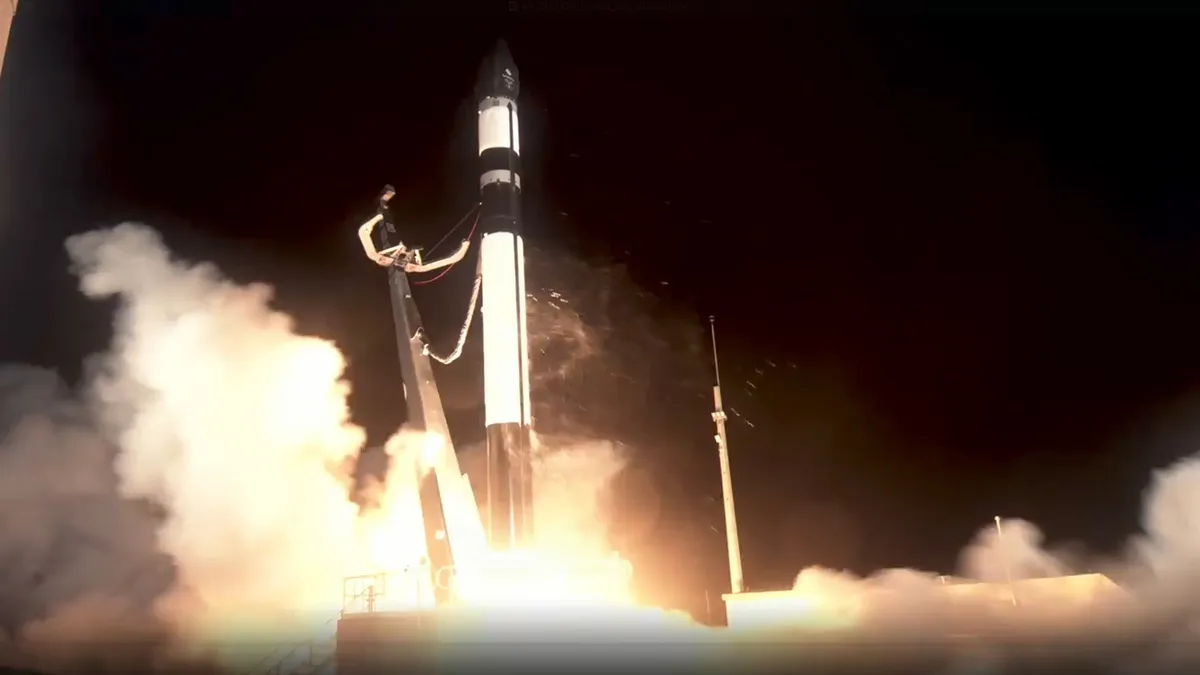
A Rocket Lab Electron rocket launched a Strix satellite for Synspective, a Tokyo-based Earth-imaging company on Sept. 2, 2026 from New Zealand. Credit: Rocket Lab
Rocket Lab launched another synthetic aperture radar satellite for Japanese Earth-observation company Synspective on September 2, extending a dedicated launch campaign supporting the expansion of the Strix constellation.
The Electron rocket lifted off from Rocket Lab’s New Zealand launch site at 8:01 a.m. EDT, or 12:01 GMT on September 2 and 12:01 a.m. local time on September 3. The mission, named “Owl Around the World,” carried a single Strix spacecraft into low Earth orbit.
Rocket Lab reported that Electron’s kick stage deployed the satellite as planned 56 minutes after liftoff at an altitude of approximately 575 kilometers.
The launch was Electron’s 12th mission of 2026 and the rocket’s 85th flight overall. It also brought the number of Strix satellites launched to orbit to 11, all carried by Electron.
Dedicated launches support constellation deployment
Synspective is developing a constellation of approximately 30 Strix satellites to provide frequent synthetic aperture radar, or SAR, observations of the Earth. The spacecraft are named after Strix, a genus of owls, reflecting their ability to acquire imagery at night.
Unlike optical imaging instruments, SAR payloads transmit microwave signals toward the surface and measure the reflected energy. They therefore do not depend on sunlight and can collect data through clouds, smoke and many adverse weather conditions. These characteristics make radar satellites particularly useful when optical imagery is unavailable during storms, floods or nighttime emergencies.
Synspective plans to use the constellation to detect and monitor changes associated with earthquakes, flooding and other disasters, including events in remote or inaccessible areas. The company also targets applications involving urban development, infrastructure, natural resources, land use and water management.
A larger constellation is central to those services. Adding satellites shortens the interval between observations of the same region, improving the ability to identify changes quickly rather than relying on occasional images. For disaster-response customers, revisit time can be as important as spatial resolution because the operational value of an image declines rapidly after an event.
Rocket Lab is currently Synspective’s sole launch provider. Following “Owl Around the World,” the launch company had another 16 Synspective missions on its manifest. That backlog indicates that the relationship has progressed beyond individual launch purchases into a long-term deployment program.
Dedicated missions give Synspective greater control over launch schedules and orbital insertion than rideshare services, where a satellite must generally accept the primary customer’s trajectory and timetable. Electron’s kick stage also enables more precise orbital deployment after separation from the rocket’s second stage, an important capability when constellation operators need spacecraft placed into specific orbital planes or phasing positions.
The tradeoff is cost per kilogram. Larger rideshare missions can offer lower transportation costs, but a dedicated small launch vehicle can reduce delays and allow an operator to deploy one satellite at a time as manufacturing and financing milestones are reached.
SAR growth shifts attention to data delivery
Deploying the spacecraft is only one part of building a commercially viable radar-imaging service. A growing SAR constellation also requires scalable ground-station access, automated tasking, rapid data downlink and processing systems capable of converting raw radar measurements into usable products.
SAR data can reveal surface displacement, structural change and flood extent, but it requires substantially more processing than conventional photography. Commercial value therefore depends not only on how many satellites are in orbit, but also on how quickly the operator can deliver calibrated, geolocated and application-ready information.
As the Strix constellation expands, Synspective will also need to manage production consistency across a growing fleet. Repeat manufacturing can reduce unit costs, but satellite builders must maintain alignment and performance across radar antennas, radio-frequency electronics, onboard power systems and thermal-control hardware. Consistent spacecraft behavior simplifies calibration and makes data from different satellites easier to combine.
Environmental testing remains a significant part of that production cycle. SAR spacecraft must withstand launch vibration while maintaining antenna geometry and radio-frequency performance. Electromagnetic compatibility testing is especially important because high-power radar transmission, communications equipment and spacecraft avionics operate in close proximity. Increasing launch cadence places pressure on manufacturers to perform these checks efficiently without weakening quality assurance.
Electron builds a repeat-launch role in Earth observation
At 18 meters tall, Electron is designed primarily for dedicated small-satellite missions. Its role in the Strix program illustrates a market position distinct from high-capacity rockets carrying dozens of spacecraft at once: repeat launches for customers that value schedule control and tailored orbital delivery.
The continuing Synspective campaign also provides Rocket Lab with a relatively predictable stream of missions. Multi-launch agreements can help a launch provider plan vehicle production, reserve launch-site capacity and standardize recurring payload integration work. For the customer, repeatedly using the same launch system reduces the need to redesign mechanical, electrical and operational interfaces for different rockets.
Beyond its orbital Electron business, Rocket Lab has completed nine missions with HASTE, the suborbital derivative developed for hypersonic technology and sensor testing. Electron first flew in 2017, while HASTE made its debut in June 2023.
The two vehicles address different markets, but both rely on frequent production and launch operations. For Electron, the Synspective backlog demonstrates how a small launcher can remain relevant alongside lower-cost rideshare services by functioning as a dedicated deployment system for constellations with demanding orbital and scheduling requirements.