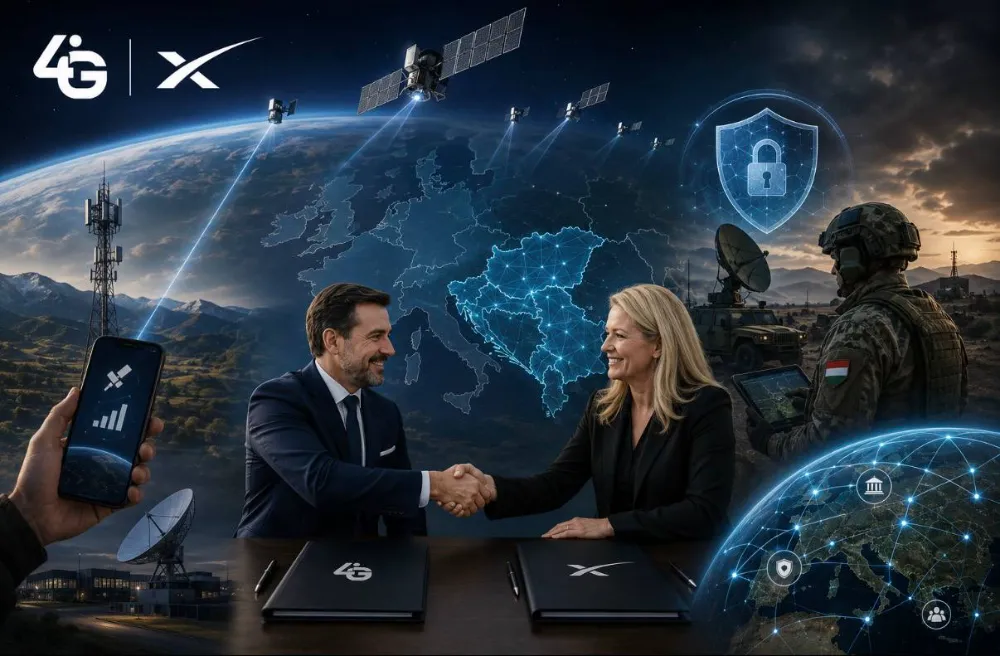
Hungarian telecommunications and defense group 4iG has signed two agreements with SpaceX covering direct-to-device mobile connectivity and secure sovereign satellite communications, establishing a framework for deploying Starlink services across Hungary and parts of the Western Balkans.
The agreements were signed in Texas on September 2, 2026, by 4iG Chairman and CEO Gellért Jászai and SpaceX President and Chief Operating Officer Gwynne Shotwell.
The partnership combines three initiatives: the introduction of the current-generation Starlink Mobile service in Hungary and Albania, a subsequent rollout of Starlink Mobile V2 across four regional markets, and the development of a secure satellite communications service for government and national-security users.
Starlink Mobile to supplement terrestrial coverage
4iG plans to launch commercial Starlink Mobile services in Hungary and Albania. The rollout schedule will depend on regulatory approvals, technical integration and commercial conditions in each country.
Previously marketed as Starlink Direct to Cell, the service allows compatible LTE smartphones to communicate directly with Starlink satellites without a specialized satellite handset or external terminal. It is designed to supplement rather than replace terrestrial mobile networks, extending basic connectivity into locations where conventional cell towers are unavailable or temporarily out of service.
For 4iG, the initial deployment could improve service availability in mountainous terrain, sparsely populated regions and coastal waters. Satellite-to-phone coverage may also provide a backup communications layer during natural disasters, power failures or other incidents that disrupt terrestrial infrastructure.
The company said the service could support public-sector users and operators of critical infrastructure in addition to commercial subscribers. However, practical performance will depend on factors including satellite visibility, spectrum access, device compatibility, network congestion and the type of service enabled in each market.
Direct-to-device systems generally begin with relatively low-bandwidth applications such as text messaging and emergency communications before expanding toward voice and broadband data. They offer substantially less capacity per coverage area than terrestrial cellular networks, but their ability to reach ordinary phones across large geographic areas makes them valuable as a resilience and coverage-extension tool.
V2 service expands to four regional markets
The companies also plan to introduce Starlink Mobile V2 in Hungary, Albania, Montenegro and North Macedonia. SpaceX expects the next-generation system to use its global priority rights in the 2 GHz band and support 5G non-terrestrial network capabilities.
SpaceX obtained access to the spectrum through its agreement to acquire EchoStar mobile-satellite-service licenses. Owning or controlling dedicated spectrum reduces Starlink’s dependence on country-by-country arrangements in which a satellite operator uses frequencies assigned to a terrestrial mobile carrier.
That model could make it easier to provide a more consistent direct-to-device service across national borders. It does not eliminate local regulatory requirements, however. Commercial deployment will still require coordination with national authorities, compliance with interference rules and integration with 4iG’s mobile networks and customer-management systems.
The 2 GHz spectrum is particularly important because the V2 architecture is intended to move beyond the limited capabilities of first-generation satellite-to-phone services. SpaceX has said the upgraded constellation will eventually support high-speed broadband directly to mobile devices. Achieving that objective will require additional satellites, higher-capacity payloads and sufficient spectrum to serve many users simultaneously.
The agreement gives 4iG a potential role as one of the earliest multi-country Starlink Mobile operators in Europe. Its existing telecommunications footprint provides the billing platforms, subscriber relationships, terrestrial backhaul and regulatory presence needed to incorporate satellite coverage into conventional mobile service plans.
The approach also demonstrates how low-Earth-orbit constellations are becoming part of mainstream mobile network architecture. Under this model, a mobile network operator retains its customer-facing role while purchasing space-based coverage from a constellation provider. For satellite operators, partnerships with established carriers offer a faster route to large numbers of users than selling standalone satellite subscriptions.
Sovereign Solutions targets government communications
A separate agreement between SpaceX and 4iG Space and Defence Technologies covers the development of an integrated Sovereign Solutions service. Scheduled to launch in 2027, the offering is expected to combine broadband satellite connectivity with end-to-end secured data communications and sovereign network infrastructure.
The companies have not disclosed the agreement’s financial value, prospective government customers or the precise division of responsibility for operating and securing the network.
The sovereign component reflects a growing European requirement for satellite services that combine the reach and resilience of commercial constellations with national control over sensitive communications. Governments increasingly want to determine how traffic is routed, encrypted, authenticated and managed, even when the underlying space segment is operated by a foreign commercial provider.
For 4iG, the arrangement connects its telecommunications infrastructure with its expanding space, defense and cybersecurity portfolio. The Budapest-listed group employs more than 11,000 people and serves retail, enterprise and government customers through businesses spanning mobile networks, information technology, data centers, international connectivity and defense systems.
Its space and defense subsidiary works across satellite design, manufacturing and operations as well as cyber systems and other dual-use technologies. This allows 4iG to act as more than a regional reseller, potentially integrating Starlink capacity with ground infrastructure, secure network management and government-specific services.
A hybrid model for European connectivity
The partnership addresses two distinct markets with overlapping infrastructure requirements. Starlink Mobile is a commercial service intended to extend cellular coverage, while Sovereign Solutions is aimed at protected government and national-security communications. Combining them gives 4iG access to the same large low-Earth-orbit constellation while applying different security, service-management and regulatory arrangements.
The deployment will nevertheless face technical and policy challenges. Satellite-to-device links must coexist with terrestrial networks, transition users between space and ground coverage, and operate within national spectrum frameworks. Sovereign communications introduce additional requirements for encryption, identity management, ground-segment control, cybersecurity and continuity of service.
The agreements also illustrate a wider change in the satellite communications market. Mobile operators increasingly view non-terrestrial networks as an extension of their existing infrastructure, while governments are seeking protected access to commercial constellations without surrendering control over sensitive data and operational policies.
If the planned services secure regulatory clearance and perform as intended, 4iG could use the partnership to create a common satellite-enabled connectivity platform across several relatively small national markets. For SpaceX, the arrangement provides a regional distribution and integration partner capable of serving commercial, public-sector and defense customers through a single group.