Stoke Space announced on September 8 that it completed the initial closing of a $1 billion Series E financing round, bringing its total capital raised to $2.3 billion. The Kent, Washington-based company will use the funding to prepare its fully reusable Nova Pathfinder rocket for a first orbital launch in early 2027, expand production and launch infrastructure, and accelerate development of the larger Nova Block 2 vehicle.
Point72 Ventures and Spark Capital co-led the round. Participants included General Innovation, Glade Brook Capital, US Innovation Technology, Washington Harbour Partners, Woven Capital and Y Combinator, alongside other new and existing investors.
Nova Pathfinder is Stoke’s first orbital launch vehicle and is intended to carry customer payloads while demonstrating the propulsion, reentry, recovery and ground operations required for a fully reusable two-stage system. The company plans to fly an operational payload on the inaugural mission rather than conduct a payload-free test.
If the first flight succeeds, Stoke aims to conduct multiple Pathfinder missions during 2027 and 2028 while developing Nova Block 2 in parallel. The larger vehicle is targeting its first launch in 2029.

Nova Pathfinder upper stage flight article 1. (Image credit: Stoke Space)
A Fully Reusable Two-Stage Architecture
Unlike launch systems that recover only the booster, Stoke is designing both Nova stages to return from flight and be reused. Achieving that goal requires the upper stage to survive orbital reentry, one of the most technically demanding parts of the architecture.
Pathfinder’s first stage uses seven Stoke-developed Zenith engines burning liquid oxygen and liquefied natural gas. The engines operate on a full-flow staged-combustion cycle, in which both propellants are fully gasified before entering the main combustion chamber.
The cycle can produce high efficiency while limiting soot and other engine deposits that increase inspection and refurbishment work between flights. However, it also requires complex turbomachinery, combustion control and propellant-management systems, making it one of the most difficult liquid-rocket engine cycles to develop.
The second stage uses Stoke’s hydrogen-fueled Andromeda propulsion system. Twelve small thrust chambers are distributed around the perimeter of a metallic, dome-shaped heat shield instead of using a single large vacuum engine mounted at the center.
That arrangement allows the base of the stage to serve both as a propulsion structure and as protection during atmospheric reentry. Liquid hydrogen actively cools the metallic heat shield, avoiding the extensive ceramic tile system used by some reusable spacecraft designs.
Stoke demonstrated an early version of the upper-stage propulsion and landing system during a short “hopper” flight in 2023. The test article climbed approximately 10 meters before descending and landing vertically.
The orbital Pathfinder vehicle will extend that work to a complete launch system. Its early missions will be important not only for proving ascent performance, but also for validating stage recovery, thermal protection and the amount of inspection or maintenance required before another flight. Those operational results will determine whether the architecture can deliver the rapid turnaround and high launch cadence envisioned by Stoke.

Andromeda upper stage engine and integral re-entry heat shield. (Image credit: Stoke Space)
Nova Block 2 Expands Payload Capacity
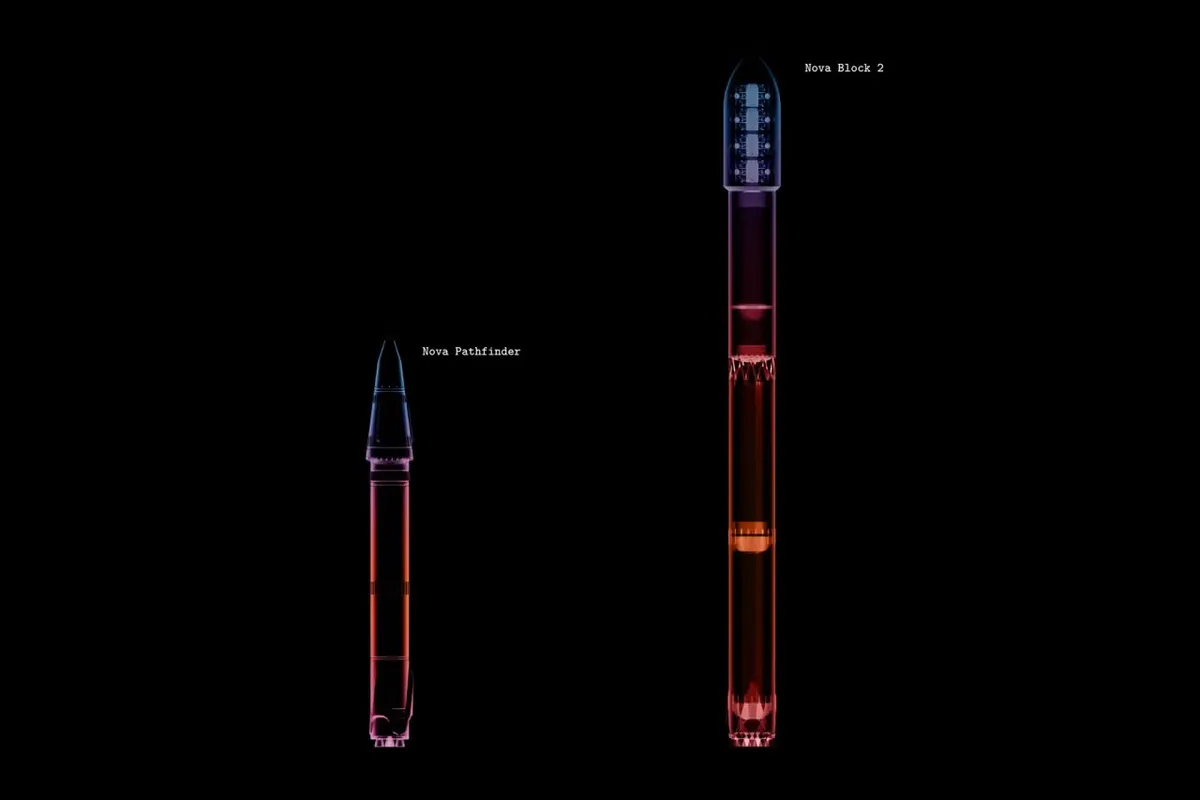
Nova Block 2 carries the same basic reusable architecture into a larger launch vehicle designed to place as much as 15 metric tons into low Earth orbit. Stoke is developing the rocket for commercial and national-security missions, including deployments of larger satellite constellations.
The Block 2 first stage will use 14 Zenith engines, twice the number installed on Pathfinder. Its upper stage will retain the ring of 12 thrust chambers but introduce independent systems for each engine, potentially increasing upper-stage thrust by more than five times compared with Pathfinder.
Stoke also plans to replace Pathfinder’s tapered upper stage with cylindrical propellant tanks. The change will increase propellant capacity and usable payload volume while supporting a 5-meter-diameter fairing, a standard size for many large spacecraft and national-security payloads.
The 15-ton-class vehicle would place Stoke in a market segment that includes SpaceX’s Falcon 9 and Rocket Lab’s planned Neutron rocket. Falcon 9 has established the commercial benchmark for reusable booster operations, but its upper stage remains expendable. Neutron is also being designed around first-stage reuse.
Nova’s proposed recovery of both stages would therefore be a major technical differentiator, although Stoke must still demonstrate the architecture in orbital flight and establish that recovered hardware can be refurbished economically.
Stoke expects to retain Pathfinder after Block 2 enters service, giving customers two vehicle configurations rather than replacing the smaller rocket outright. Some payloads and orbital missions may not require Block 2’s additional capacity.
Test, Launch and Recovery Infrastructure Expands
Part of the Series E proceeds will fund manufacturing, testing, launch and recovery infrastructure needed to operate both Nova variants at higher cadence.
In Washington state, Stoke plans to add 475 acres to its existing 75-acre Moses Lake Test Site. The enlarged complex will support propulsion and integrated vehicle testing as Pathfinder approaches flight and the first Block 2 hardware enters development.
At Cape Canaveral Space Force Station in Florida, Stoke is developing Space Launch Complex 14, which the U.S. Space Force selected the company to operate in 2023. A new payload-processing facility at the site is being sized for both Pathfinder and Block 2 missions.
The company is also developing an offshore recovery platform. That asset will be required to retrieve reusable stages that cannot return directly to the launch site because of mission trajectory or performance requirements.
Stoke’s next major milestone is the first orbital Pathfinder mission in early 2027. A successful flight would begin an operational test campaign extending through 2028, ahead of Nova Block 2’s planned debut in 2029.