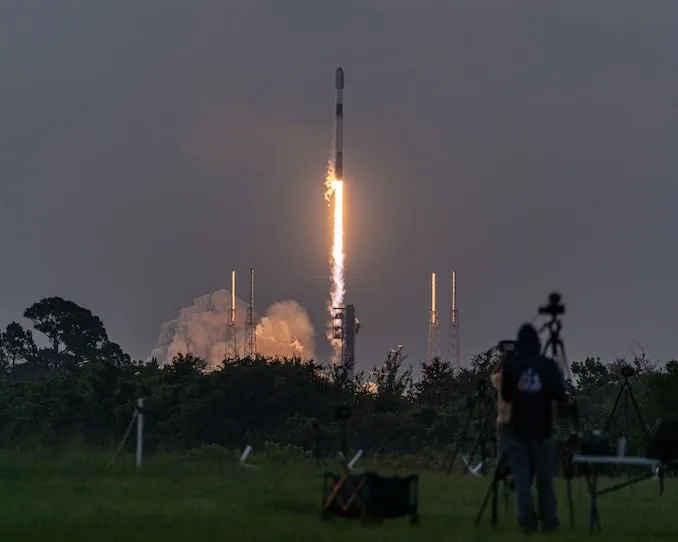
Besxar, a space manufacturing startup founded by former OpenAI employee Ashley Pilipiszyn, has reached an agreement with SpaceX to prototype an orbital semiconductor factory across 12 Falcon 9 flights. The company aims to manufacture critical precursor materials for advanced semiconductors in the vacuum of space and return them to Earth, targeting a market currently served mainly through the International Space Station and a small group of return-capsule startups.
The planned flight campaign is intended to give Besxar a repeatable path for testing manufacturing processes in orbit. Rather than attempting to fabricate finished chips in space, the company initially wants to produce high-quality wafers and semiconductor materials that terrestrial chipmakers can process into advanced devices.
Besxar has raised nearly $14 million, including a $9 million seed round led by Dauntless Ventures and Overture VC. It plans to iterate on its hardware and manufacturing processes over the next two years, gradually progressing from passive exposure tests to heating wafers and depositing multiple material layers.
Using Space as a Semiconductor Processing Environment
Modern semiconductor manufacturing requires tightly controlled clean rooms because microscopic particles can contaminate wafers, create defects and reduce production yields. These facilities rely on extensive air filtration, pressure control, chemical management and contamination-monitoring systems.
Besxar’s approach is based on using the naturally high vacuum available in space for selected stages of semiconductor-material production. Pilipiszyn argues that falling launch costs and higher flight rates could make it more economical to transport manufacturing equipment to an environment where some required physical conditions occur naturally rather than reproducing those conditions entirely on Earth.
The company is not proposing to move the entire semiconductor supply chain into orbit. Its near-term objective is to manufacture valuable precursor materials in space, recover them and deliver them to established chipmakers for further processing on the ground. Besxar is targeting wafers intended for advanced power semiconductors used to control and convert electricity in data centers, robots and electric vehicles.
The commercial case will depend on whether orbital processing produces materials with sufficiently higher purity, lower defect rates or better performance to offset launch, spacecraft and recovery costs.
Space also presents its own contamination risks. Spacecraft materials can release gases, launch environments can introduce particles and reentry and recovery can expose wafers to additional contaminants. Besxar therefore must protect its products throughout the complete mission—from payload integration and launch to orbital processing, atmospheric return and delivery to customers.
First Fabships Complete Orbital Test
Besxar launched its first two “fabships” on a Starlink mission in July. The small canisters were designed to carry semiconductor wafers, protect them during launch and expose them to the vacuum of space.
The first mission concentrated on qualifying the containers rather than actively manufacturing semiconductor materials. Besxar sought to confirm that the fabships could survive launch loads, prevent sample contamination and operate in the orbital environment.
Both canisters completed the experiment, although one experienced a malfunction in its flight-data system. The company is investigating the failure.
According to Pilipiszyn, the flown samples were cleaner and contained less particulate matter than comparable wafers that remained on Earth. While encouraging, the result represents an early-stage test. Besxar will need additional controlled flights to show that the improvement is repeatable and can be maintained during active thermal and material-deposition operations.
The company’s next experiments will heat wafers in orbit before progressing to the deposition of one material and then multiple materials. Each flight is expected to increase the complexity of the process while generating data on temperature control, contamination, deposition uniformity and payload performance.
A 12-flight campaign could allow Besxar to modify its system between missions rather than relying on a single large technology demonstration. Falcon 9’s flight frequency gives the startup more opportunities to test successive hardware and process configurations.
Returning Products Is the Central Constraint
Manufacturing semiconductor materials in orbit addresses only part of the technical and commercial challenge. Besxar must also return a meaningful volume of fragile, high-value products to Earth without compromising their purity or physical condition.
Available commercial return capacity remains limited. The International Space Station has provided an established platform for microgravity research and sample return, but access, experiment volume and mission schedules are constrained. Outside the station, only a small number of companies are developing dedicated reentry capsules capable of carrying manufactured products back from orbit.
Falcon 9’s reusable first stage provides a high-cadence transportation platform for Besxar’s experiments, but an operational orbital factory will still require an end-to-end return architecture. That may involve integration with a separate reentry capsule or, eventually, a large reusable spacecraft capable of returning substantial payload mass.
Other companies pursuing space-based semiconductor and advanced-material production include United Semiconductors and Space Forge. All face the same economic bottleneck: proving not only that orbital conditions improve the product, but also that enough material can be manufactured and returned frequently enough to support industrial customers.
Starship Could Enable Larger Orbital Fabs
Pilipiszyn initially approached SpaceX approximately three years ago about purchasing flights on Starship. With that vehicle still in development, Besxar selected the Falcon 9 flight campaign as an intermediate step for reducing technical risk and validating individual manufacturing operations.
The company eventually wants to deploy larger fabs aboard a vehicle such as Starship and increase capacity from experimental samples to hundreds and then thousands of wafers per mission. Such a transition would require greater electrical power, thermal-management capability, processing volume and return capacity than current small orbital payloads can provide.
Besxar’s growth plan therefore depends partly on lower-cost, high-capacity reusable launch and reentry systems. SpaceX’s Starship is one possible platform, while next-generation vehicles under development by companies including Rocket Lab and Stoke Space could eventually offer alternatives.
The immediate test will be whether Besxar can move from exposing protected samples to vacuum toward controlled heating and material deposition. Its remaining Falcon 9 flights are intended to establish that progression and determine whether space-manufactured semiconductor precursors can be returned to Earth with the consistency and volume required by commercial chipmakers.