NASA added Relativity Space’s Terran R rocket to its NASA Launch Services II contract on September 9, making the still-unflown vehicle eligible to compete for future agency launch orders. The award expands NASA’s pool of launch providers as Relativity prepares Terran R for its first flight from Cape Canaveral Space Force Station in late 2026.
Relativity entered the NLS II contracting vehicle through its annual on-ramp provision. The mechanism allows NASA to add new launch service providers and lets existing contractors propose vehicles not already covered by their agreements.
The award does not assign Terran R a specific mission or guarantee future launch orders. Instead, it establishes the contractual framework through which NASA may compete and award individual missions after evaluating factors including vehicle performance, schedule, price and mission risk.
NLS II is a multiple-award, indefinite-delivery/indefinite-quantity contract used by NASA to procure commercially provided launch services. Its ordering period runs through June 2030, while the overall period of performance extends through December 2032.
The contract supports missions across NASA’s human exploration, science, and space technology portfolios. NASA may also use the framework to arrange launches for other federal agencies, including the National Oceanic and Atmospheric Administration.
NASA’s Launch Services Program at Kennedy Space Center in Florida manages the contracts and oversees the integration of agency spacecraft with commercial launch vehicles. Each mission is purchased through a separate task order, allowing NASA to match payload mass, destination, schedule and risk requirements with an appropriate rocket.
Terran R Approaches Its First Flight
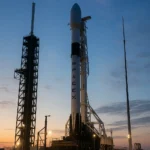
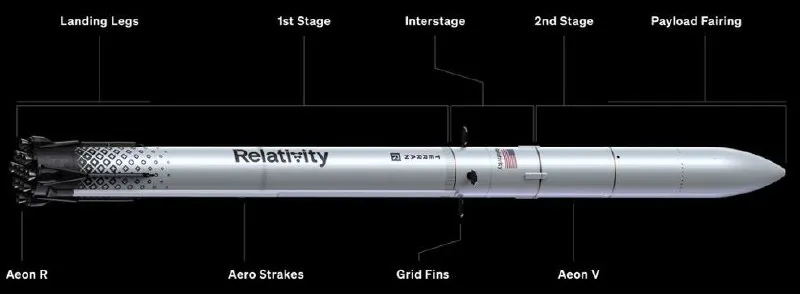
Terran R is a two-stage, partially reusable rocket designed for medium- and heavy-lift missions. Relativity lists the vehicle at 86.6 meters tall with a diameter and payload fairing width of 5.4 meters.
The rocket is designed to place as much as 23,500 kilograms into low Earth orbit when its first stage performs a downrange landing. Its advertised expendable capacity is 33,500 kilograms to low Earth orbit, while the reusable configuration can deliver 5,500 kilograms to geosynchronous transfer orbit.
Thirteen methane-fueled Aeon R engines will power the first stage, producing approximately 15.6 meganewtons of combined liftoff thrust. An Aeon V vacuum engine will power the expendable second stage. Both engine types burn liquid oxygen and methane, a propellant combination increasingly used by new launch systems because of its performance and relatively clean combustion characteristics.
Relativity plans to launch Terran R from Launch Complex 16 at Cape Canaveral Space Force Station. The company has been installing launch infrastructure at the site while assembling flight hardware and conducting Aeon engine testing at NASA’s Stennis Space Center in Mississippi.
The company currently targets late 2026 for the rocket’s inaugural mission. A successful debut would be the first step toward establishing the flight record required to compete for higher-value government spacecraft, although NASA can use additional engineering reviews and certification processes when evaluating new vehicles.
Terran R represents a major shift in Relativity’s launch strategy. The company flew its smaller Terran 1 rocket once in March 2023, but the vehicle failed to reach orbit after its second stage engine did not ignite. Relativity subsequently retired Terran 1 and concentrated its resources on the larger Terran R, targeting the constellation, commercial communications and government launch markets.
Relativity says it has secured more than $3 billion in launch service agreements across commercial and government customers. Its announced customers include satellite operator SES, which expanded its agreement in 2025 to cover multiple Terran R missions involving medium Earth orbit or geostationary satellites.
The NLS II award gives those commercial plans an additional government pathway, but Terran R’s first launch remains the program’s central near-term milestone. Demonstrating the vehicle’s propulsion system, stage separation, orbital insertion and first-stage recovery architecture will determine how quickly it can progress from contractual eligibility to carrying operational NASA payloads.