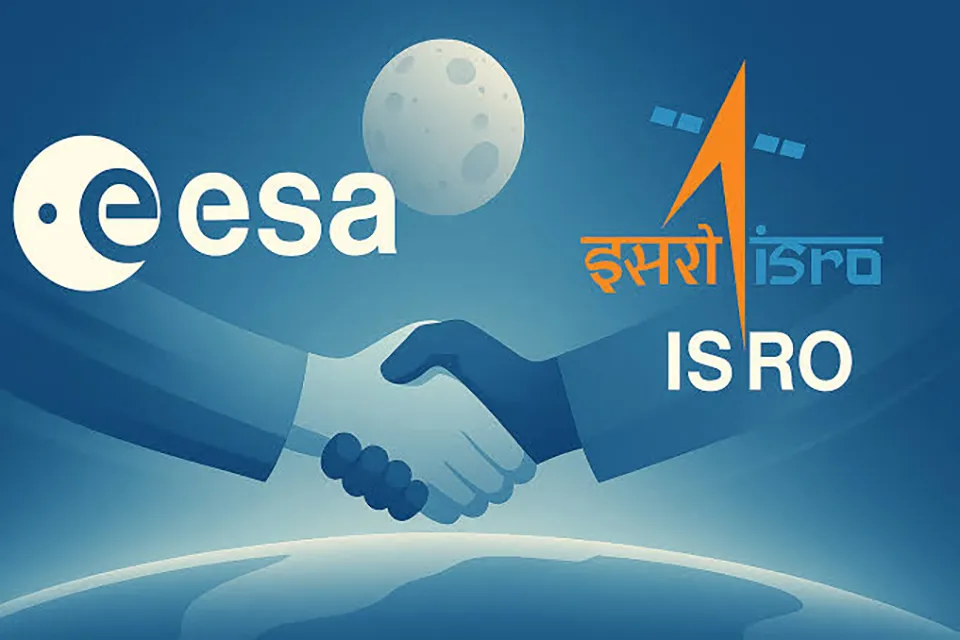
The European Space Agency and the Indian Space Research Organisation signed an exchange of letters in Paris on September 10, 2026, extending their bilateral Cooperative Agreement for five years, through January 8, 2032. Signed during the International Space Summit, the extension adds space weather and human and robotic exploration to a framework that already supports cooperation in Earth observation, navigation, space science and mission operations.
The agreement entered into force in January 2002. ESA’s governing council approved its extension and amendment in June 2026, before the agencies signed the exchange of letters in September. The revised scope also recognizes the growing importance of sustaining space activities as the number of spacecraft in orbit increases.
The agencies have an established record of providing operational support for each other’s missions. ESA’s ground network has supported India’s Chandrayaan lunar missions and Aditya-L1 solar observatory, while ISRO has provided deep-space antenna support. Such arrangements give mission teams access to tracking and communications facilities beyond their own networks, an important capability during launch, early operations and deep-space flight.
The expanded exploration provision follows a 2025 joint statement of intent on human space exploration. It also builds on a separate agreement covering astronaut training, mission implementation and research experiments. The renewed overarching agreement creates room for further joint work, although the agencies have not announced a new mission under it.
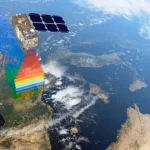
Cooperation in Earth observation has advanced on a separate track. In March 2026, ESA and ISRO signed an arrangement for joint satellite calibration, validation and scientific studies. Calibration and validation help teams compare measurements from different instruments and establish how reliably satellite data represent conditions on the ground.
For space weather, cooperation could bring together observations and expertise relevant to solar activity and its effects on spacecraft and communications. The agencies identified the field as part of the agreement’s expanded scope but have not specified a joint instrument or operational forecasting service.
The extension keeps the institutional framework in place through 2032. Its practical reach will depend on the mission plans and technical arrangements ESA and ISRO develop within that period.