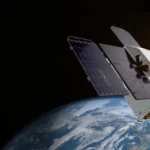
Satellite-to-Device (S2D) services, also known as direct-to-device (D2D) or direct-to-cell services, allow regular phones, Internet of Things (IoT) sensors, and other consumer devices to connect directly to a satellite in orbit without the need for a ground tower, dish, or specialized hardware. S2D use a satellite, which is positioned hundreds of kilometers overhead rather than on a rooftop, as that tower, whereas a typical mobile network relies on a nearby cell tower. As a result, coverage is available in areas that terrestrial networks have never been able to reach, such as mountains, deserts, oceans, and numerous rural areas where tower construction would be too expensive.
Working Operation:
A satellite equipped for S2D has a base station much like the one inside a terrestrial cell tower. It also has a large antenna that compensates for the enormous distance and weak signal strength involved in talking to an unmodified phone. The satellite either reuses a mobile carrier’s existing ground spectrum or operates on dedicated mobile-satellite frequencies, depending on the provider.

Satellite to Direct Service
Low Earth orbit (LEO) satellites are used to keep the distance manageable, phased-array antennas spanning hundreds of square meters boost the received signal, and onboard processing corrects for Doppler shift as the satellite races overhead at roughly 27,000 Km/h. Standards bodies have also updated the mobile specifications themselves: 3GPP Release 17 and 18 define Non-Terrestrial Networks (NTN), the rules that let a satellite and a terrestrial network hand a device back and forth seamlessly. When it loses terrestrial signal, it automatically searches for and locks onto the satellite link, the same way a phone switches between cell towers.
Key features of S2D Services:
- No special hardware: Most S2D services work with existing smartphones through a software or modem update, not a new phone or add-on antenna.
- Automatic network switching: Devices move between terrestrial and satellite coverage without any manual setup.
- Global reach: A single satellite constellation can offer coverage across borders and oceans, where laying cable or building towers isn’t practical.
- Built on open standards: 3GPP’s NTN standards mean S2D isn’t locked to one satellite operator, multiple companies can build compatible services.
- Limited but growing bandwidth: Early S2D services handle text messages and short data bursts; voice calls and modest data speeds are rolling out as satellite constellations and antennas scale up.
Key applications of S2D Services:
- Emergency communication: The most mature use case today. When a phone has no terrestrial signal, S2D lets a person send an SOS text with their location to emergency responders, a capability already built into several flagship smartphones.
- Coverage in remote and underserved regions: S2D fills the gaps left by terrestrial networks across rural areas, mountains, deserts, and open ocean, extending basic connectivity to places a cell tower will never economically reach.
- Disaster recovery: When storms, earthquakes, or fires knock out local cell towers, S2D acts as a backup link, keeping affected areas reachable until ground infrastructure is repaired.
- IoT and asset tracking: Shipping containers, agricultural sensors, and vehicles operating outside normal network coverage can report their location and status via low-power satellite links, useful for logistics, farming, and environmental monitoring.
- Maritime and aviation connectivity: Ships and aircraft that spend long stretches beyond terrestrial coverage use S2D for messaging and safety communication without carrying dedicated satellite terminals.