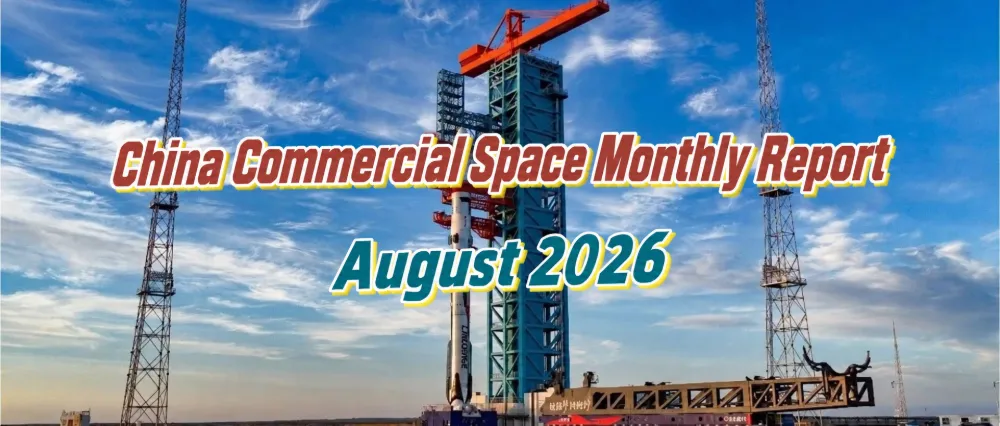
In August 2026, China and the United States continued to dominate the global launch market. The United States maintained its lead through the high-cadence reuse and launch operations of Falcon 9, while China saw parallel advances by both its state-owned space sector and commercial space companies.
A total of 26 orbital launches were conducted worldwide during the month, placing 322 spacecraft into orbit. China completed seven orbital launches and placed 29 spacecraft into orbit. China’s commercial space sector recorded 23 financing deals, with disclosed funding exceeding RMB 11.597 billion.
Monthly activity showed that global launches and satellite deployment remained largely driven by the U.S. market, while China’s commercial space sector continued to advance in commercial launch vehicles, new-generation rockets, satellite internet constellation deployment, and capital-market activity.
Rocket Launches in August
A total of 26 orbital launches were conducted worldwide in August, of which 25 were successful, for a success rate of approximately 96%. The United States carried out 16 launches and China seven, while Russia, Europe, and Japan each conducted one. China and the United States together accounted for approximately 88% of global launches during the month.
China: China conducted seven orbital launches in August, with six successes and one failure. Five were commercial launch missions, and three were performed by commercial launch vehicles.
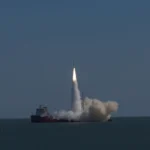
Notably, Zhuque-3 successfully completed China’s first land recovery of an orbital launch vehicle’s first stage on August 19. Earlier, on July 10, Long March 10B had achieved a sea-based net capture and recovery of its first stage. Within just 40 days, China demonstrated two different reusable launch vehicle recovery approaches: sea-based net capture and land-based landing-leg recovery. Reusable rocket development in China has now entered a phase in which multiple vehicle types and recovery architectures are being tested in parallel.
United States: The United States completed 16 orbital launches in August, all successfully. SpaceX conducted 14 launches, including 13 Falcon 9 missions and one Falcon Heavy mission, while Rocket Lab’s Electron completed two launches.
By the end of August, Falcon 9 had flown 101 missions in 2026. On August 26, Falcon 9 booster B1067 completed its 37th flight and was successfully recovered, setting a new reuse record for a single booster.
Spacecraft Placed Into Orbit in August
A total of 322 spacecraft were placed into orbit worldwide in August. Of these, 290 were from the United States and 29 from China, while Russia, Europe, and Japan each placed one spacecraft into orbit. The United States accounted for approximately 90% of the global monthly total, maintaining its dominant share of worldwide satellite deployment.
Of the 29 spacecraft placed into orbit by China, 19 were communications satellites, accounting for 66% of the total; six were remote-sensing satellites; and four were technology demonstration satellites.
Of the 290 spacecraft placed into orbit by the United States, 273 were communications satellites, accounting for 94% of the total; 14 were military satellites; two were remote-sensing satellites; and one was a scientific satellite.
Major Global Constellation Deployment Progress in August
Major constellation deployment activity in August was concentrated in Starlink and China’s GW constellation, which together placed 279 satellites into orbit.
Starlink completed 10 deployment missions during the month, placing 261 satellites into orbit, all launched by Falcon 9. By the end of August, approximately 11,096 Starlink satellites were operating in orbit, while the number of users had exceeded 13 million.
China’s GW constellation completed two deployment missions in August, placing 18 satellites into orbit aboard Long March 8A and Long March 12 launch vehicles. By the end of August, the constellation had reached 198 satellites in orbit.
Commercial Space Financing in China in August
China’s commercial space sector recorded 23 financing events in August, with disclosed funding exceeding RMB 11.597 billion.
By segment, satellite manufacturing accounted for 10 financing deals, or approximately 43% of the monthly total. On-orbit servicing recorded four deals, satellite applications three, launch vehicle manufacturing two, supporting services two, space tourism one, and satellite operations one.
Ten Years of Commercial Space Data
From 2016 to 2025, the number of global orbital launches increased from 85 to 323, nearly quadrupling over the decade. Growth accelerated particularly after 2020, as low-Earth-orbit satellite internet constellations entered large-scale deployment. Global orbital launches reached a record 323 missions in 2025.
Global launch activity continued to grow in 2026. As of August 31, 205 orbital launches had been completed worldwide during the year, up approximately 4% from 197 launches during the same period in 2025.
The annual number of spacecraft placed into orbit worldwide increased from 209 in 2016 to 4,508 in 2025, while 3,074 spacecraft had already reached orbit during the first eight months of 2026. Over the same period, the global in-orbit spacecraft population increased from 1,385 in 2016 to 16,953 in 2025, before rising further to 20,055 by the end of August 2026, highlighting the accelerating expansion of the global spacecraft fleet.
According to incomplete statistics, China’s commercial space sector recorded a total of 346 financing events from 2016 to 2025, with publicly disclosed funding of approximately RMB 55.402 billion.
Capital-market activity accelerated significantly in 2026. By the end of August, the cumulative number of financing events had reached 493, with disclosed funding totaling approximately RMB 98.078 billion. Of these, 147 financing events took place during the first eight months of 2026, with disclosed funding of approximately RMB 42.676 billion—already close to 80% of the total amount publicly disclosed during the entire 2016–2025 period. The scale of capital investment in China’s commercial space sector has expanded substantially.