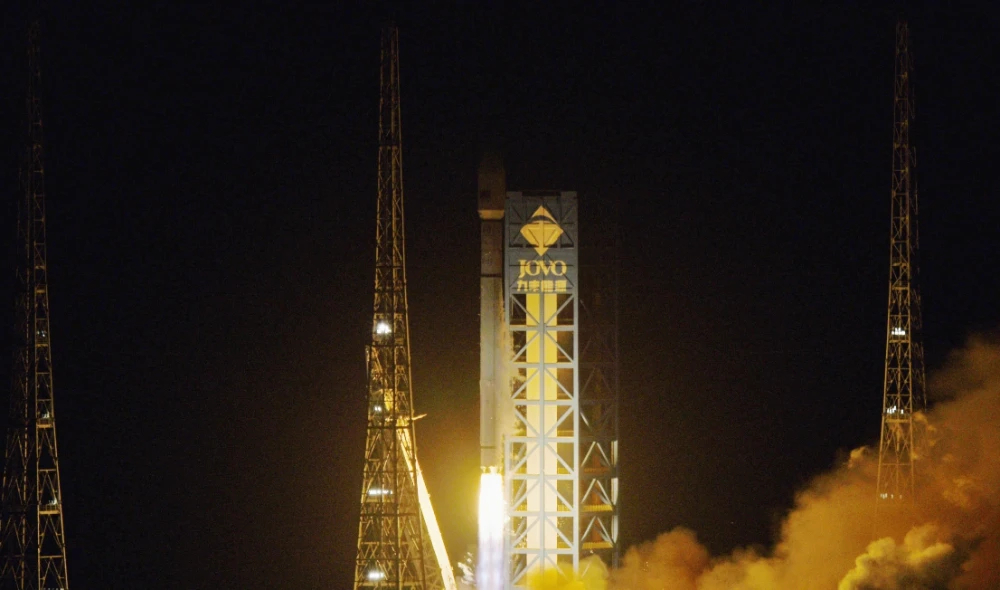
At 3:27 a.m. on October 10, 2026, China successfully launched the 27th group of low-Earth orbit internet satellites aboard a Long March 12 carrier rocket from the Hainan Commercial Space Launch Site. The satellites entered their designated orbit, continuing the phased deployment of China’s satellite internet system and marking the 671st mission of the Long March rocket family.
A commercial-launch subsidiary of China Aerospace Science and Technology Corporation served as the launch-services prime contractor. The Long March 12 was developed under the leadership of the Shanghai Academy of Spaceflight Technology, also known as CASC’s Eighth Academy.
The October 10 mission was the ninth launch of the standard Long March 12 configuration since the vehicle’s debut in November 2024. CASC did not disclose the number of satellites aboard the rocket, their individual mass or configuration, the target orbit’s altitude and inclination, or when the spacecraft are expected to enter operational service. The designation “27th group” refers to the deployment batch rather than the number of satellites carried.
The flight extended a rapid sequence of numbered satellite internet deployments from Hainan. A Long March 12 launched the 24th group on August 16 and the 25th group on September 17, followed by a Long March 8A carrying the 26th group on September 23. Four consecutive groups were therefore deployed within 55 days, using three Long March 12 missions and one Long March 8A flight.
Long March 12 Supports Multi-Satellite Deployment
The Long March 12 is a two-stage liquid-propellant launch vehicle approximately 62 meters long. Its 3.8-meter core places it in China’s 4-meter-class launcher category, making it the country’s first single-core vehicle in that diameter class.
The rocket’s first stage uses four liquid oxygen-kerosene engines, each producing approximately 1,250 kilonewtons of thrust. CASC rates the vehicle to carry at least 12 metric tons to low Earth orbit or at least 6 metric tons to a 700-kilometer sun-synchronous orbit. These figures describe the launcher’s overall performance and do not indicate the orbit used for the October 10 payload, which was not disclosed.
Mission planners can select either a 4.2-meter- or 5.2-meter-diameter payload fairing, providing flexibility for single spacecraft, multi-satellite stacks and missions targeting different orbits. Fairing volume is particularly important for constellation launches because deployment adapters and separation systems must be accommodated alongside the satellites.
The Long March 12 uses horizontal assembly, horizontal testing and horizontal transfer to the launch area. This ground-processing model is suited to repeat launch operations and the higher mission cadence required for large satellite constellations.

Long March 12 Rocket in Transit
The rocket completed its maiden flight on November 30, 2024, during the first launch conducted from the Hainan Commercial Space Launch Site, China’s first launch complex dedicated to commercial missions. The recent deployment sequence shows that China’s low-orbit internet satellite campaign is drawing on both the Long March 12 and Long March 8A to maintain its launch cadence.
The launch of the 27th low-Earth orbit internet satellite group reflects the growing capacity and launch cadence of China’s satellite industry. International operators planning dedicated satellites, payloads or constellation projects can contact STARPATH GLOBAL to explore competitively priced solutions supported by China’s expanding manufacturing base, including satellite platforms, payloads and AIT equipment. Our team helps match technical requirements, schedules and budgets with suitable resources across the Chinese commercial space supply chain.