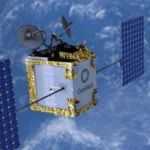
When a headline says an “AI computing satellite” has reached orbit, where does the computing hardware go? The basic layout is straightforward: a satellite has a bus that keeps it operating and a payload that carries out its mission.
Think of the Bus as Hardware and the Payload as an App
The satellite bus provides shared services. Its power system supplies electricity, attitude control points the spacecraft, propulsion adjusts its orbit, communications equipment maintains contact with the ground, and thermal control keeps components within their operating temperatures.
The payload performs the mission. It might be a camera on an Earth observation satellite, a transponder on a communications satellite, or an AI computing module that analyzes data in orbit. The phone analogy helps: the bus is the hardware that supports the device, while the payload determines what it is built to do.
What Changes When Computing Moves Aboard?
A conventional communications satellite receives signals, amplifies or converts them, and relays them onward. It handles the signal without interpreting the information inside it. An AI computing payload can instead analyze suitable data aboard the satellite and transmit a result, such as a detected object or a change in an image.
That distinction changes the satellite’s role. For some tasks, sending a compact finding can be more useful than waiting to send all the underlying data to a ground processing center.
One Satellite, Several Payloads
PEGA-SUS1, launched on September 20, 2026, shows how several functions can share one spacecraft. Jointly developed by GALAXYSPACE, Peng Cheng Laboratory, Southern University of Science and Technology and other partners, the 150-kilogram technology demonstration satellite carries three payloads: a 5G non-terrestrial network (NTN) communications payload, a 100 Gbps satellite-to-ground laser communications payload, and a digital-retina onboard computing payload.
The mission brings communications, high-speed data transmission and AI computing together on one satellite. The 100 Gbps figure describes a planned laser communications test capability; it is not a measure of the satellite’s AI computing speed.
Two Terms to Remember
Bus: The spacecraft’s shared systems, including power, pointing, communications and temperature control. Payload: The equipment that performs its specific mission.
The simplest way to remember the layout is satellite = bus + payload. Onboard AI adds a new kind of payload, allowing selected data to be processed where it is collected or received.
For organizations exploring a satellite mission, the useful starting point is the task the payload must perform and the result users need on the ground. STARPATH GLOBAL combines software development with access to satellite data and China’s established space supply chain to help turn those requirements into a practical system. You can share your requirements with the team.
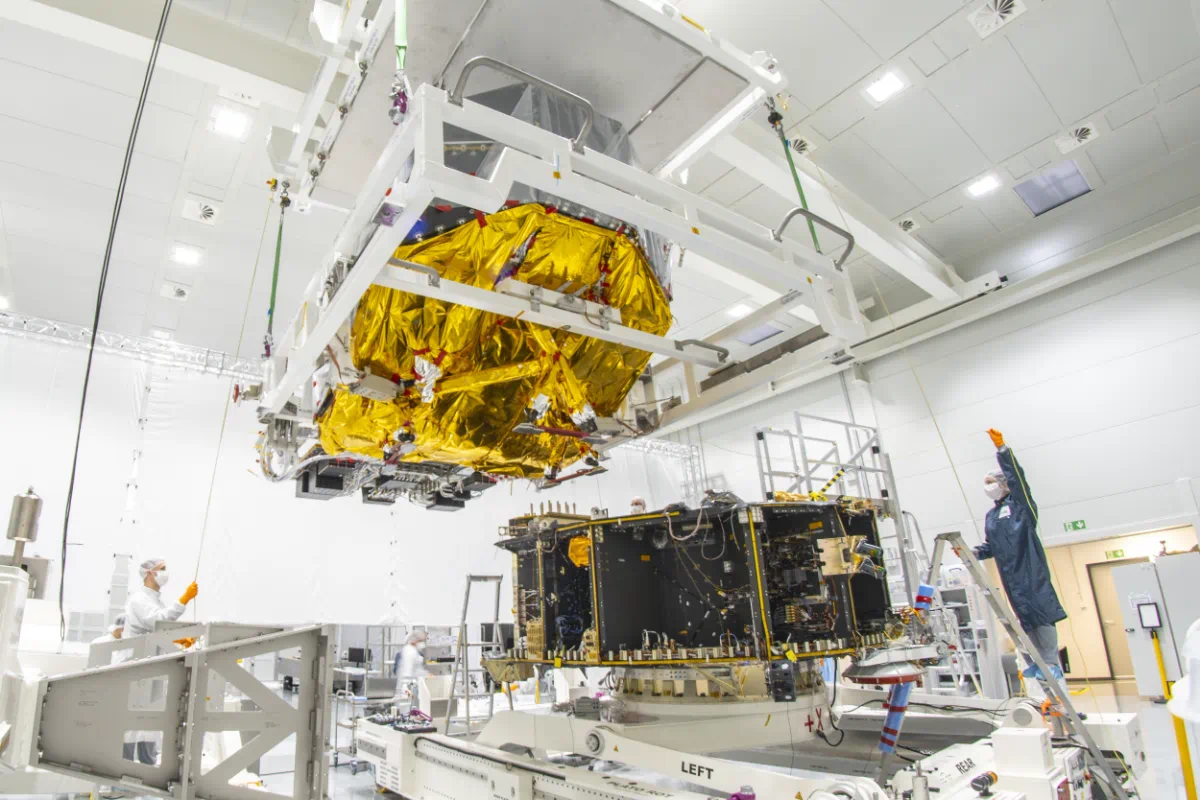
Feature image: Engineers lower the camera payload module onto the service module of ESA’s PLATO spacecraft at OHB’s facility in Germany.