
Tag: exoplanets
-
Using JWST, scientists observe silicate clouds and measure the temperature of exoplanets
With help from the joint NASA/ESA/CSA James Webb Space Telescope, two teams of scientists have made groundbreaking, first-of-their-kind discoveries on two exoplanets. One team utilized the immense power of Webb’s Mid-Infrared Instrument (MIRI) and Near-Infrared Spectrograph (NIRSpec) instruments to observe and characterize clouds and molecules in the atmosphere of an exoplanet located 40 light-years away.…
-

Webb peers at young star’s dusty disk, discovers an exoplanet, and uncovers star formation
At the 241st meeting of the American Astronomical Society (AAS) on Jan. 11, three teams presented research that utilized the capabilities of NASA’s James Webb Space Telescope. The first team used Webb to observe the dusty disk surrounding a young red dwarf star, the second to discover an exoplanet, and the third used the telescope’s…
-
TESS returns from safe mode, the case of the missing exoplanet atmosphere
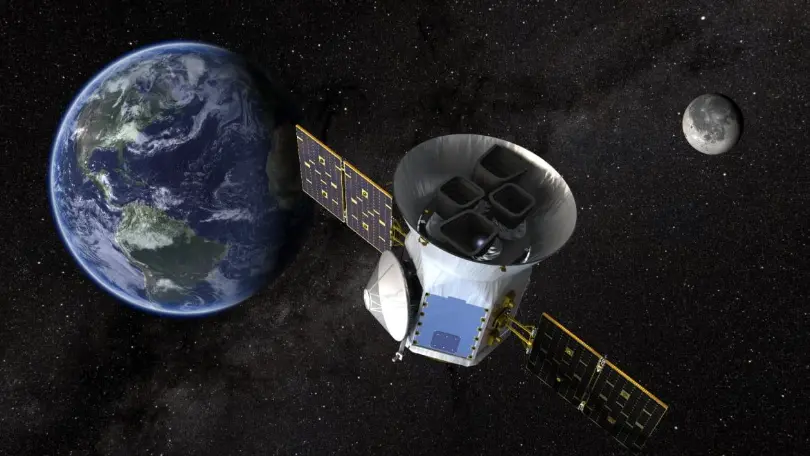
Following an incident that triggered the telescope to enter safe mode, NASA’s Transiting Exoplanet Survey Satellite (TESS) has resumed normal science operations in its highly elliptical Earth orbit. TESS entered safe mode on Monday, Oct. 10, and was in the protective states until Thursday, Oct. 13, at approximately 22:30 UTC. Meanwhile, a team of researchers…
-
As Webb begins observing exoplanets, scientists use Spitzer data & brown dwarfs to reveal how silicate clouds form
In a new study from a group of researchers in Canada, data from NASA’s now-retired Spitzer Space Telescope was used to determine the conditions under which silicate clouds form on distant exoplanets outside of our solar system — giving scientists insight into what’s inside the atmospheres of exoplanets similar in size, temperature, and composition to…
-
NASA, ESA, CSA release historic first images from the James Webb Space Telescope
NASA, the European Space Agency (ESA), and the Canadian Space Agency (CSA) have released the first set of full-color images taken by the James Webb Space Telescope — the world’s newest, most powerful, and largest space telescope. A total of five images were released, with the first image being unveiled by United States President Joe…
-
Researchers use Hubble to observe dead star destroying planetary system
A team of researchers using archival data from the Hubble Space Telescope, a joint venture between NASA and the European Space Agency (ESA), as well as other NASA observatories have observed a white dwarf consuming and destroying a planetary system — the first time an observation of such kind has been made. The white dwarf, a…
-
James Webb targets detailed as commissioning nears completion
Over the past five months, the James Webb Space Telescope and the joint NASA, European Space Agency, and Canadian Space Agency teams behind the project have been working towards the completion of the observatory’s six-month-long commissioning phase at the Sun-Earth Lagrange point 2 (L2). With the observatory’s mirrors recently completing alignment, Webb and its teams…
-
Roman Space Telescope to search for other Earths by surveying space dust
With the James Webb Space Telescope continuing its commissioning phase, NASA is already looking ahead to its next major space observatory, the Nancy Grace Roman Space Telescope. Currently scheduled to launch in 2027, Roman will observe the universe to answer crucial questions needed for the complete understanding of our universe, especially in the areas of…
-

New research directly observes atmospheric loss on mini-Neptune exoplanets, provides insight into exoplanet evolution
In two studies recently released by a group of astronomers researching exoplanets, the first direct observations of atmospheric loss on mini-Neptune exoplanets were confirmed. What’s more, the data from the studies points to the atmospheric loss potentially causing the mini-Neptunes to transform into super-Earth exoplanets — a stunning discovery in exoplanet research. “Most astronomers suspected…
-
New research from ESA’s CHEOPS observatory reveals rugby ball shape of strange exoplanet
Exoplanets all over the universe come in different sizes, compositions, colors, and temperatures. However, they typically don’t come in different shapes, as nearly every single planet ever discovered is thought to be spherical in shape — except for one. New data from the European Space Agency’s (ESA) Characterising Exoplanets Satellite (CHEOPS) space observatory, as well…