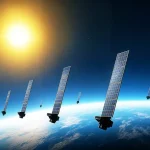
On January 30, 2026, SpaceX submitted an application to the U.S. Federal Communications Commission (FCC) that shocked the industry: it planned to deploy and operate up to 1 million satellites. This number is approximately 70 times the current total number of active satellites in orbit around the world (approximately 14,500).
Once this news was released, it instantly detonated the industry and capital circles. This is not a radical satellite application, but a clear signal:
SpaceX is advancing space from communication networks to next-generation computing infrastructure.
This time, China cannot just be a bystander.
01
What are 1 million satellites pointing at?
In the FCC filing, SpaceX did not simply describe this system as a communication constellation, but a clear new concept: Orbital Data Center System. There is only one core goal: to provide large-scale AI reasoning and data center-level computing power support for billions of users around the world.
Judging from the technical description, this is not a fantasy puzzle:
Satellites are deployed in 500km/1000km/2000km multi-layer orbits;
The thickness of a single track shell is limited to 50 kilometers to reduce the occupation of track resources;
The entire system relies on inter-satellite laser communications and is interconnected with the existing Starlink network;
The energy comes from solar energy, and the heat is dissipated using the space environment.
In other words, it’s more like moving part of cloud computing to orbit. This is not an expansion of the communication system, but an upgraded version of the global computing infrastructure – the space computing power center may become a new strategic high ground in the AI era.
This strategic path is regarded by the industry as “orbital data center = continental-level computing power infrastructure in space”, and its impact far exceeds that of satellite Internet in the traditional sense.
02
SpaceX has entered the next phase
Many people underestimate this.
Because before this, from Starlink to Starship, SpaceX has completed an extremely rare space commercial closed loop.
1. Starlink has completed large-scale network construction, and commercialization has become a reality.
Since 2019, SpaceX has launched a total of approximately 9,500 Starlink satellites, with more than 9 million users worldwide, covering more than 150+ countries and regions around the world. Starlink has become the world’s largest satellite Internet operating network, and its paid services provide SpaceX with continuous cash flow—contributing 50%–80% of SpaceX’s revenue of more than $15 billion in 2025.
2. Falcon 9 turned launch into a “flight”
In 2025, SpaceX launched 3,190 satellites via Falcon 9, accounting for approximately 70% of global payload launches. This means: emission is no longer the limiting factor, but a schedulable resource.
3. Starship will open a new era of transportation capacity
Starship v3 is expected to enter the commercial operation stage in 2026. It can carry more than 100 tons of payload at a time, which is six times that of Falcon 9. It will become a key force in the batch deployment of large-scale satellite systems.
Putting these three things together, the conclusion is actually very clear:
Starlink is not the end, but the first stage;
Space computing power is the next stage that SpaceX has truly entered.
SpaceX is not just “imagining things”, but building a closed business loop of sustained profitability and expansion.
03
Why is space computing power more important than Starlink?
Let’s not worry about “whether all 1 million satellites can be used”. In the history of satellite supervision, applying for the maximum scale first and then gradually shrinking it is a conventional game method. What really matters is path selection.
The core logic is this:
AI and data centers require massive computing power and have become the most power-hungry and resource-hungry infrastructure on the planet;
Ground data centers are facing bottlenecks in power, cooling and land constraints;
Space computing power circumvents these constraints: almost unlimited solar energy + natural heat dissipation in a vacuum environment, which can break through the physical limitations of land; laser links have high bandwidth and low latency, and after integration with the Starlink network, computing power results can be efficiently transmitted back to the ground.
If this route is even partially true, it will reshape the global computing power and energy competition landscape. Once established, the question is no longer “who does it first”, but “will the latecomers still have a place”.
04
A real dilemma
The question is, should China follow?
This is a multiple-choice question that has no standard answer, but must be faced.
1. If you don’t follow up, the risk lies in the future.
Once space computing power becomes global infrastructure, Chinese companies’ lagging behind in this regard will lead to the externalization of technology and ecology;
Spectrum and orbital resources are locked in advance, and they lack the right to speak in the construction of the future space economy and will be in a passive position for a long time.
2. Follow up, the risk is now
The technology is not yet fully mature and the business prospects are highly uncertain;
The cost of large-scale deployment of satellites and space computing power is extremely high;
Blind investment is likely to result in waste of resources and strategic misjudgment.
This is the most real situation currently facing China’s commercial aerospace industry.
05
How should China respond?
As the global space competition enters a new stage, there are several judgments that are more important than “whether it is recyclable”:
1. Large transport capacity is the ticket, low cost is the goal, and recyclability is only one of the means.
Without mature, reliable, low-cost high-capacity rockets, any constellation and space computing power ideas are just plans on paper. But Falcon 9 proves the cost curve, not some technological myth. Disposable rockets can also be competitive as long as they are low-cost enough.
2. Use the market to change time, rather than confronting behind closed doors
China is an important global market and indispensable to any global commercial space services. In some market segments, the pilot program relaxes the use of systems such as Starlink and trades the market for time and technical cooperation space, which is conducive to cultivating local markets and industries. It may be the most realistic and effective strategy at present.
3. Competition under international rules is as important as technological competition.
Space is a common space resource for all mankind. Faced with the conflicts that may arise from space debris, security, and frequency and orbital resources caused by a single huge satellite system, China should lead or participate in the formulation of binding international rules to avoid “one dominance.”
4. Planning for lunar and deep space launches, this is the possibility of overtaking in corners
For example, Musk once mentioned the idea of using the moon as a launch base, which has implications for promoting China’s lunar commercial launch layout.
In short, for China’s commercial aerospace industry:
The next stage of competition is not just a competition between rocket companies, but a competition of “business model + infrastructure imagination”.
Conclusion
SpaceX’s application for 1 million satellites may not all be realized. But if one day computing power really begins to migrate from the ground to the orbit, then all today’s “too early” judgments will appear too late.
For China’s commercial aerospace industry, the question has never been whether to compete with SpaceX, but whether it will sit at the poker table when space is redefined as infrastructure.