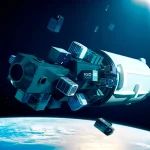
1. What is a satellite? Satellites are generally divided into natural satellites and artificial satellites. Natural satellites refer to natural celestial bodies that orbit a planet and move periodically in a closed orbit; artificial satellites refer to devices made by humans and launched into space through a carrier (usually a launch vehicle), orbiting the earth or other planets like natural satellites. The world’s first artificial earth satellite: On October 4, 1957, the former Soviet Union launched the world’s first artificial earth satellite, “Sputnik” 1, and it was sent into orbit. Humanity has since entered a new era of using spacecraft to explore outer space. my country’s first artificial earth satellite: On April 24, 1970, my country’s first artificial satellite “Dongfanghong-1” was successfully launched by the Long March-1 rocket, and the music “Dongfanghong” sounded in space for the first time. China became the fifth country in the world to launch a satellite. 2. What are the classifications of satellites? Satellites are classified according to their mass, which can generally be divided into: pico-satellites (0.1-1 kg), nano-satellites (1-10 kg), micro-satellites (10-100 kg), small satellites (100-500 kg), small and medium-sized satellites (500-1000 kg), and large satellites (>1000 kg). Satellites are classified according to orbital altitude and can generally be divided into: low-orbit satellites (200-2,000 kilometers), medium- and high-orbit satellites (2,000-more than 20,000 kilometers), and geostationary orbit satellites (36,000 kilometers above the equator). Satellites are classified according to their flight directions and can generally be divided into: prograde orbit (orbital inclination angle is less than 90 degrees), retrograde orbit (orbital inclination angle is greater than 90 degrees), equatorial orbit (orbital inclination angle is 0 degrees), and polar orbit (orbital inclination angle is 90 degrees). Satellites are classified according to their operating orbits and can generally be divided into: geosynchronous orbit (a prograde orbit with the same operating period as the earth’s rotation period), geostationary orbit (36,000km above the equator, orbital inclination angle is 0), sun-synchronous orbit (the orbital plane rotates around the earth’s rotation axis, in the same direction as the earth’s revolution, and the angular speed is equal to the earth’s revolution angular speed), polar orbit (the inclination angle is 90 degrees, and each revolution passes through the two poles). Satellites are classified according to their applications and can be divided into: communication satellites, navigation satellites, remote sensing satellites, and scientific experiment satellites. 3. What parts does a satellite consist of? A satellite mainly consists of two parts: a platform and a payload. The platform is further divided into structure and mechanism, thermal control, attitude and orbit control, integrated electronics, power supply, measurement and control, etc.; the payload is divided into communication load, navigation load, remote sensing load, and scientific test load. Payload refers to the components, instruments or subsystems used to complete a specific space mission. Navigation satellites: atomic clocks, short messages. Communication satellites: transponders, communication antennas; remote sensing satellites: visible light cameras, CCD cameras, infrared detectors, radio reconnaissance receivers, microwave radiometers, atmospheric detectors, synthetic aperture radar, etc. Scientific experiment satellites: particle detectors, astronomical telescopes. 4. Why man-made satellites can fly Man-made earth satellites can fly in the earth’s orbit mainly because they have the first cosmic speed and the earth’s gravity (centripetal force) keeps pulling them. Consider the satellite and the earth as a particle, and the satellite rotates around the center of the earth. The motion trajectory of the satellite’s center of mass depends on the position of the orbit entry point and the orbit entry speed. As long as the orbital inclination, semi-major axis, eccentricity, ascending node right ascension, perigee angle, and perigee time are known, the motion of the satellite can be determined.
What is an artificial satellite? This article will help you understand it
References to third-party companies, products, services, or projects are for informational purposes only and do not imply endorsement, affiliation, or partnership unless explicitly stated.
LATEST POSTS
- China Sets 2030 Targets for Next-Generation Communications and Low-Earth-Orbit Satellite Internet

- Commercial, Industrial, Standard Military and Space: What These Component Labels Mean, and Where CAST and SAST Parts Lists Fit In

- Elon Musk Says Starlink Could Carry Most Global Internet Traffic Within a Decade
- Impulse Space Wins $28 Million Space Force Contract for LEO-Based GEO Surveillance Mission
- Viasat Wins First $42 Million Order Under $307 Million Marine Corps SATCOM Contract

- DMU41 IMU Recovers From Proton Strikes and Withstands 30 kRad Radiation Test
- Space Epoch Raises $343 Million to Fund Reusable Yuanxingzhe-1 Rocket
- Beyond Reach Labs Opens Brooklyn Facility to Scale Flarewing Solar Arrays
- China Launches Satellite Internet LEO Group 26 on Long March 8A (Video)
- Exolaunch Books First SpaceX Starfall Earth-Return Mission for 2029