China has concluded the first emergency operation in the history of its human spaceflight program after an uncrewed Shenzhou 20 return capsule landed safely in north China’s Inner Mongolia, authorities said on Monday.
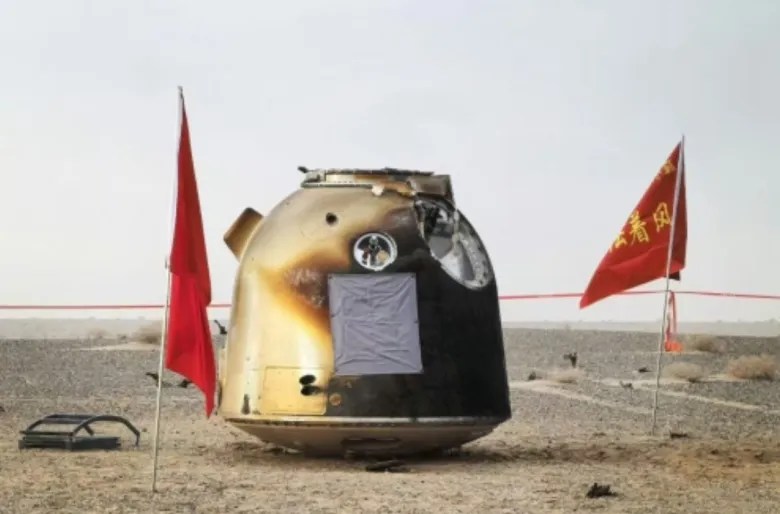
The capsule parachuted into the Dongfeng landing site on Jan. 19 after spending about 270 days in orbit, where it had remained docked to China’s Tiangong space station for nine months. Its delayed return followed the discovery of tiny cracks in a viewport window, believed to have been caused by a space debris impact.
On-site inspections found the capsule’s exterior to be “generally normal,” with all internal payloads in good condition, according to the China National Space Administration (CNSA). Recovery teams immediately protected the damaged porthole after landing to preserve evidence for post-flight analysis.
The damage had prompted Chinese space officials to rule out using Shenzhou 20 to bring astronauts back to Earth. Instead, the crew returned safely aboard Shenzhou 21 on Nov. 14. An uncrewed Shenzhou 22 mission was launched on Nov. 24 as an emergency backup and is now docked to Tiangong to support the current Shenzhou 21 crew, who are due to return later this year.
CNSA officials said a porthole crack repair device was rushed to the launch site and installed by astronauts inside the Shenzhou 20 capsule while in orbit, improving its heat protection and sealing performance for reentry.
State broadcaster China Central Television quoted Xu Peng, the on-site commander at the landing site, as saying the recovery was unique in several respects. It marked the first time a spacecraft recovery had been conducted at Dongfeng during the coldest time of year, requiring special preparations to protect personnel and equipment.
Xu said the operation also debuted new recovery methods, including drones and unmanned ground vehicles, while helicopters were not used. Because the capsule was uncrewed, there was no astronaut onboard to manually release the main parachute after touchdown, increasing the risk of the capsule being dragged by strong winds and requiring rapid intervention by ground teams.
Among the items returned aboard Shenzhou 20 was a retired Chinese spacewalking suit that had been used for more than four years in orbit, far exceeding its original design life. According to CCTV, the suit supported 11 astronauts across eight missions and enabled 20 spacewalks.
Chinese media reported that the damaged porthole showed a triangular crack about two centimetres long on the outermost heat-resistant glass layer. The Shenzhou capsule porthole consists of three layers, with only the outer layer designed to withstand the extreme heat of atmospheric reentry.
A safety assessment concluded that reentry with a cracked heat-resistant window posed unacceptable risks to crew safety. China’s human spaceflight program has operated a “rolling backup” system since the Shenzhou 12 mission, ensuring that one spacecraft is always ready as a contingency. CNSA said this was the first time the backup capability had been activated in a real emergency, with the full response — from damage assessment to the launch of Shenzhou 22 — completed in 16 days.
“With the return of the Shenzhou 20 spacecraft, the main tasks of this emergency space operation for the Chinese space station have been successfully completed,” CNSA said.