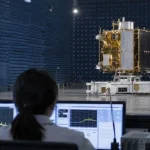
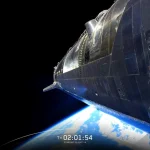
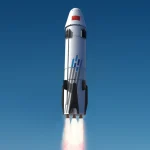
At 00:05 on March 30, 2025, the Long March 7A carrier rocket carrying the communication technology test satellite No. 16 was successfully launched from the Wenchang Space Launch Site, and the launch mission was a complete success.
The following is the relevant research and analysis content of the Long March 7A launch vehicle:
1. Basic information
The Long March 7A launch vehicle is a three-stage semi-medium-sized launch vehicle developed by the First Academy of Aerospace Science and Technology through combined design and development on the basis of the Long March 7 launch vehicle and the Long March 3A series launch vehicle. The first, second and third sub-stages of the Long March 3A series rocket are used for the first, second and boost stages. They are mainly used to launch geostationary satellites. The GTO has a carrying capacity of 7 tons, filling the gap in my country’s launch vehicle high orbit carrying capacity of 5.5 tons to 7 tons. The first and second sub-stages of the Long March 7 are 3.35 meters in diameter, the third sub-stage is 3 meters in diameter, the boost diameter is 2.25 meters, and the height is 60.13 meters (when using the 4.2-meter fairing) and 60.7 meters (when using the dual main star fairing). It is my country’s first bundled rocket that adopts cluster separation technology of booster and core stage. In addition, the Long March 7A also made breakthroughs in key technologies such as large slender ratio rocket attitude control technology and guidance control technology that adapts to typical failure modes during the development process. On March 16, 2020, the Long March 7A made its first flight. At 168 seconds into the flight, the rocket suddenly lost control and the launch mission failed. The reason for the failure was that cavitation occurred at the outlet of the booster oxygen tank, which caused the pump inlet pressure to decrease and did not meet the lower limit requirements of the engine’s operation.
2. Rocket composition
(1) One sub-level
The first stage of the Long March 7A launch vehicle has a diameter of 3.35 meters and is equipped with two fixed YF-100 liquid oxygen kerosene engines. The YF-100 is my country’s first-generation 120-ton oxygen-rich pre-combustion staged combustion cycle engine with a sea level specific impulse of 335 seconds. The filling amount of the first sub-stage of the Long March 7A launch vehicle was reduced during the design process, so that the booster and the first sub-stage are not separated, reducing one separation link and simplifying the rocket bundled connecting rod structure.
(2) Second level
The second stage of the Long March 7A launch vehicle has a diameter of 3.35 meters and is equipped with four YF-115 liquid oxygen and kerosene engines, two fixed and two double-swing. Developed by the Sixth Academy, YF-115 is a high-altitude oxygen-rich supplementary combustion cycle liquid oxygen kerosene engine. YF-115 is of great scientific research significance and has verified the feasibility of designing and manufacturing low-temperature afterburning cycle engines in my country. However, the thrust of YF-115 is too small and it is difficult to perfectly adapt to the second stage of medium and large launch vehicles. Therefore, the second stage working section of the Long March 7A launch vehicle requires the engine to provide a positive angle of attack to resist gravity loss, which seriously reduces the transportation capacity. In addition, compared with the Long March 7, the Long March 7A also shortened the second stage, and the mass was reduced from 106 tons of the Long March 7 to 62.2 tons, which was used to make up for the shortcomings of the YF-115’s small thrust.
(3) Third sub-level
The third sub-stage of the Long March 7A is basically the same as the third sub-stage of the Long March 3B. It is equipped with two parallel YF-75 hydrogen and oxygen engines, two engines and two pendulums. The YF-75 has a single vacuum thrust of 8.5 tons and a vacuum specific impulse of 438 seconds. As my country’s second-generation hydrogen-oxygen engine, the YF-75 uses a gas generator cycle. Due to the simple cycle method, the specific impulse is relatively low and the thrust is relatively small.
(4) Booster
The Long March 7A has four boosters, each with a diameter of 2.25 meters, and is equipped with a YF-100 liquid oxygen kerosene engine. The boost of the Long March 7A is not separated from the first stage, but separated from the second stage as a combination. During takeoff, the first-stage engine ignites first, and then the booster engine ignites. A total of 6 YF-100s in the booster and first-stage engines provide a takeoff thrust of 727 tons, and the takeoff thrust-to-weight ratio is 1.27.
3. Launch record
So far, the Long March 7A has been launched a total of 9 times, all of which are GTOs. All launches were launched from the 201 station of the Wenchang Space Launch Site. In fact, the Long March 7A also has the ability to launch at the inland launch site, but it has not been launched at the inland launch site so far. Among the 9 missions, 1 failed (first flight) and 8 were successful, with a launch success rate of 88.89%.