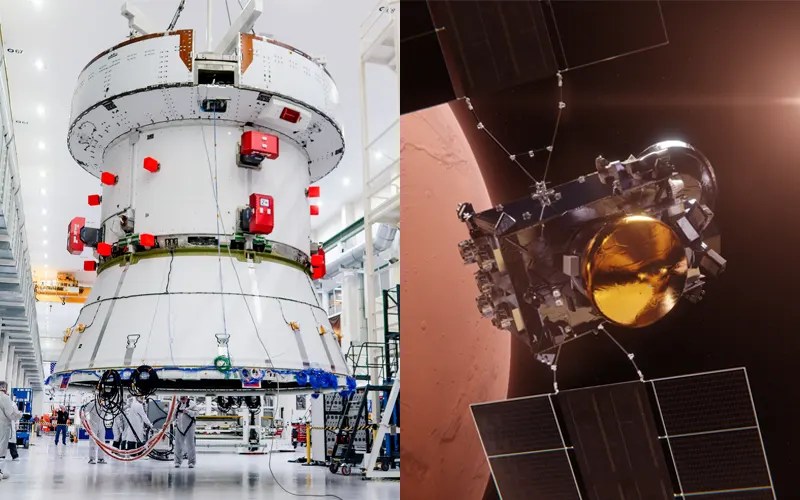
The European Space Agency (ESA) is assessing options to repurpose two of its major spacecraft programmes after growing uncertainty over continued U.S. support for the NASA missions they were originally built to serve, ESA officials told ministers during the agency’s Ministerial Council in Bremen this week.
ESA Director General Josef Aschbacher presented proposals that would redefine the future use of both the European Service Module (ESM), developed for NASA’s Orion capsule under the Artemis programme, and the Earth Return Orbiter, built for the joint Mars Sample Return mission. The moves come as the United States considers scaling back or cancelling both initiatives because of budget constraints.
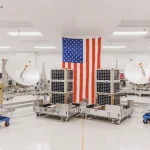
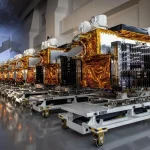
Under current agreements, ESA is supplying service modules for Orion, whose crew capsule is led by Lockheed Martin, as well as contributing elements to the lunar Gateway station. In return, Europe secures access for three European astronauts to future crewed missions. ESA has contracted Airbus Defence and Space to build six service modules, known as ESM-1 through ESM-6. However, U.S. proposals to end the Orion programme after Artemis III could leave at least three modules without a mission.
ESA has now suggested converting the ESM into what it described as an “autonomous modular cargo tug,” according to documents presented to member states. The agency said implementation would depend on the outcome of technical assessments and the broader “international context,” which officials indicated reflects the uncertain future demand for such a vehicle.
Uncertainty is also weighing on the Mars Sample Return programme, a long-planned joint ESA–NASA effort to bring Martian samples back to Earth. As part of its contribution, ESA is developing the Earth Return Orbiter and the Sample Transfer Arm, which would load samples into the Mars Ascent Vehicle. However, the U.S. government’s 2026 budget proposal described the mission as “grossly over budget,” raising the prospect of cancellation.
In response, ESA has outlined a fallback plan to convert the Earth Return Orbiter into its own standalone mission, tentatively named ZefERO. In its proposal, ESA described ZefERO as a “dedicated European exploration mission, with scientific and communication relay dimensions.” The spacecraft would launch in 2032 and conduct studies of Martian winds, geological features and serve as a communications relay.
ESA also indicated that ZefERO could overlap with aspects of its LightShip programme, a planned propulsive tug designed to deliver payloads to Mars orbit while carrying a data relay system. While ZefERO is not expected to affect LightShip’s transport role, it could replace its communications relay function. The agency is also reviewing whether the Sample Transfer Arm could be adapted for future lunar surface operations.
ESA’s proposals highlight Europe’s effort to safeguard long-term exploration capabilities as shifting U.S. political priorities create uncertainty over transatlantic space cooperation.