
Get SAT, a provider of lightweight and field-proven satellite communications terminals, continues to expand the portfolio of electronically steered and mechanically stabilized solutions designed for airborne, ground-mobile and tactical platforms. The company’s terminals are engineered to deliver high-throughput, low-latency connectivity using compact, ruggedized hardware suitable for aircraft, unmanned systems, ground vehicles and rapid-deployment missions. Get SAT’s product line emphasizes SWaP reduction, fast acquisition and multi-band support across Ka-band and Ku-band networks.
Aero Series – Low-SWaP Airborne SATCOM Terminals for High-Mobility Platforms

Get SAT’s Aero product family provides full-duplex satellite connectivity for aircraft requiring compact antennas and rapid deployment. Designed for fixed-wing, rotorcraft and unmanned aerial platforms, the Aero solutions integrate Get SAT’s signature miniaturized satcom electronics with stabilized tracking or electronically steered beam control (depending on model). The units are optimized for minimal drag, low power consumption and high throughput, supporting ISR data feeds, real-time C2 traffic, and broadband airborne applications. Each Aero terminal combines modem, RF assemblies and tracking elements into a unified enclosure to reduce weight and simplify platform integration. The terminals support seamless operation over major commercial and military Ka-band and Ku-band networks, enabling aircraft to maintain connectivity during dynamic maneuvers, altitude changes, or high-speed flight profiles.
Aero Blade Duo Ku – Dual-Panel Ku-Band Terminal for Continuous Broadband Airborne Connectivity
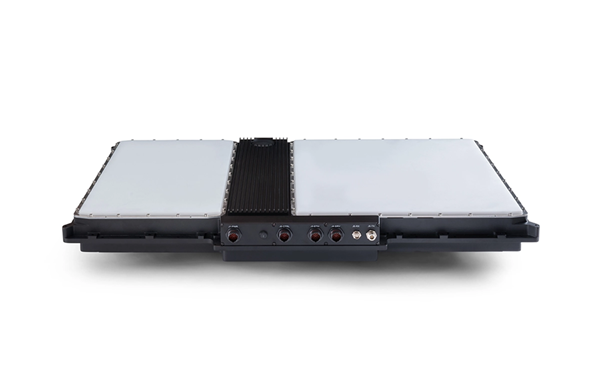
The Aero Blade Duo Ku is Get SAT’s dual-panel, electronically steered airborne SATCOM terminal designed to maintain continuous Ku-band connectivity during dynamic flight conditions. Built around two independent flat-panel ESAs, the system enables true make-before-break (MBB) handovers, ensuring that one panel maintains lock on the satellite while the other transitions during aircraft maneuvers, banking, or rapid heading changes. Both panels operate as solid-state, no-moving-part antennas, reducing maintenance requirements and increasing reliability for long-duration missions. The terminal’s low-profile aerodynamic form factor supports integration on fixed-wing aircraft, rotorcraft, unmanned aerial systems and special-mission platforms without imposing significant drag or structural modification. Integrated RF electronics and modem capability are housed within the antenna unit, minimizing cabling and simplifying aircraft installation. Operating across Ku-band service providers, the Aero Blade Duo Ku supports high-throughput ISR data transfer, secure command-and-control links, live video streaming, and broadband-class cockpit or mission-crew connectivity. This combination of dual-panel resiliency, compact architecture, and electronically steered performance positions the system for defense aviation, airborne surveillance fleets, governmental transport aircraft and commercial operators requiring uninterrupted SATCOM availability under demanding flight profiles.
Sling Blade – SATCOM Terminal for C-17 and Mobility-Class Aircraft
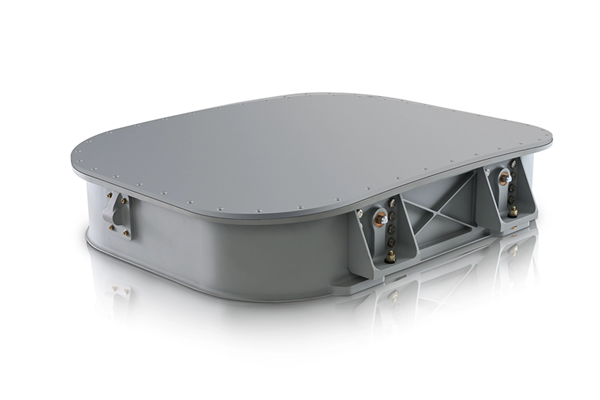
The Sling Blade SATCOM system is purpose-built for the C-17 Globemaster III and other mobility-class aircraft that operate in highly dynamic flight environments. Designed around a ruggedized, gooseneck-mounted stabilized antenna, Sling Blade maintains continuous Ku-band connectivity by compensating for pitch, roll, yaw and rapid aircraft maneuvers. Get SAT’s product specifications highlight its full-duplex Ku-band capability, mechanical stabilization for precise satellite tracking, and reinforced construction engineered to withstand vibration, shock loading, cabin-pressure variation and temperature shifts associated with military airlift missions. The terminal integrates into aircraft interiors using rapid-installation mounting kits tailored for cargo platforms, allowing crews to deploy SATCOM capability without extensive modification. Sling Blade enables broadband communications for mission coordination, inflight situational awareness, logistics updates, troop and asset movement, humanitarian-response operations and airborne command functions supporting reliable connectivity during strategic airlift and operational transport missions.
Aero Blade Solo Ka – Compact Ka-Band Terminal Engineered for High-Throughput Airborne Communications
The Aero Blade Solo Ka is Get SAT’s single-panel Ka-band electronically steered antenna (ESA) designed for airborne platforms that require high-throughput connectivity in a compact, lightweight form factor. According to Get SAT’s published specifications, the Solo Ka integrates a solid-state ESA with embedded radio and control electronics into a unified, low-profile housing that minimizes aerodynamic impact when fuselage- or pod-mounted. The terminal operates across Ka-band frequencies used by high-throughput satellite (HTS) networks, enabling broadband uplink and downlink performance for data-intensive airborne missions. The electronically steered beam supports rapid beam switching and continuous tracking during tight maneuvers, ensuring stable connectivity even in high-dynamics flight profiles. The small physical footprint allows installation on UAVs, helicopters, special-mission aircraft and smaller fixed-wing platforms with limited payload capacity. With an architecture optimized for mobility, reduced wiring and simplified integration, the Aero Blade Solo Ka enables reliable airborne links for ISR data transmission, real-time situational awareness, emergency-response operations and missions requiring consistent access to modern Ka-band satellite networks.
Integrated Product Architecture – Miniaturized Full-Duplex SATCOM
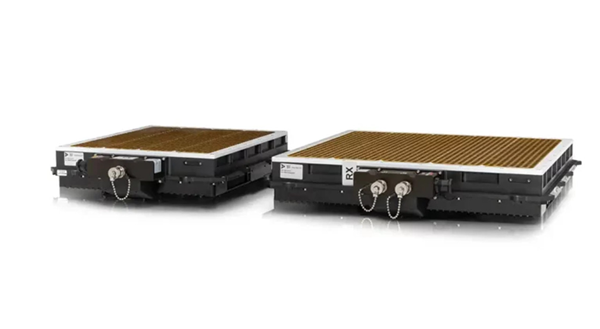
Get SAT’s airborne and mobility terminals are built around a highly integrated product architecture that consolidates the antenna, RF front end, modem and control electronics into a single compact unit, reducing overall system SWaP (size, weight, and power) and simplifying platform installation. Instead of relying on separate below-deck components, the terminals incorporate full-duplex RF chains, digitally controlled beam-steering hardware, and embedded signal-processing modules within a hardened enclosure. This integration supports low-latency tracking algorithms that maintain satellite lock during high-dynamic motion, as well as compatibility with major commercial and government SATCOM networks across Ku and Ka-band. The architecture is engineered for reliability in multi-domain environments, airborne vibration, rapid altitude changes, temperature swings and continuous maneuvering while providing unified diagnostics, health monitoring and control interfaces for aircraft avionics or mission systems. By compressing a complete SATCOM chain into an ultra-small terminal footprint, Get SAT enables broadband-class connectivity on platforms where conventional mechanically steered or multi-box systems are impractical, including UAVs, rotary-wing aircraft, small fixed-wing aircraft, tactical ground vehicles and expeditionary mobility assets.
Mission Applications – Aviation, Defense, Emergency Response and ISR
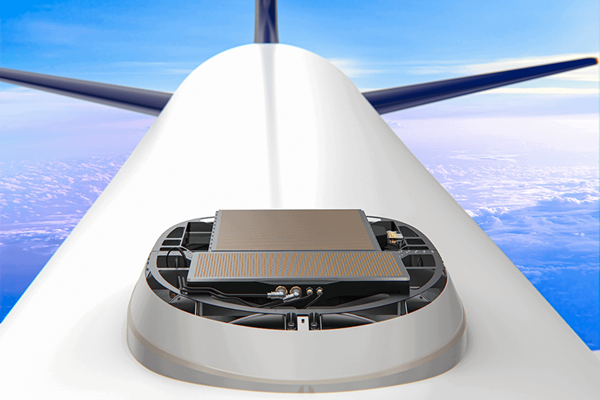
Get SAT’s airborne terminals are deployed across a broad spectrum of mission environments where stable, high-throughput connectivity is essential. In intelligence, surveillance and reconnaissance (ISR) operations, the terminals provide continuous broadband links for transmitting sensor data, video and telemetry in real time. Defense mobility aircraft use Get SAT systems to maintain command-and-control communications during transport operations, tactical deployments, and long-range missions. The low size, weight and power (SWaP) profiles of the terminals also make them suitable for unmanned aerial systems, where payload mass and electrical consumption are tightly constrained. In search-and-rescue and emergency-response roles, Get SAT’s equipment supports airborne teams operating in remote or infrastructure-limited regions by enabling situational awareness, coordination and data exchange. Commercial aviation platforms benefit from the low-profile, aerodynamically efficient antennas that reduce drag while supporting broadband cabin connectivity and operational data services. This mission versatility across defense, commercial and civil aviation, stems from the terminals’ rugged construction, electronically steered architectures and consistent performance in high-dynamic flight conditions.
Get SAT’s satellite terminals—led by the Aero Blade Duo Ku, Sling Blade systems and Aero Blade Solo Ka—represent a focused portfolio of ultra-compact, high-performance SATCOM solutions for airborne and mobility environments. With integrated architectures, electronically steered or stabilized designs and compatibility with both commercial and military satellite networks, these terminals deliver broadband-class connectivity in some of the most demanding operational conditions. Their small footprint and robust engineering make them suitable for UAVs, military transports, rotorcraft and high-speed aircraft requiring uninterrupted global communications.
About Get SAT
Get SAT, headquartered at Eli Horovitz 27, Rehovot, 7608803, Israel, is a leading developer of portable, lightweight and high-performance satellite communication terminals for government, defense, aviation, maritime and enterprise users. The company specializes in designing fully integrated, ultra-compact Ka-band and Ku-band SATCOM terminals built around advanced electronically steered antenna (ESA) and high-efficiency RF architectures. GetSat’s terminals are engineered to deliver broadband data, ISR support, voice and mission-critical communications from platforms with strict size, weight and power (SWaP) constraints. GetSat enables seamless connectivity across GEO, MEO and emerging LEO networks, supporting high-throughput defense and commercial applications. GetSat’s terminals are fielded globally and used in airborne ISR missions, tactical mobility operations, emergency response, VIP and commercial aviation and remote enterprise connectivity. With a focus on reliability, rapid deployment and low-SWaP engineering, GetSat continues to advance portable SATCOM technology for dynamic communication requirements.