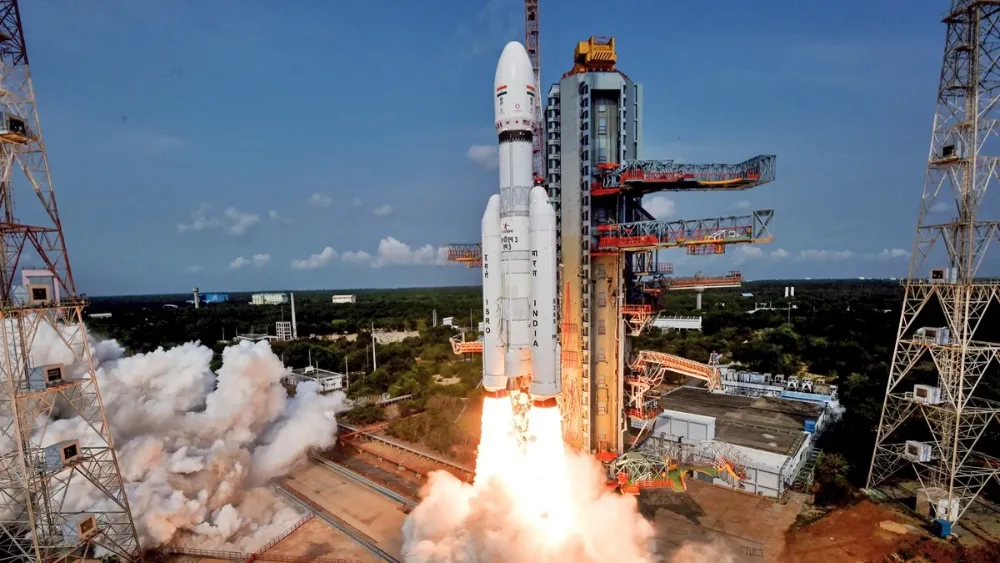
The Indian Space Research Organisation said on September 6 that it will neither be privatised nor lose its central role in India’s space programme, clarifying that the government’s private-sector reforms are intended to shift mature, scalable activities to industry while allowing ISRO to concentrate on advanced research, strategic missions and exploration.
The statement followed concerns among sections of ISRO’s workforce and broader debate over plans to expand the involvement of private companies and public-sector undertakings in the production of launch vehicles, satellites and other established space systems.
“We wish to categorically state that ISRO will neither be privatised nor will its importance be diminished,” the agency said.
ISRO said it would remain India’s principal institution for advanced space research and technology development, national and strategic missions, space science, human spaceflight, planetary exploration and other frontier capabilities.
“What is changing is not the importance of ISRO, but the scale and structure of India’s space ecosystem,” the agency said, describing the emerging framework as an “ISRO-led national space ecosystem.”
Industry to Scale Mature Space Systems
India began opening more of its space sector to private participation in 2020. The reforms were subsequently formalised through the Indian Space Policy 2023 and complemented by the liberalisation of foreign direct investment rules for space-related businesses.
Under the evolving framework, private companies, startups, academic institutions and public-sector enterprises are being encouraged to operate across the space value chain. Their potential activities include satellite and launch vehicle manufacturing, component production, ground infrastructure, satellite services and the commercialisation of technologies developed by ISRO.
India has established separate organisations to manage parts of this expanded ecosystem. The Indian National Space Promotion and Authorisation Centre, or IN-SPACe, serves as the principal interface for promoting and authorising non-government space activities. NewSpace India Limited, or NSIL, acts as the commercial arm responsible for transferring and commercialising ISRO-developed systems, procuring launch services and supporting commercial satellite missions.
This structure is intended to separate advanced government research and strategic programmes from routine production and commercial operations. Established launch vehicles, recurring satellite platforms and other mature systems could increasingly be manufactured by industry through competitive procurement processes.
ISRO said it has already transferred multiple technologies to industrial partners. Such transfers do not mean the agency is abandoning the relevant technical fields, it added. Instead, industry can provide production capacity, capital and commercial market access after a technology reaches sufficient maturity.
The approach could also reduce the need for ISRO laboratories and engineering centres to manage repeated manufacturing tasks for operational systems. Private and public-sector manufacturers would assume more responsibility for serial production, supply-chain management, quality assurance and delivery schedules, while ISRO retains responsibility for new technology development and nationally important missions.

Frontier Missions Remain With ISRO
ISRO said its role would become stronger in research-intensive areas such as human spaceflight, next-generation launch systems, deep-space and planetary exploration, advanced propulsion and strategic national capabilities.
The agency will also continue developing communication, navigation and Earth observation payloads, sensors and propulsion technologies. These systems frequently require lengthy research, qualification and flight-validation campaigns before they can be transferred to industrial production.
The division of responsibilities reflects a broader objective of increasing India’s space manufacturing capacity without requiring ISRO itself to perform every stage of development, production and commercial service delivery. Industry would scale proven systems, while the agency’s scientific and engineering workforce would focus on missions involving greater technical risk and longer development cycles.
The policy is also connected to India’s effort to attract international capital and integrate domestic companies into global space supply chains. Revised foreign direct investment rules permit up to 100% foreign investment in parts of the space sector, although the applicable approval route and investment threshold vary by activity. Satellite components, user and ground segments, and the manufacture of space-system subsystems generally receive more liberal treatment than launch vehicles and certain satellite operations.
ISRO’s clarification does not reverse the transfer of routine work to commercial suppliers. Instead, it defines that transition as an industrial expansion in which the agency continues to lead national space technology development while other organisations assume a larger share of manufacturing and service delivery.
The effectiveness of the model will depend on whether Indian companies can convert transferred technologies into reliable production lines, meet launch and spacecraft quality requirements, and compete for domestic and international contracts. ISRO, meanwhile, plans to direct more of its resources toward the complex technologies and missions that will shape the next phase of India’s space programme.