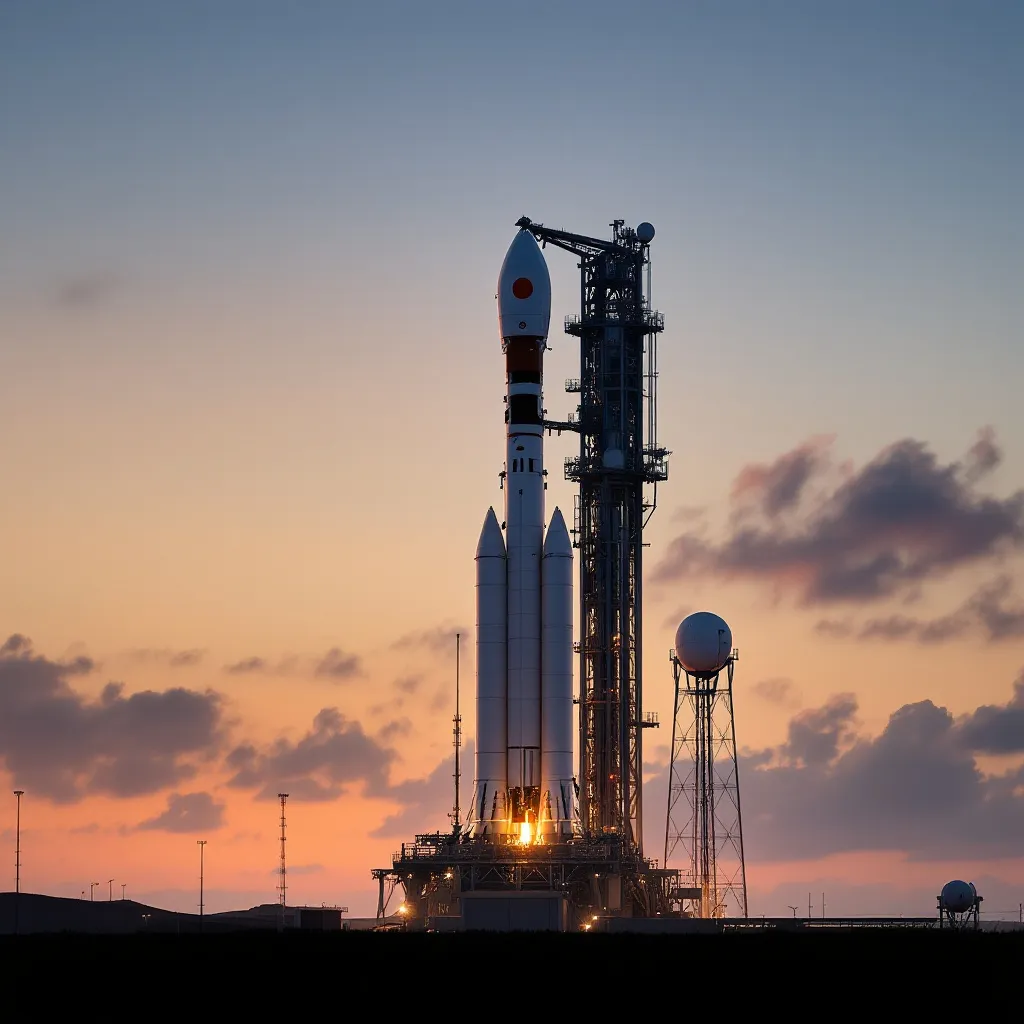
Japan has confirmed October 20, 2026, as the launch date for its Martian Moons eXploration (MMX) spacecraft, setting the stage for one of the most ambitious robotic planetary missions yet attempted by the Japan Aerospace Exploration Agency (JAXA).
The MMX spacecraft is scheduled to lift off aboard Japan’s H3 rocket at 4:41 a.m. Japan Standard Time from the Tanegashima Space Center. The mission is designed to travel to Mars, investigate both of the planet’s moons, Phobos and Deimos, land on Phobos, collect at least 10 grams of surface material and eventually return those samples to Earth in 2031.
If successful, MMX would become the world’s first mission to return samples from the Martian system. It could also resolve a long-standing question in planetary science: whether Phobos and Deimos are captured asteroids or formed from material ejected by a major impact on Mars.
The mission is led by JAXA and includes major contributions from NASA, the European Space Agency (ESA), France’s CNES and Germany’s DLR, alongside universities and industrial partners.

The propulsion module (back) and exploration and return modules (front), making up the Martian Moons eXploration (MMX) spacecraft, at the Tanegashima Space Center in Minamitane, Kagoshima Prefecture, on Aug. 13. | AFP-JIJI
October 20 Launch Opens a Five-Year Mission
JAXA’s newly confirmed launch time is 4:41 a.m. JST on October 20, 2026. The H3 rocket will carry MMX into space from the Tanegashima Space Center in southern Japan.
The launch is only the beginning of a mission expected to last roughly five years. MMX is scheduled to reach the Martian system in 2027 after a journey of approximately one year. Rather than immediately attempting a landing, the spacecraft will spend an extended period studying the Mars system and maneuvering around Phobos.
From 2027 through 2030, MMX is expected to conduct detailed observations of Phobos and Deimos while preparing for its most technically demanding operation: landing on Phobos and acquiring samples.
The spacecraft will subsequently depart the Martian system in 2030 and begin its return journey to Earth. The mission plan calls for the sample-return capsule to separate from the spacecraft in 2031 and enter Earth’s atmosphere before recovery in Australia.
That sequence is important because MMX is not simply a Mars-orbiting science mission. Its defining objective is to complete an interplanetary round trip while carrying material collected from another world.
Why Phobos Matters to Planetary Scientists
Phobos is a small, irregularly shaped moon located extremely close to Mars. Unlike Earth’s comparatively large and distant Moon, Phobos orbits only thousands of kilometers above the Martian surface and travels around Mars in less than eight hours.
Its unusual characteristics have produced two competing explanations for its origin.
One possibility is that Phobos is a captured asteroid. Under this scenario, the moon formed elsewhere in the Solar System and was subsequently trapped by Mars’s gravity.
The second possibility is that Phobos formed from debris generated by a massive impact on Mars early in the planet’s history. Material blasted into orbit could have gradually accumulated into a moon.
Remote observations have not conclusively resolved the question. Phobos has some characteristics consistent with primitive asteroid material, while its orbit and other properties have also supported scenarios involving material originating from Mars.
MMX is designed to address the problem with a combination of remote sensing and laboratory analysis of returned material.
That distinction is significant. Spacecraft instruments can measure the composition and physical properties of a distant body, but laboratories on Earth can apply much more sophisticated analytical equipment to tiny samples. Scientists can examine mineral structures, elemental and isotopic compositions and other characteristics at levels of detail that are difficult or impossible to achieve with a spacecraft operating millions of kilometers away.
MMX Will Study Both Martian Moons
Although Phobos is the mission’s sample-return target, MMX is designed as a broader investigation of the Martian satellite system.
The spacecraft will observe Deimos, the smaller and more distant of Mars’s two moons, but it will not land there. Comparing observations of Deimos with measurements from Phobos could help scientists determine whether the two bodies share a common origin.
MMX will also study the broader Martian environment. Understanding the moons is closely connected to understanding the evolution of Mars itself, because material on Phobos may preserve evidence from the early history of the Martian system.
JAXA’s mission objectives therefore extend beyond determining where the moons came from. The spacecraft is also intended to investigate the evolution of Mars and the processes that influenced the distribution of water and organic materials in the early Solar System.
Landing on Phobos Is a Major Engineering Challenge
The landing operation is among the most technically difficult elements of MMX.
Phobos has extremely weak gravity. A spacecraft approaching its surface cannot rely on the same landing dynamics used on a much larger planetary body. A small error in velocity or attitude could cause the spacecraft to rebound from the surface rather than settle safely.
MMX is consequently being designed around detailed orbital navigation, surface mapping and autonomous or precisely controlled operations near the moon.
A small rover called IDEFIX will play an important role. Developed through European cooperation involving CNES and DLR, the rover is intended to operate on the surface of Phobos and conduct close-range observations.
Before the main spacecraft performs its sample collection operations, IDEFIX will provide valuable information about the surface environment and help characterize terrain that cannot be fully understood from orbit.
The mission therefore combines several different forms of exploration: orbital reconnaissance, surface mobility, precision landing and sample acquisition.
Two Sampling Systems Add Redundancy
MMX incorporates two different mechanisms for acquiring material from Phobos.
The C-Sampler is designed to obtain subsurface material using a coring mechanism capable of reaching approximately 2 centimeters below the surface. This provides an opportunity to collect material that is less exposed to the space environment than loose surface grains.
The spacecraft also carries the P-Sampler, a pneumatic sampling system contributed by NASA. The system uses pressurized gas to disturb and collect surface material rapidly.
Using different sampling approaches provides an important advantage for a mission operating so far from Earth. The goal is not simply to collect a predetermined amount of dust but to maximize the scientific value and reliability of the sample-return effort.
The combined mission target is at least 10 grams of Phobos material. That may sound modest compared with terrestrial geological sampling, but even a small quantity of extraterrestrial material can support extensive laboratory investigations.
NASA and European Partners Expand the Mission’s Scientific Reach
MMX is a Japanese-led mission, but its scientific architecture reflects the increasingly international nature of deep-space exploration.
NASA is contributing the MEGANE instrument, which will measure gamma rays and neutrons emitted from Phobos. These measurements can help determine the elemental composition of the moon’s surface and provide another line of evidence concerning its origin.
The European contribution is particularly visible through IDEFIX. CNES and DLR are working on the rover and its scientific instruments, including systems intended to characterize the surface and the interaction between its wheels and the unusual Phobos terrain.
This international structure also spreads technical risk and allows different agencies to contribute instruments and expertise developed through their own planetary exploration programs.
For Japan, MMX represents an extension of capabilities demonstrated by the country’s earlier asteroid sample-return missions.
Hayabusa2 Provides a Critical Precedent
Japan has already established itself as a leader in asteroid sample return through the Hayabusa and Hayabusa2 programs.
Hayabusa2 successfully reached asteroid Ryugu, collected samples from its surface and subsurface and returned them to Earth in December 2020. The mission demonstrated that Japan could perform autonomous operations around a small body, conduct a controlled surface interaction and safely return extraterrestrial material.
MMX builds on that heritage but introduces a much more complicated environment.
Ryugu is an asteroid traveling around the Sun, while Phobos is deeply embedded in Mars’s gravitational field. MMX must navigate not only the spacecraft-to-Phobos relationship but also the interaction between Phobos and Mars.
The mission must therefore demonstrate technologies for operating within the Martian gravitational environment, reaching a moon, landing on it, collecting material and then escaping from the Mars system with the samples intact.
In that sense, MMX is both a planetary science mission and an engineering bridge between asteroid exploration and future Mars exploration.
The Mission Could Shape Future Mars Exploration
The importance of MMX extends beyond the scientific question of Phobos’s origin.
JAXA has identified technologies for round-trip travel between Earth and the Martian system as an important engineering objective. The mission will therefore provide practical experience with deep-space navigation, communications, surface operations and sample handling in the Mars environment.
Phobos itself has sometimes been considered as a potential staging location for future Mars exploration. A spacecraft operating from or near Phobos could theoretically use the moon as an intermediate point for missions into the Martian environment, although turning that concept into an operational infrastructure would require major advances in propulsion, power, logistics and surface operations.
MMX will not establish such an outpost. Its importance is that it will test several of the fundamental capabilities required to operate around a small body in the Martian system.
That makes the mission relevant to the longer-term evolution of robotic Mars exploration, even though its immediate objective is scientific sample return.
A Rare Sample-Return Opportunity in the Mars System
The October launch date also places MMX within a broader expansion of international activity around Mars and small bodies.
NASA’s Perseverance rover is already collecting samples on the Martian surface, while other spacecraft continue to study Mars from orbit. MMX approaches the problem from a different direction by targeting Phobos, potentially obtaining material that contains information about the moon itself as well as material transported from Mars.
This distinction could make the returned samples particularly valuable.
If Phobos formed from Martian impact debris, its material could preserve clues about ancient Mars that are difficult to obtain from the modern surface. If it is instead a captured asteroid, the samples could provide a rare window into primitive material from a different region of the early Solar System.
Either result would significantly improve understanding of how the Martian system evolved.
What Comes After the October Launch
The October 20 launch should therefore be viewed as the first milestone in a much longer sequence rather than the culmination of the mission.
After liftoff, MMX must complete its roughly one-year cruise to Mars. It will then enter the Martian environment and begin detailed observations of Phobos and Deimos. The mission is expected to remain in the Mars system for about three years, with surface operations and sample collection forming its central phase.
The spacecraft is scheduled to depart Mars in 2030 before returning toward Earth. In 2031, the sample-return capsule is expected to separate and make its atmospheric entry, with recovery planned in Australia.
Every one of those stages has to succeed for MMX to achieve its defining objective.
The October 20 launch confirmation is consequently more than a calendar milestone for Japan’s space program. It marks the transition of a decade-long planetary exploration effort toward its most demanding phase: leaving Earth, reaching Mars, operating around a tiny moon, collecting extraterrestrial material and bringing it home.
If MMX completes that sequence, Japan will add another major achievement to its sample-return record while providing scientists with the first deliberately collected material from the Martian system. The resulting samples could finally help determine whether Phobos and Deimos are remnants of Mars’s violent early history or visitors captured from elsewhere in the Solar System.