China’s commercial space industry is entering a phase of rapid development. However, to truly understand where the sector is heading, several underlying factors need to be recognized in advance.
1. Commercial Space Has Become an Industry China “Must” Develop
From a broader perspective, one undeniable reality is that global commercial space innovation is, to a certain extent, continuing along the technological path opened by Elon Musk and SpaceX. At least in the near term, the industry is unlikely to completely move away from this trajectory.
Musk’s greatest contribution is not a single technological breakthrough, but rather his ability to redefine rocket engineering as an industrial manufacturing challenge based on first principles.
Today, almost all next-generation launch vehicles under development worldwide are converging toward several common characteristics: larger diameters, higher efficiency, and reusable architectures. Within the physical and material constraints that define the feasible engineering space, there is currently no equally efficient alternative path. This is not a matter of technological worship, but rather an example of convergent evolution driven by engineering realities.
Looking at the issue through the lens of global geopolitical competition and industrial rivalry reveals an even harsher reality: every major technological breakthrough achieved by Musk is redefining the baseline standard for what it means to be “behind.”
As long as SpaceX continues advancing, other countries have little choice but to respond.
This “following” is not necessarily an active strategic preference, but rather a defensive reaction to changing technological realities.
For China and Russia, if Starship eventually becomes a foundation of U.S. space capabilities while their own countries lack comparable heavy-lift reusable launch systems, they could lose critical leverage in future competition over space resources and strategic capabilities.
Therefore, China’s development of projects such as the Long March 9 heavy-lift rocket and reusable launch technologies is not simply about missions to Mars. It is about preventing a technological gap from emerging in a strategically important domain.
Musk’s progress has effectively raised a technological flag in space: countries that fail to keep pace risk losing their position at the future table of space resource allocation.
But this is only the more visible layer of the issue.
The deeper impact lies in the possibility that SpaceX could shape the worldview of the next generation of aerospace engineers. This may be the most consequential factor.
The most talented young minds today will define the technological ceiling of tomorrow. If their imagination becomes dominated by Musk’s vision alone, China’s aerospace industry could remain trapped in a follower position rather than becoming an original source of innovation, because its technological inspiration would be imported rather than internally generated.
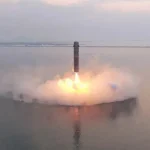
Consider an 18-year-old high school student who watches videos of SpaceX catching Starship’s booster with launch tower arms and thinks: “This is the future.”
He chooses aerospace engineering as his major. During four years of university education, the most advanced examples he encounters are almost entirely from SpaceX. His graduate research focuses on Starship-related technologies. Over time, his mental model of aerospace innovation naturally begins to take the shape of Musk’s approach.
Ten years later, when he becomes a core engineer, he may instinctively believe that “doing things like SpaceX” is the only correct path.
Without China’s own ambitious technological narrative, some of its most creative young talent could psychologically become followers of Musk’s path rather than original innovators for China’s aerospace sector.
Therefore, countries are compelled to pursue similar ambitions—not simply to reach Mars, but to anchor the imagination of their young engineers within their own national technological visions. This will become the foundation of future innovation.
The same logic applies to venture capital.
If investors see SpaceX leading the industry, they may increasingly focus on funding Chinese companies that resemble SpaceX rather than supporting entirely new directions. This could unintentionally lock the industry into imitation rather than exploration.
A closer look suggests this is no longer merely a theoretical possibility—it is already happening.
Ultimately, the conclusion is simple:
Commercial space has become an industry that China cannot afford not to develop.
2. Aerospace Entrepreneurship Looks Glamorous, but the Reality Is Extremely Difficult
If entrepreneurs enter commercial space purely for financial returns, it is extremely difficult to survive.
The industry operates on very long timelines. It may take five, ten, or even more years for a company to move from technology validation to stable mass-market demand and large-scale commercial orders.
During this process, companies must overcome numerous complex challenges.
The first challenge is the transformation of mindset and role.
Many Chinese commercial space entrepreneurs today come from the traditional aerospace sector. They often have impressive technical backgrounds, and investors naturally prefer founders with such experience.
Without this background, raising initial capital can be extremely difficult.
However, the research environment of traditional aerospace institutions and the commercial world are fundamentally different.
In state-led research programs, the primary focus is often technological capability and performance excellence—achieving the best possible technical outcome.
In commercial markets, however, understanding customer needs and delivering solutions that customers are willing to pay for become the highest priorities.
A government research project can focus primarily on technical achievement. A commercial product must also consider cost, pricing strategy, and profitability.
Only profitable business models can sustain long-term operations.
Excellent technology is important, but in the early stages of an industry, the companies that build sustainable revenue structures fastest will gain greater bargaining power and strategic control.
Balancing these competing priorities requires exceptional adaptability from founders.
As companies mature, competition is no longer only about technology. It also depends on the founder’s ability to evolve—management capability, strategic judgment, resilience, and long-term vision must all improve simultaneously.
The process of becoming a successful aerospace entrepreneur involves challenges that only those inside the industry truly understand.
The second challenge is continuous capital requirements.
In many industries, funding shortages may simply result in slower growth, business contraction, or temporary layoffs.
In aerospace, however, a financial breakdown can lead to irreversible collapse.
The first impact is often the breakdown of supply-chain trust.
Space-grade components and specialized materials are frequently customized. Once payments stop, not only do current projects face delays, but restarting the supply chain later can involve significantly higher negotiation costs and premiums.
The next challenge is talent retention.
Aerospace expertise requires years of accumulated project experience. When funding cannot support future development, much of the engineering knowledge accumulated within a company can quickly disappear as key personnel leave.
Finally, aerospace is not an industry that can be built simply by assembling a group of engineers.
The difficulty of aerospace development does not come from a single extremely advanced technology. Instead, it comes from the exponential complexity created by system-level integration.
Successful development requires deep engineering expertise and strong cross-disciplinary collaboration.
However, during the early growth phase of commercial space, most engineers with complete spacecraft and launch vehicle development experience remain concentrated within traditional state aerospace organizations.
Talent movement from these institutions faces multiple constraints, including employment structures, project attachment, and security management requirements.
Those willing and able to enter commercial companies are relatively limited.
Even when they do move, they often leave individually rather than as complete engineering teams.
Yet a capable aerospace engineer requires years of hands-on project experience. This is not simply a matter of transferring knowledge—it is the cultivation of engineering intuition through repeated testing, troubleshooting, and failure analysis.
Universities cannot fully replace this process, and short-term training programs are even less effective.
This creates a fundamental contradiction:
The commercial space industry is expanding rapidly, but the growth curve of experienced aerospace talent remains almost flat.
Meanwhile, as the commercial space window opens, competitive pressure is increasing dramatically.
This pressure does not spread evenly across an organization. Instead, it directly challenges management capability.
External competition demands speed.
The fundamental laws of aerospace engineering demand caution.
When investors and public expectations measure aerospace progress using internet-era timelines, management teams are forced into constant trade-offs between schedule acceleration and reliability assurance.
This tension eventually reaches frontline engineers.
When engineers receive not a discussion such as “please evaluate whether this schedule can be shortened,” but rather an implicit message of “the schedule is critical, find a way,” their perception of acceptable engineering risk can gradually shift.
By the time problems become visible, the cost of correction may have multiplied several times.
At the same time, competitors will continue seeking opportunities to recruit experienced engineers, especially during difficult moments such as failed tests, delayed projects, or financing challenges.
Companies must constantly pay the double cost of retaining existing talent while replacing those who leave.
Each cycle places additional pressure on their ability to survive.
3. The Aerospace Supply Chain Has Extremely Strong Interdependence
The aerospace industry has unusually strong relationships between upstream suppliers and downstream manufacturers.
Technology validation cycles are long, while investments in manpower, equipment, and capital are substantial.
The efficiency of product finalization and the maturity of mass-produced systems depend heavily on coordination between partners and shared industry knowledge.
As a result, aerospace supply chains develop unusually strong relationships.
On one hand, when upstream production capacity becomes constrained or supply disruptions occur, strong supplier relationships allow companies to secure critical components more reliably, ensuring continuity and stability of their own projects.
This is extremely valuable in a commercial environment.
On the other hand, long-term and large-scale cooperation improves bargaining power and delivery efficiency.
Suppliers gain predictable demand, while customers receive more competitive pricing and shorter delivery cycles.
Therefore, as the industry matures, the importance of industrial networks and trusted partnerships will become increasingly visible.
A closer examination of recent developments already shows this trend emerging.
This is not simply about informal relationships—it reflects the creation of stable, efficient, and collaborative industrial ecosystems built on long-term trust and mutual benefit.
Furthermore, as leading commercial space companies enter a new stage of growth, increasing production capacity and expanding business scale will inevitably lead to industrial consolidation.
The purpose of this consolidation will not merely be to create larger companies.
More importantly, it will aim to strengthen product delivery capabilities, shorten development cycles, reduce costs, and improve overall efficiency.
In summary, China’s commercial space sector is not simply entering a period of technological competition. It is entering a long-term industrial transformation process involving technology, capital, talent, supply chains, and strategic vision.