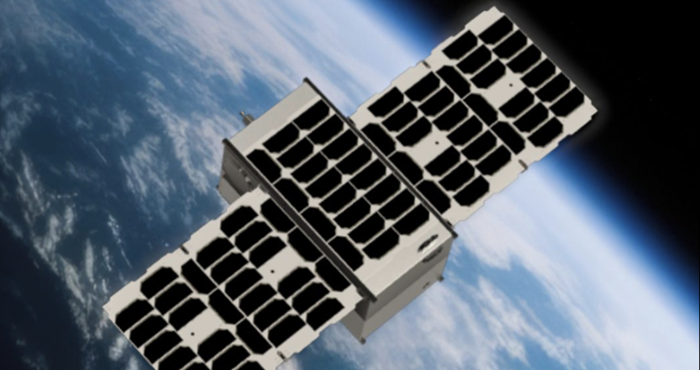
During the 2026 Space Weather Workshop, Mission Space announced that it will fly the fourth in-orbit space weather payload on HEX20’s MAYA-V1 mission, a 16U-class LEO hosted-payload platform designed for in-orbit validation of new space technologies. MAYA-V1 is part of HEX20’s Multi-Application Yearly Assimilated Vehicle mission series, built on the company’s NX spacecraft bus. The platform is designed to support multiple hosted payloads across science, security, propulsion and in-orbit system validation, with a mission life exceeding one year.
The HEX20 mission adds to Mission Space’s expanding in-orbit roadmap, following its ZOHAR-I pathfinder mission and upcoming payloads with Starcloud and Rogue Space. Together, these missions support Mission Space’s plan to build a multi-point, high-temporal-resolution measurement layer for radiation, charged particles, neutral density and surface-charging intelligence.
Mary Glaz, CEO of Mission Space: We are seeing growing interest in real-time, in-situ space-weather data from LEO. Mission Space is building a constellation of compact, 1 kg payloads to close that data gap by measuring the charged-particle environment directly from orbit and turning those measurements into localized warnings, forecasts, modeled outputs and validated data for specific missions. HEX20’s MAYA-V1 gives us another operational data point in orbit and brings us closer to deploying that distributed measurement network.
Amal Chandran, CEO of HEX20: MAYA-V1 was designed to give advanced payloads a practical route to in-orbit validation. Mission Space’s payload fits directly into that purpose: it brings operational space-weather sensing into orbit and supports the kind of environmental intelligence future missions will require. We are pleased to host Mission Space on MAYA-V1 as part of our first cohort of mission partners.