NASA’s Deep Space Station 23 began operations on Aug. 3, 2026, at the Goldstone Deep Space Communications Complex near Barstow, California, adding a 34-meter antenna to its heavily subscribed Deep Space Network. Its first operational contact tracked the Chandra X-ray Observatory, following a testing campaign from May through July.
NASA marked the antenna’s completion with an Aug. 25 ribbon-cutting ceremony. Construction began in February 2020, and crews installed the 133-ton reflector framework in December 2024 before adding reflective panels and calibrating the system. DSS-23 has since communicated with spacecraft including Mars Reconnaissance Orbiter, Psyche, Juno and Voyager 1.
The DSN supports more than 40 spacecraft, including Voyager 1, Voyager 2 and New Horizons, through complexes at Goldstone, near Madrid, Spain, and near Canberra, Australia. Each site combines a 70-meter antenna with smaller dishes.
The expansion comes as lunar exploration places additional demands on infrastructure shared by human and robotic missions. Artemis I in 2022 and the crewed Artemis II mission in 2026 received priority during their journeys around the Moon, reducing capacity available to other spacecraft. DSN managers had warned by 2021 that antenna additions were failing to keep pace with demand.
The network’s history extends to tracking stations JPL established in Nigeria, Singapore and California in 1958. Formally established in December 1963, the DSN supported Apollo 11’s July 20, 1969, moonwalk, Mars rover imagery beginning in the 1990s and measurements confirming the Voyagers’ entry into interstellar space.

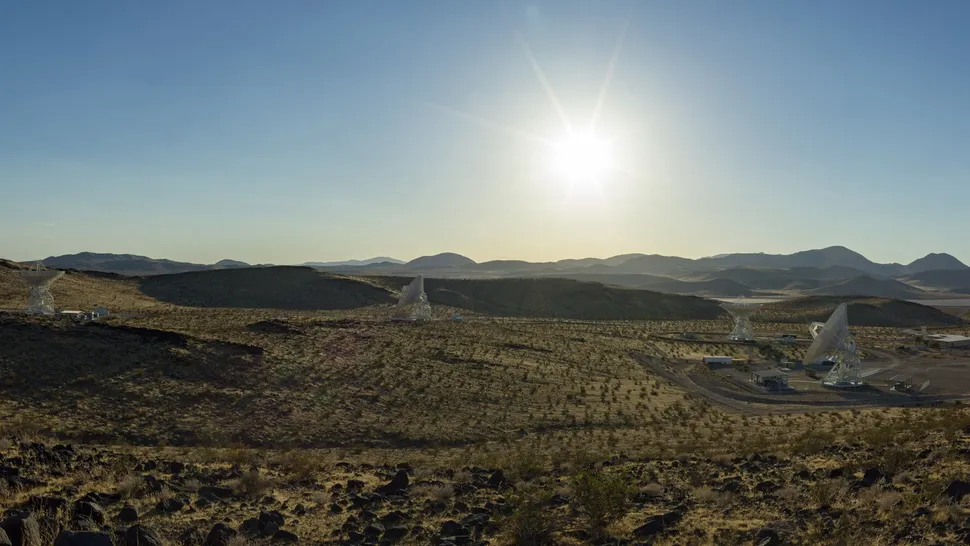
The recently completed Deep Space Station 23 at the Deep Space Network’s Goldstone complex near Barstow, California. (Image credit: NASA/JPL-Caltech)
DSS-23 uses a multifrequency beam-waveguide design that routes signals to electronics in a climate-controlled underground room. Keeping sensitive equipment off the moving dish improves maintenance and upgrade access. It joins three other 34-meter antennas and one 70-meter antenna at Goldstone.
NASA also plans to combine signals from smaller antennas to back up the aging 70-meter dishes. DSS-23 is the fifth of six antennas under the Aperture Enhancement Project, which began in 2009.
Additional capacity addresses a documented scheduling constraint. NASA’s Office of Inspector General reported that demand exceeded available DSN support by as much as 40% at times. Artemis I alone required more than 900 hours of support over 25 days. Human spaceflight receives safety-based priority, while other mission teams negotiate access months in advance. Reduced tracking allocations can delay commands and science downloads and potentially cause data loss.
The expansion has also faced cost increases and delays. A 2015 inspector general audit described a $362.4 million plan covering new antennas and transmitters through fiscal 2025. A later watchdog assessment put expected costs at $706 million at the start of fiscal 2023, with the project nearly five years behind schedule. These figures describe the wider enhancement effort, rather than DSS-23 alone.
The next milestone is commissioning DSS-33 at Canberra in 2029. NASA expects that antenna to complete the enhancement project and bring the network’s total number of 34-meter antennas to 13.