In February 2025, a piece of news shocked the global aerospace community: The National Aeronautics and Space Administration (NASA) may terminate its “Space Launch System” (SLS) heavy-lift rocket project, and Boeing, as the main contractor, has begun preparing to lay off 400 people.
01
SLS “Death Countdown”: Why did NASA cut off its arm?
From a “national asset” with high hopes of “returning to the moon” to a “fiscal black hole” that everyone abandons like worn-out shoes? Behind the cancellation of SLS is the triple strangulation of technology, cost and time.
1. Technological patchwork: the aging “space shuttle legacy”
The SLS rocket has been labeled as a “technological stitch monster” since its inception. Its core engine, the RS-25, was directly inherited from the space shuttle era. It was designed for reuse, but was forcibly transformed into a one-time use, resulting in a low thrust-to-weight ratio and a waste of redundant mass. What’s even more ironic is that early launches of SLS even directly used retired space shuttle inventory engines.
(Picture: Three RS-25 engines carried by the space shuttle. Source: NASA)
SLS’s welding process, fuel leakage and other structural problems have caused repeated delays in the project. From the initial planned first flight in 2017 to the launch of the Artemis 1 mission at the end of 2022, SLS has experienced at least 16 delays, including hydrogen fuel leaks. NASA’s original plan of “low-cost and rapid implementation” has completely come to nothing.
2. Costs are out of control: a single launch of the “Gold-Eating Beast” costs US$2 billion.
SLS’s financial collapse is a textbook case. The initial budget of the project was US$400 million for a single launch, but now this figure has soared to more than US$2 billion. If the payload and ground system are included, the total cost is even as high as US$4 billion.
(Picture: Heavy rocket development costs
mapping:
hello space
)
What is even more shocking is that the total cost of SLS development has exceeded US$26.4 billion, far exceeding the US$6.4 billion of the Saturn V (about US$15 billion today after accounting for inflation). NASA’s auditor general said bluntly: “SLS’s budget management is disastrous.”
3. Abandoned by the times: When the “national team” meets the “starship revolution”
The fatal blow suffered by SLS was the dimensionality reduction blow from commercial aerospace.
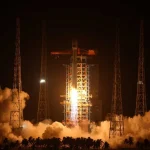
(Picture: SLS on the launch pad
Source: NASA
)
After the first test flight of SpaceX’s “Starship” in 2023, it achieved key technological breakthroughs such as chopstick-clip rocket recovery in just two years. Its low-Earth orbit transport capacity reaches 150 tons (far exceeding SLS’s 95 tons), and it can be fully reused. The target launch cost is only US$28 million, which is 1/70 of the cost of a single launch of SLS.
While NASA is still struggling with the delay of SLS, SpaceX has used actual results to prove that cheap, efficient, and sustainable space transportation is no longer a fantasy.
02
Commercial aerospace disrupted”
Traditional aerospace
”
Boeing’s woes don’t end with SLS.
From the frequent malfunctions of the manned spacecraft “Starliner” to the disintegration of satellites in orbit and the wave of aviation manufacturing strikes, this century-old giant is experiencing a “systemic collapse.”
Behind it is the fierce collision between the traditional military-industrial complex model and commercial aerospace logic.
1. Starliner: A “Failed Experiment” Worth $1.4 Billion
Boeing and SpaceX were selected by NASA to develop manned spacecraft at the same time, but their fates were completely opposite. Since 2019, the “Starliner” has experienced a series of accidents such as propellant valve leaks, software failures, and docking failures, resulting in cumulative losses of US$1.4 billion, while SpaceX’s “Manned Dragon” spacecraft has stably performed more than ten missions.
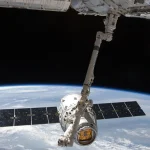
(Picture: Starliner approaching the International Space Station
Source: Boeing
)
In June 2024, the first manned flight of “Starliner” encountered another accident: helium leaked after liftoff and the attitude locked. The two crew members are still trapped on the International Space Station. This farce completely ended Boeing’s credibility in the field of manned spaceflight.
2. The tragedy of the system: bureaucracy and lack of innovation
The essence of Boeing’s decline is the collapse of the system. As a “quasi-state-owned enterprise”, its decision-making chain is lengthy, technically conservative, and risk-averse:
Technology path dependence: Both SLS and “Starliner” excessively use old technologies and lack disruptive innovation;
Quality control is out of control: the disintegration of satellites and the 737MAX crash exposed the failure of supervision in the production process;
Labor conflicts intensify: Continuing strikes have led to the suspension of passenger aircraft production, with losses reaching US$8 billion in 2024.
(Picture: Starship first-level super-heavy booster transferred to the star base launch pad Source:
SpaceX
)
Looking back at SpaceX, its “Silicon Valley DNA” of flat management and rapid iteration has completely rewritten the rules of the game.For example, “Starship” uses radical stainless steel materials and full-flow staged combustion engines. These solutions were once ridiculed by traditional manufacturers, but ultimately won out with low cost and high reliability.
3. Business model: from “cost plus” to “fixed price”
Traditional aerospace projects mostly use “cost-plus contracts” (that is, cost overruns are covered by the government), which directly caused SLS’s budget to get out of control. NASA’s “fixed-price contract” for commercial aerospace requires companies to bear their own risks – SpaceX even mortgaged company assets in order to obtain the contract. This kind of “life and death” pressure forces commercial companies to cut costs and improve efficiency to the extreme.
03
Business reshapes space rules
The victory of commercial aerospace is no accident. It represents the rise of a new scientific research paradigm:
1. From “national glory” to “market driven”
(Picture: SLS rocket on the launch pad Source:
NASA
)
Technological progress in the Apollo era relied on the political thrust of the Cold War, while commercial aerospace anchored demand in sustainable market logic: satellite Internet, space tourism, lunar resource development… SpaceX’s Starlink program has launched more than 7,000 satellites and generated US$6.6 billion in revenue every year. This self-generating ability is difficult to achieve by traditional projects.
2. From “closed monopoly” to “open ecology”
(Picture: The Orion spacecraft of the Artemis 2 mission Source:
NASA
)
The traditional system represented by Boeing is highly dependent on government orders and forms a closed supply chain. Commercial aerospace activates the innovation ecosystem through open source technology and competitive procurement (such as NASA bidding to multiple private companies). For example, the rise of new players such as Blue Origin and Rocket Lab has transformed the aerospace industry from an “oligopoly game” to a “national competition.”
3. From “safety first” to “risk tolerance”
(Picture: The SLS booster used by the Artemis 2 mission is being assembled. Source:
NASA
)
NASA has postponed SLS launches many times due to safety concerns, while SpaceX believes in “rapid trial and error” – the “Starship” test exploded 12 times before and after, but key issues were solved in each iteration. The essence of this cultural difference is the redefinition of the value of “failure”.
04
How can China Aerospace overcome the “Boeing Trap”?
Boeing’s lessons are equally profound for China:
Be wary of technical path dependencies:
The failure of SLS proves that simply stacking traditional technologies cannot meet the challenges of the new era;
Embrace the power of business:
Companies such as Blue Arrow Aerospace and Interstellar Glory have emerged in China, and it is necessary to further improve launch infrastructure and build a business path suitable for the Chinese system.
Reconstruct the incentive mechanism:
Promote the collaboration between the “national team” and private enterprises to establish an innovative consortium that shares risks and benefits.
Conclusion
The final chapter of SLS symbolizes the end of an era.
While Boeing struggles with layoffs and strikes, SpaceX is preparing its first commercial lunar base.
Behind this change of power is the dimensionality reduction attack of the rigid system by commercial forces, and it is also the inevitable transition of human aerospace from “national narrative” to “star market”.
Perhaps only by breaking monopoly and embracing change can aerospace truly become a journey that belongs to all mankind.
Find the commercial space sector
“Startup”
We will gradually launch
commercial aerospace startups,
The company with the most investment potential and innovation
We welcome start-ups or companies with financing needs to contact us.
Through Nihao Space, you can reach hundreds of top investment institutions, tens of thousands of industry experts and technical talents for free.
if
You or the companies you have worked with