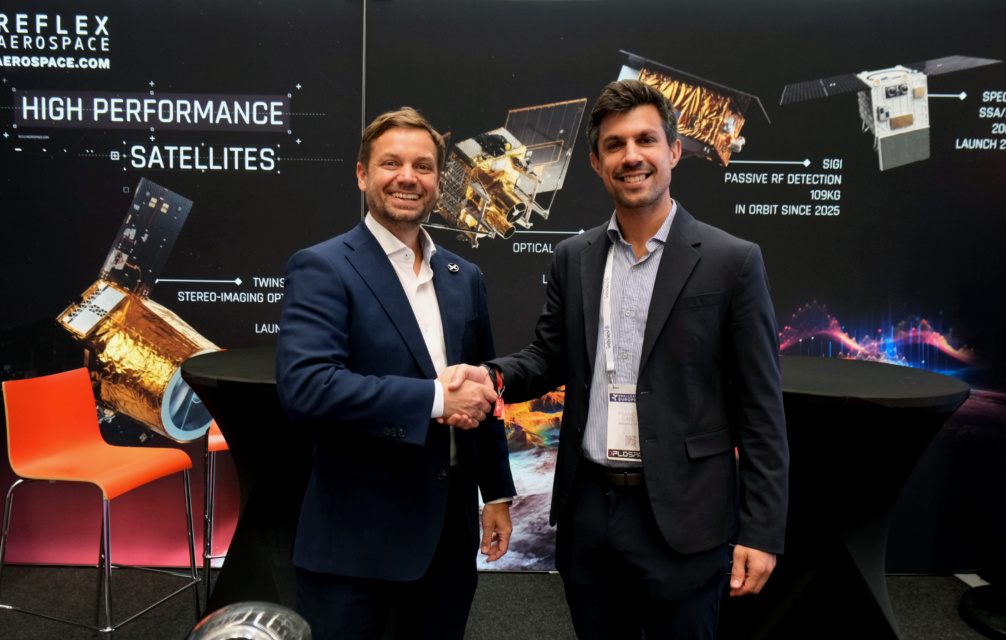
German satellite manufacturer Reflex Aerospace has selected Spanish startup Arkadia Space to provide the propulsion system for a commercial satellite mission scheduled to launch in 2027, marking the first time Reflex will deploy a chemical-propulsion system on one of its spacecraft.
Under the agreement, Reflex’s 200-kilogram satellite will use Arkadia Space’s Triton 5N monopropellant engine for in-orbit maneuvers and end-of-life deorbiting operations. The satellite is currently slated to launch aboard SpaceX’s Transporter-20 rideshare mission, with liftoff targeted for the second quarter of 2027.
According to the companies, Reflex selected Arkadia largely because of its ability to rapidly manufacture and integrate propulsion hardware while offering a European, ITAR-free supply chain. The agreement also highlights growing demand among European space companies for locally sourced technologies that reduce reliance on foreign suppliers.
“As a European and ITAR-free supplier with demonstrated in-orbit heritage, Arkadia Space enables us to move quickly while maintaining high technical standards and supply-chain independence,” said Walter Ballheimer, chief executive of Reflex Aerospace.
“The short lead time and flexibility of their system are key enablers for our ambitious development timeline.”
The mission will represent a significant commercial milestone for Arkadia Space, as it will be the first time the company’s propulsion technology has been selected for a commercial satellite program. The Triton engine is derived from the company’s DARK demonstrator propulsion system, which successfully flew on a technology demonstration mission with D-Orbit in 2025.
Unlike conventional satellite propulsion systems that often rely on hydrazine, a highly toxic propellant widely used in the space industry, Arkadia’s systems utilize hydrogen peroxide as a greener alternative. The company says the approach can significantly reduce fueling costs and operational complexity during spacecraft integration and launch preparations.
While hydrogen peroxide offers environmental and handling advantages, it has traditionally faced challenges related to long-term storage and degradation in space. Arkadia says it has developed solutions that allow the propellant to support multi-year satellite missions while maintaining performance and reliability.
The Reflex mission is expected to serve as an important demonstration of the technology’s commercial viability and could help position Arkadia as an alternative supplier in the growing market for satellite propulsion systems.
The company has already expanded beyond satellite applications. In February 2025, Arkadia announced an agreement with French launch vehicle developer MaiaSpace to supply 250-newton thrusters for the reaction-control system of its rocket. Two months later, the company revealed a partnership with Dassault Aviation to integrate similar propulsion technology into the VORTEX subscale demonstrator program, which is expected to conduct its first flight as early as 2028.
Looking ahead, Arkadia plans to develop more powerful bipropellant propulsion systems aimed at larger spacecraft and future exploration missions, including potential lunar landers.
The Reflex contract provides another step toward that goal while giving the German satellite manufacturer a propulsion solution capable of supporting orbital operations and responsible spacecraft disposal at the end of the mission’s operational life.