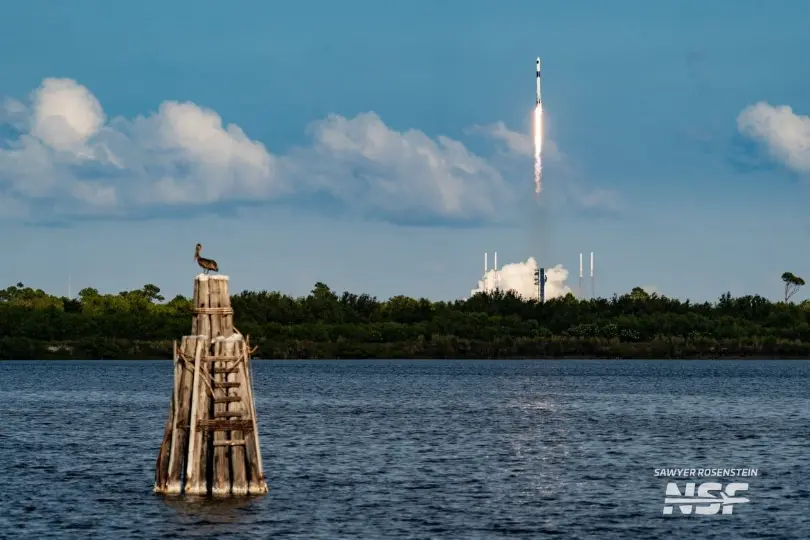
Just over two weeks after Progress MS-34 docked to the Station, the ISS is set to receive a new visiting vehicle loaded with cargo. A SpaceX Falcon 9 successfully launched the CRS-34 cargo mission to ISS on Friday, May 15 at 6:05 PM EDT (22:05 UTC) from Space Launch Complex 40 (SLC-40) at the Cape Canaveral Space Force Station (CCSFS) in Florida.
CRS-34 had originally been scheduled to launch on Tuesday, May 12 at 7:16 PM EDT (23:16 UTC), but the weather forecast had a 65% probability of violation of launch criteria from the start. The weather became such that SpaceX and NASA pushed the flight back to the following day.
A backup window was available on Wednesday, May 13, at 6:50 PM EDT (22:50 UTC), and became the primary target. The weather forecast degraded to 10% favorable, but the trend went in the right direction as the countdown proceeded to past the T-1:00 point. At that point the forecast went to 95% favorable, but SpaceX scrubbed the launch around the T-30 second mark due to a violation of the cumulus cloud rule.
Falcon booster B1096, flying on its sixth mission, launched on a northeast trajectory and conducted a successful return-to-launch-site with a landing at Landing Zone 40 (LZ-40), located directly adjacent to SLC-40.
Cargo Dragon C209 was launched into a 51.6-degree orbit to match the International Space Station’s (ISS) orbit, and the cargo ship will take roughly 38 hours to reach ISS. Docking is now set for Sunday, May 17 at 11:05 UTC. C209 will dock to the Harmony module’s forward port.
See Also
- CRS-34 Updates
- ISS Section
- NSF Store
- Click here to Join L2
B1096 started its career with the Amazon Leo (formerly Kuiper) KF-01 flight, and also launched the IMAP, Starlink Group 6-87, NROL-77, and GPS III SV09 missions. Dragon C209 is also making its sixth flight, having first launched to the Station on CRS-22 in June 2021. This Cargo Dragon has also visited ISS during the CRS-24, CRS-27, CRS-30, and CRS-32 missions.
Spaceflight news subscription
(adsbygoogle = window.adsbygoogle || []).push({});
Cargo Dragon is carrying around 2,948 kg of supplies to the ISS, including a variety of food, equipment, and experiments. There have been more than 4,000 experiments aboard the Station over its 25 year lifespan, conducted by scientists from 110 countries, and there are 831 kg of experiments aboard C209 for CRS-34.
The Outcomes of microbial Dynamics during Spaceflight and in SimulatEd microgravity (ODYSSEY) experiment is designed to test the fidelity of microgravity simulators on Earth by comparing them to actual behavior of two species of bacteria in space. ODYSSEY will evaluate biofilm formation and exchange of genetic material in bacteria in the microgravity environment.

The US Space Force’s STP-H11 pallet prior to its launch on CRS-34. (Credit: US Space Force)
The Storm Time O+ Ring current Imaging Evolution (STORIE) will investigate a captive swarm of charged particles trapped in Earth’s donut-shaped ring current that is sandwiched between the two Van Allen belts and is part of Earth’s magnetic field. STORIE is flying as part of the U.S. Space Force’s Space Test Program-Houston 11 (STP-H11) payload and will be installed on the exterior of ISS by the Canadarm2 a few days after its arrival.
Also mounted on the STP-H11 external payload, which will be mounted on the Columbus laboratory module, is the Autonomous Ion Mass Spectrometer Sentry (AIMSS) experiment. AIMSS is designed to measure ionospheric plasma in high resolution, as well as to measure the thruster plumes of visiting vehicles and the effects on that plasma.

Graphic of the Green Bone experiment flying on CRS-34. (Credit: NASA)
Laplace is an experiment designed to study how dust particles behave in space, in particular, how these particles aggregate. This experiment also examines how particles and gas move in dust clouds in microgravity, and researchers hope to better understand how clouds of dust and gas can form planets and solar systems.
The Green Bone in Microgravity experiment is designed to grow human bone cells on a biomimetic rattan wood scaffold known as b.Bone aboard the Station. Microgravity causes bone loss in humans similar to that caused by osteoporosis, and scientists hope to test this bone scaffold’s performance under similar conditions. Scaffolds can be used to help repair weak bones.

Rendering of the STP-H11 pallet mounted on the ESA Columbus module. (Credit: NASA/USSF)
Spleen Activity in Space Anemia and Red Cells Kinetics (SPARK) uses ultrasound and magnetic resonance imaging to study how the spleen changes in microgravity. SPARK also measures how red blood cells break down and looks for hemolysis markers. Anemia has been noted in astronauts returning from space, and it is important to avoid serious anemia during long-duration missions to the Moon or Mars.
The CLARREO Pathfinder, which will be mounted on an external platform on the Station’s truss, is designed to accurately measure sunlight reflected off Earth and to help calibrate other on-orbit sensors that monitor solar reflectivity. These measurements can improve our understanding of how sensitive Earth is to greenhouse gas emissions.

CLARREO Pathfinder will observe Earth and use the Sun and the Moon for calibration. (Credit: NASA)
These experiments are joined by others as well as 618 kg of crew supplies, 128 kg of spacewalk equipment, 469 kg of vehicle hardware, 84 kg of computer resources, and 816 kg of unpressurized payloads. Among other things, a replacement power cable for a European exercise device, an on-orbit spare catalytic reactor for the water management system, and a pretreatment concentrate tank for the Station’s toilets are also onboard the Cargo Dragon.
NASA astronaut Jack Hathaway and European Space Agency (ESA) astronaut Sophie Adenot will monitor Dragon’s arrival. After it docks, the Cargo Dragon will spend about a month docked to the ISS before leaving the Station in mid-June and returning to Earth with cargo. It will splashdown in the Pacific with time-critical experiment samples and hardware to be returned for repair, or in the case of the Advanced Plant Habitat, eventual museum display.
This flight was the 56th Falcon 9 flight of 2026, and also the fifth launch overall to ISS this year. Soyuz MS-29 is the next scheduled launch to the Station, with Roscosmos’ Pyotr Dubrov and Anna Kikina and NASA’s Anil Menon onboard, on July 14. This flight will precede the end of Expedition 74 and Soyuz MS-28’s return to Earth on July 26.
(Lead image: CRS-34 launches to the International Space Station as a wild bird looks on. Credit: Sawyer Rosenstein for NSF)