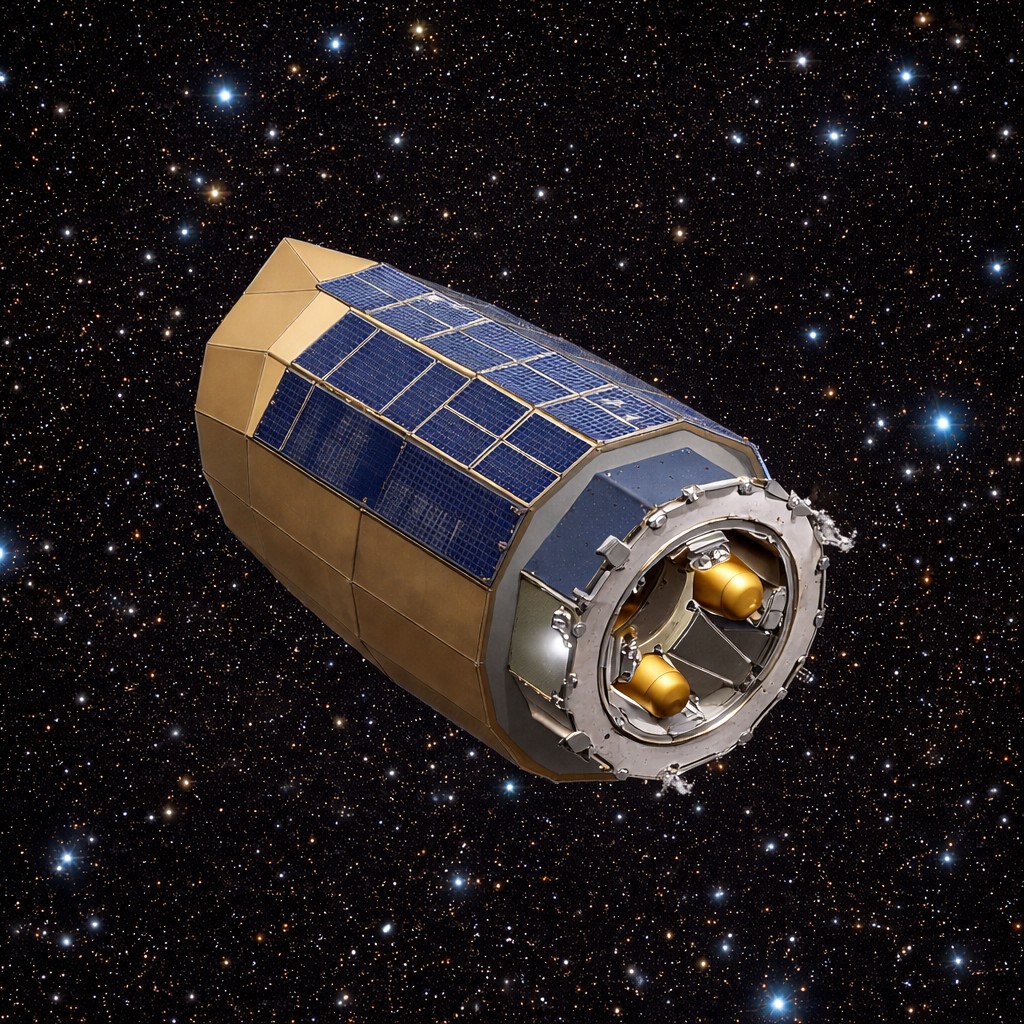
Surrey Satellite Technology Ltd (SSTL) has been selected as a key industrial collaborator for the Lazuli Space Observatory, part of the Eric and Wendy Schmidt Observatory System, a privately financed project aimed at developing one of the most ambitious space telescopes ever undertaken outside government programs.
SSTL will develop the spacecraft platform that will carry the Lazuli observatory beyond Earth orbit into deep space. The mission was unveiled by Schmidt Sciences at a meeting of the American Astronomical Society.
The telescope is designed to become the first full-scale privately funded space telescope, featuring a primary mirror larger than that of the Hubble Space Telescope. The observatory will carry a range of scientific instruments including a wide-field camera, integral-field spectrograph and coronagraph to study exoplanets, supernovae and transient cosmic events.
SSTL said its platform will provide the precision pointing, propulsion and communications systems required to place and operate the observatory in a stable deep-space orbit.
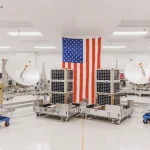
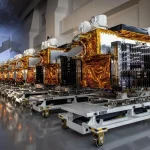
The company plans to apply its rapid development model—originally demonstrated through projects such as the Carbonite programme—to enable large scientific missions to be delivered more quickly and at lower cost.
“While SSTL is known for small satellites, ‘small’ has always described our approach, not the size of the satellite — and certainly not our ambition,” said Andrew Cawthorne.
“Lazuli is a powerful example of how that philosophy can scale to enable a new generation of deep-space science missions,” Cawthorne added.
The Lazuli observatory forms part of a broader effort to combine rapid spacecraft development, open data access and global scientific collaboration in order to lower barriers to advanced astronomy research.
Launch of the telescope is currently anticipated before the end of the decade, with the mission aiming to demonstrate that innovative engineering approaches can deliver major scientific capabilities faster and at lower cost than traditional large-scale space programmes.