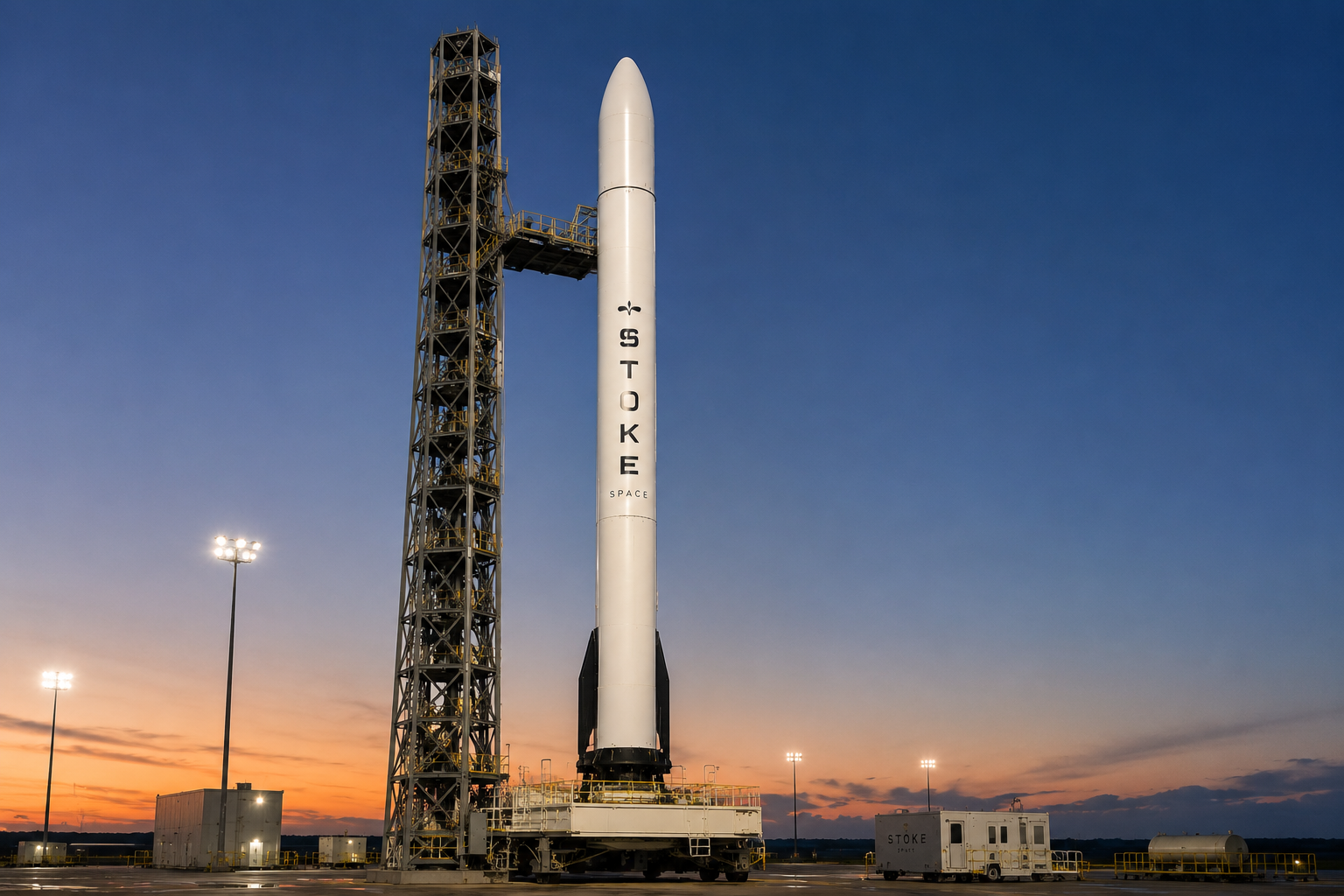
The structural verification campaign ran over a three-week period and included 46 tests of the first-stage flight article, along with testing of critical fluid systems, avionics, and ground support systems. During the campaign, the company filled both fuel tanks above maximum expected pressure conditions and demonstrated automated pressure control across various fill levels. The stage also endured hurricane-force winds and lightning during a thunderstorm that rolled through the area, which Stoke said proved its structural and operational robustness without causing damage.
Nova features a 27.1-meter reusable first stage powered by seven full-flow staged combustion Zenith engines, fueled by liquefied natural gas and liquid oxygen. The stage can generate 3,110 kN of thrust at liftoff and will use return-to-launch-site or droneship recovery. The Zenith engines have undergone hours of vertical hot-fire testing at Moses Lake, and the stage will receive its engines in the coming months before further testing and eventual transport to Cape Canaveral for final integration.
The fully assembled vehicle will measure 40.2 meters in height and 4.2 meters in diameter. Nova can deliver up to 3,000 kg to low-Earth orbit in a reusable configuration and 7,000 kg when expended, along with 2,500 kg to geostationary transfer orbit and 1,250 kg to translunar injection. The second stage uses a single Andromeda 2 engine fueled by liquid hydrogen and liquid oxygen, featuring a distributed ring of 24 3D-printed thruster chambers and a regeneratively cooled metallic heat shield. The second-stage flight hardware completed structural qualification at Moses Lake in 2025.
Stoke acquired Launch Complex-14, the launch complex that delivered the first American to orbit, in 2023, and completed its refurbishment in early 2026. More than 8,000 kg of concrete from the original Mercury and Atlas era were crushed and reused on the rebuilt site. The launch mount sits on concrete pilings 32 meters deep and was designed to react to up to 5.3 MN of thrust at liftoff, alongside a nearly 37-meter umbilical support structure.
Stoke described the campaign as more than a successful structural test. “The result was a broader demonstration that Nova’s hardware, software, ground systems, and operations approach are maturing together,” the company stated in a June 8 news release. It added that “the margin between ‘light enough to fly’ and ‘robust enough to survive’ is narrow and proving that margin requires disciplined testing at increasing levels of complexity.” The company, founded in 2020, has raised over 1.34 billion dollars under Series D funding as of June 2026 and aims to provide lower-cost, on-demand access to space using a fully and rapidly reusable launch vehicle.
Additional Andromeda 2 hot-fires will occur before the engine is integrated with the flight vehicle, followed by further acceptance testing before the second stage is delivered to Florida. Both stages will be mated horizontally in the Horizontal Integration Facility before being rolled to the pad and raised vertically. Nova’s first mission will fly to a heliocentric orbit with the vehicle expended to prove its capabilities, with later missions testing recovery of both stages.