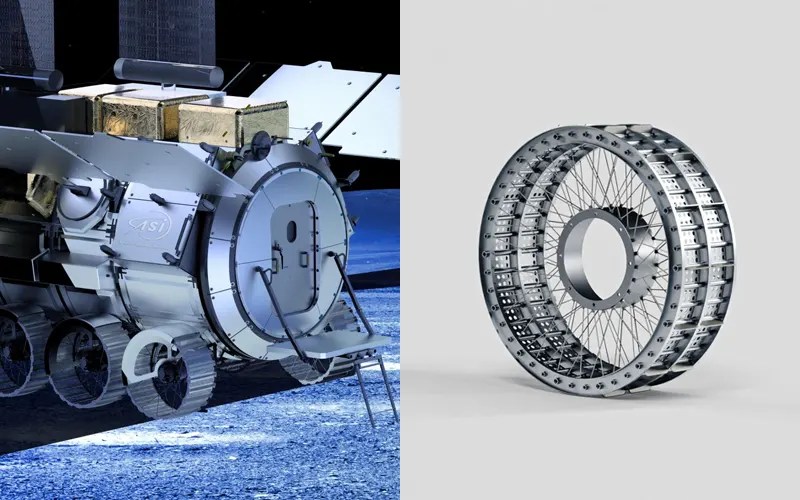
Space manufacturer Thales Alenia Space has awarded a contract to U.S. robotics company Astrobotic to develop specialized wheels for a mobile lunar habitat under development for the Italian Space Agency (ASI).
The wheels will be used on the Multi-Purpose Habitation Module, a concept designed to support human missions on the Moon as part of the Artemis Program.
The project originates from cooperation between ASI and NASA, which signed a joint statement of intent in 2020 to collaborate on the development of a lunar habitat capable of supporting crewed surface missions. A bilateral agreement signed in June 2022 tasked ASI with carrying out the preliminary design of the habitation module.
In July 2025, ASI selected Thales Alenia Space Italia to lead the preliminary design phase, including the development of key enabling technologies for the module. As part of that effort, Thales Alenia Space signed a contract with Astrobotic on March 3 to design and develop the module’s mobility system.
Early versions of the habitat concept did not include mobility. The addition of wheels was first revealed in July 2024, following the project’s mission definition review.
According to Nicola Genco, the mobility capability would allow the module to relocate to areas more suitable for surviving the extreme conditions of the lunar night. The system could also enable the habitat to move between different exploration sites during Artemis missions.
Astrobotic said the wheel design will build on technology developed for its Astrobotic Mobility Platform, adapted to meet the size, durability, and operational requirements of the habitation module.
The design uses lightweight tensioned cables connecting the hub to the rim, maintaining structural strength while minimizing mass. Flexible tread elements on the outer rim allow the wheel to conform to the Moon’s uneven terrain, improving traction and reducing wear over time.
The preliminary design phase of the Multi-Purpose Habitation module is expected to last around two years, after which a decision will be made on whether to proceed with full development.
If constructed, the habitat would measure approximately three metres wide and six metres long and be designed for an operational lifespan of around ten years. The module would be capable of hosting two astronauts for missions lasting between seven and 30 days once per year, while also supporting larger crews for shorter periods during emergency situations.