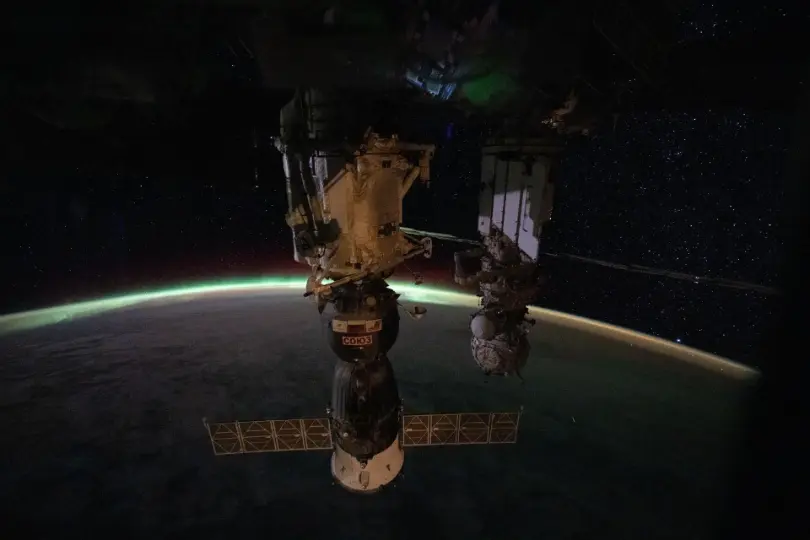
Recent weeks aboard the International Space Station have been busy, with the Expedition 74 crew overseeing two vehicle arrivals, a departure, and an orbital reboost. The crew also completed several technology demonstrations, science experiments, and routine Station maintenance.
NASA also announced the crew for its upcoming Crew-13 mission, which is expected to launch to the Station in September on a SpaceX Crew Dragon. The four-person crew includes NASA astronauts Jessica Watkins (commander) and Luke Delaney (pilot), with mission specialists Joshua Kutryk from the Canadian Space Agency and Sergey Teteryatnikov from Roscosmos.
Vehicle departures, arrivals, and reboosts
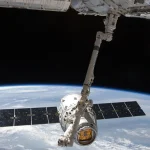
On April 11 at 07:41 AM EDT (11:41 UTC), Northrop Grumman’s Cygnus XL launched atop a SpaceX Falcon 9 from Space Launch Complex 40 (SLC-40) in Florida on the CRS NG-24 mission. Canadarm2 captured the vehicle on April 13 at 17:20 UTC, and the vehicle was berthed at the Unity nadir port at 20:00 UTC. Cygnus XL carried 11,000 pounds of science and research to the Station and is expected to depart the Station for a destructive reentry in Oct. 2026.

Cygnus XL approaches the ISS for berthing. (Credit: NASA)
The Russian Progress 93 cargo vehicle fired its engines for just over five minutes on April 16 to boost the International Space Station’s (ISS) orbit.
The burn raised the Station’s orbital altitude — which slowly decays due to drag from trace amounts of Earth’s atmosphere in low-Earth orbit — preparing it for the arrival of the Progress 95 cargo vehicle. After the burn, Progress 93 departed from the Station’s Zvezda aft port on April 20 at 22:08 UTC and reentered Earth’s atmosphere hours later. The cargo vehicle was launched atop a Soyuz-2.1a from Site 31/6 at the Baikonur Cosmodrome on Sep. 11, 2025, and spent 219 days docked at the ISS.
See Also
- Expedition 74 Updates
- ISS Forum Section
- NSF Store
- Click Here to Join L2
Another cargo vehicle, Progress 95, launched from Site 31/6 at the Baikonur Cosmodrome on April 25 at 22:21 UTC aboard a Soyuz 2.1a rocket. The spacecraft docked with the ISS at Zvezda’s aft port on April 28 at 00:00 UTC and is expected to remain docked for approximately eight months. The spacecraft carried 2,515 kg of cargo, supplies, and fresh food to the orbiting outpost.
scientific
(adsbygoogle = window.adsbygoogle || []).push({});
The most recent cargo resupply mission to the Station, SpaceX’s CRS-34, launched on May 15 from SLC-40 in Florida. The Cargo Dragon spacecraft, loaded with nearly 3,000 kg of cargo for Expedition 74, successfully docked autonomously with the Harmony module’s forward port on May 17 at 10:37 UTC.
Science, technology demonstrations, and maintenance
With each cargo resupply mission to the ISS, dozens of new scientific experiments arrive for research in the Station’s microgravity environment. One standout payload that Northrop Grumman’s Cygnus XL spacecraft delivered on April 11 was the Fluorescent Deep Space Petri-Pod, developed by the University of Exeter and the University of Leicester.
The compact miniature laboratory houses dozens of microscopic C. elegans worms, which are used to study how living organisms respond to the stresses of long-term spaceflight, employing advanced fluorescent imaging techniques. The experiment will be placed outside the Station on an experimental platform and monitored using photographic stills, time-lapse images captured with white light, and laser-based fluorescence stimulation.

The Fluorescent Deep Space Petri-Pod experiment. (Credit: Space Park Leicester)
On April 2, NASA astronauts Jack Hathaway and Chris Williams spent time in the Columbus laboratory studying changes in the brain, including balance and orientation, during spaceflight. Hathaway wore specialized goggles that use high-speed video to test an astronaut’s sense of motion and balance. After the study, the astronauts switched roles, and Hathaway scanned Williams’s eyes using medical imaging equipment inside the Harmony module.
Hathaway and Williams also spent time in the cupola module on April 6, practicing maneuvering Canadarm2 to capture Cygnus NG-24 on April 11. After the robotic arm captured the spacecraft, ground controllers remotely installed the vehicle at the Unity nadir port.
Earlier in the day, both astronauts were joined by NASA astronaut Jessica Meir for spacesuit maintenance. Hathaway and Meir cleaned and flushed the suit’s water-cooling loops, which regulate astronauts’ temperature during extravehicular activities (or spacewalks). Meanwhile, Williams swapped a pair of lithium-ion batteries that power the spacesuits in the Quest airlock’s battery stowage compartment.
On April 15, Chris Williams began unpacking computer hardware that supports the European Space Agency’s (ESA) European Enhanced Exploration Device (E4D). Williams and Meir then replaced components on the new microgravity workout machine to ensure accurate motion, alignment, and system longevity. The workout machine is being evaluated for its use on future deep-space missions to the Moon and Mars.

Progress 93 fires its engines to boost the Station’s orbit. (Credit: NASA)
Also on the 15th, Hathaway added a new quantum physics module to the Destiny laboratory module’s EXPRESS rack. This module enhances the Cold Atom Lab (CAL), which uses quantum physics to improve our understanding of general relativity and assist in dark matter research.
The CAL cools clouds of atoms to roughly one-ten-billionth of a degree above absolute zero, forming Bose-Einstein condensates (BECs). Unlike gases, liquids, solids, and plasmas, BECs exhibit quantum properties on a macroscopic scale, making them easier for scientists to observe.
Williams gathered hardware and samples for the Veg-06 space botany study on April 17. The experiment investigates how plants and microbes interact in microgravity, potentially enabling the automation of plant growth through nitrogen fixation. The study also examines changes in lignin, the material that allows plants to stand upright on Earth. The astronaut mixed nutrients for an alfalfa plant with microbe samples inside the Columbus laboratory’s Veggie facility. The study aims to advance food production practices for future deep-space missions.
Williams and ESA astronaut Sophie Adenot worked in the Japanese Kibo laboratory module on April 22, processing genetic samples for the DNA Nano Therapeutics-3 experiment. The experiment is studying DNA-inspired assembly techniques for manufacturing nano-therapies, including chemotherapies, to kill cancer cells and activate the immune system. After the samples are analyzed with a spectrophotometer aboard the Station, they will be returned to Earth for further study.

Williams and Adenot work in the ISS’s Kibo module. (Credit: NASA)
In another DNA experiment, Meir swapped scientific hardware in the BioLab inside the Columbus laboratory module. The incubator supports research into the effects of microgravity on small organisms. Meir also focused on the Lux in Space investigation, which examines how DNA damaged by space radiation repairs itself.
Adenot explored using the Station’s potable water to produce medical-grade Intravenous Fluids (IV) and saline solutions on April 27 to treat medical conditions in space. The Intravenous Fluid Generation-Mini medical experiment aims to reduce a crew’s reliance on cargo resupply missions for medical supplies and help avoid the expiration of in-space medicines — a capability that will be crucial for future long-duration space missions.
With more cargo resupply missions expected in May, the International Space Station continues to advance our understanding of human health during long-duration spaceflight and to provide key scientific studies that benefit life on Earth.
(Lead image: The ISS, with a Soyuz vehicle docked to its Russian segment, orbits Earth with aurora australis in the background. Credit: NASA)