This piece is an attempt to unpack the advantages, disadvantages, and economics of an orbital datacenter. Can the cost gap close compared against a terrestrial hyperscaler running the same inference workload? When? The short answer is that it can close, but most likely – at least in the medium-term – only for inference (not training), and only under a specific and not-yet-real launch price. The timeline remains unclear. Let’s dive in.
Why send compute to orbit?
The binding constraint on terrestrial AI is the availability of power on any reasonable timeline. According to a recent PowerLines report, US investor-owned utilities have laid out roughly $1.4 trillion in capital plans through 2030, a figure that jumped 27% in a single year, and they still cannot energize clusters fast enough. Grid interconnection queues in established European hubs run up to a decade against roughly two years to build the facility. The gas turbine backlog runs to 2030, gated by a handful of firms that cast the vanes and blades. SpaceX CEO Elon Musk’s framing on the Dwarkesh interview was blunt: while the industry is scaling chip production, the physical limitation on Earth is the lack of electricity infrastructure to support the massive energy demand those chips require.
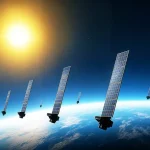
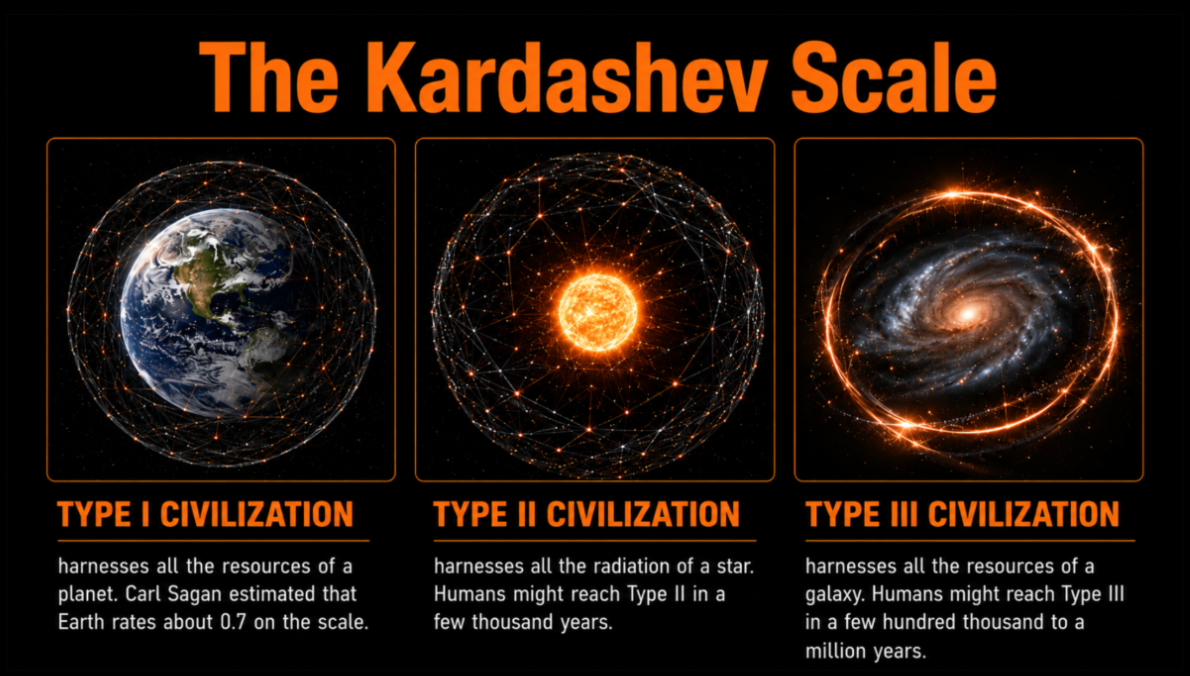
That is the core argument for sending compute to orbit: 24/7 availability of electrons from the Sun which, in case you forgot, is so large that about 1.3 million Earths could fit inside it. The Sun is a colossal, natural nuclear fusion reactor floating in space, which brings the marginal cost of energy in orbit to near zero, making it cost-effective for turning electrons into AI tokens. To further reinforce this point, Musk talks about the Kardashev Scale, referring to it as the single most objective metric any advanced alien species would use to judge human progress. He frequently points out that humanity is “practically nowhere” on the scale, currently utilizing less than a trillionth of the Sun’s total power output.
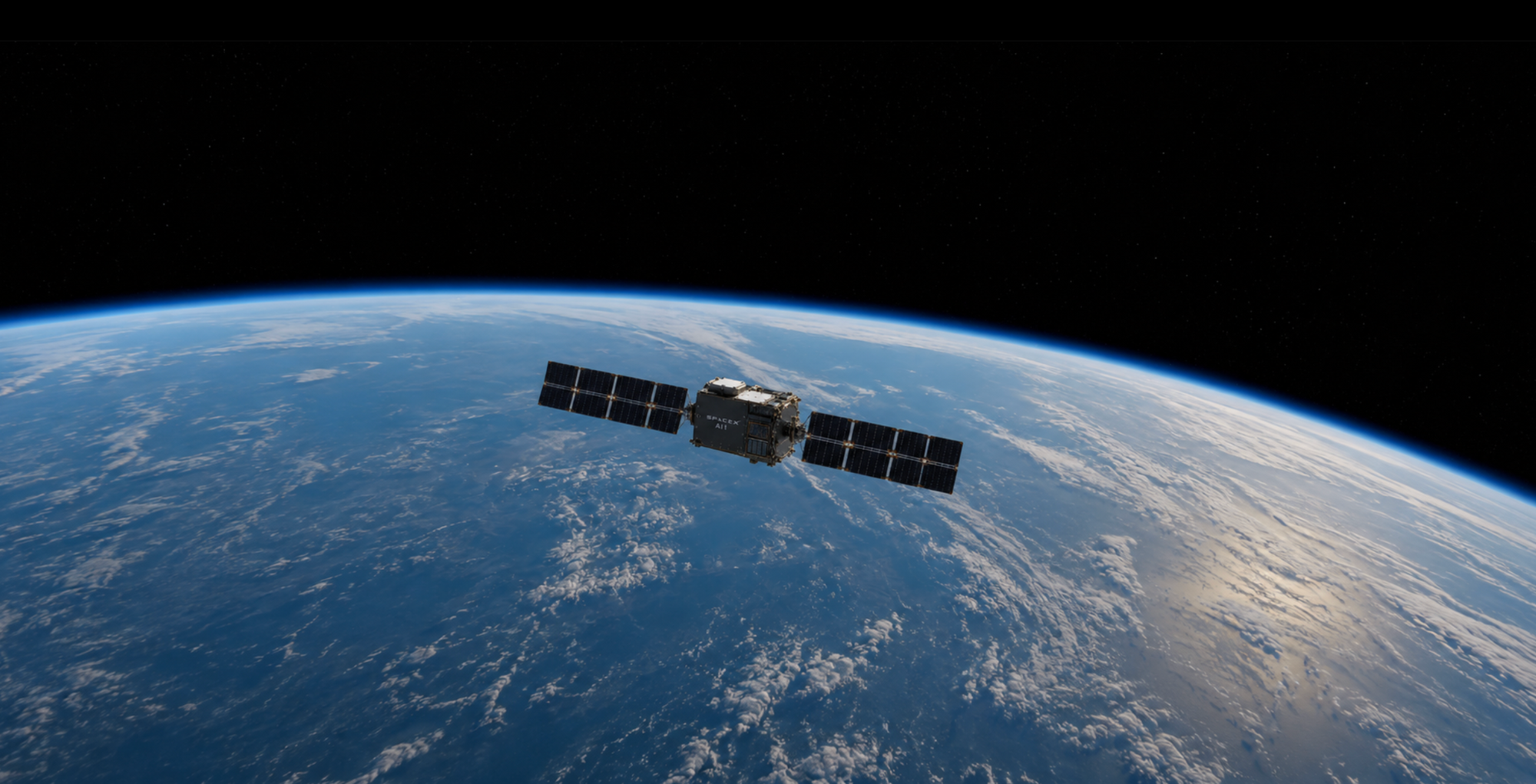
Musk envisions scaling orbital computing capacity to reach up to 100 gigawatts annually, ultimately aiming to deploy a staggering 1 million AI satellites through his newly publicly listed company, SpaceX, and their AI satellites.
The orbital advantages
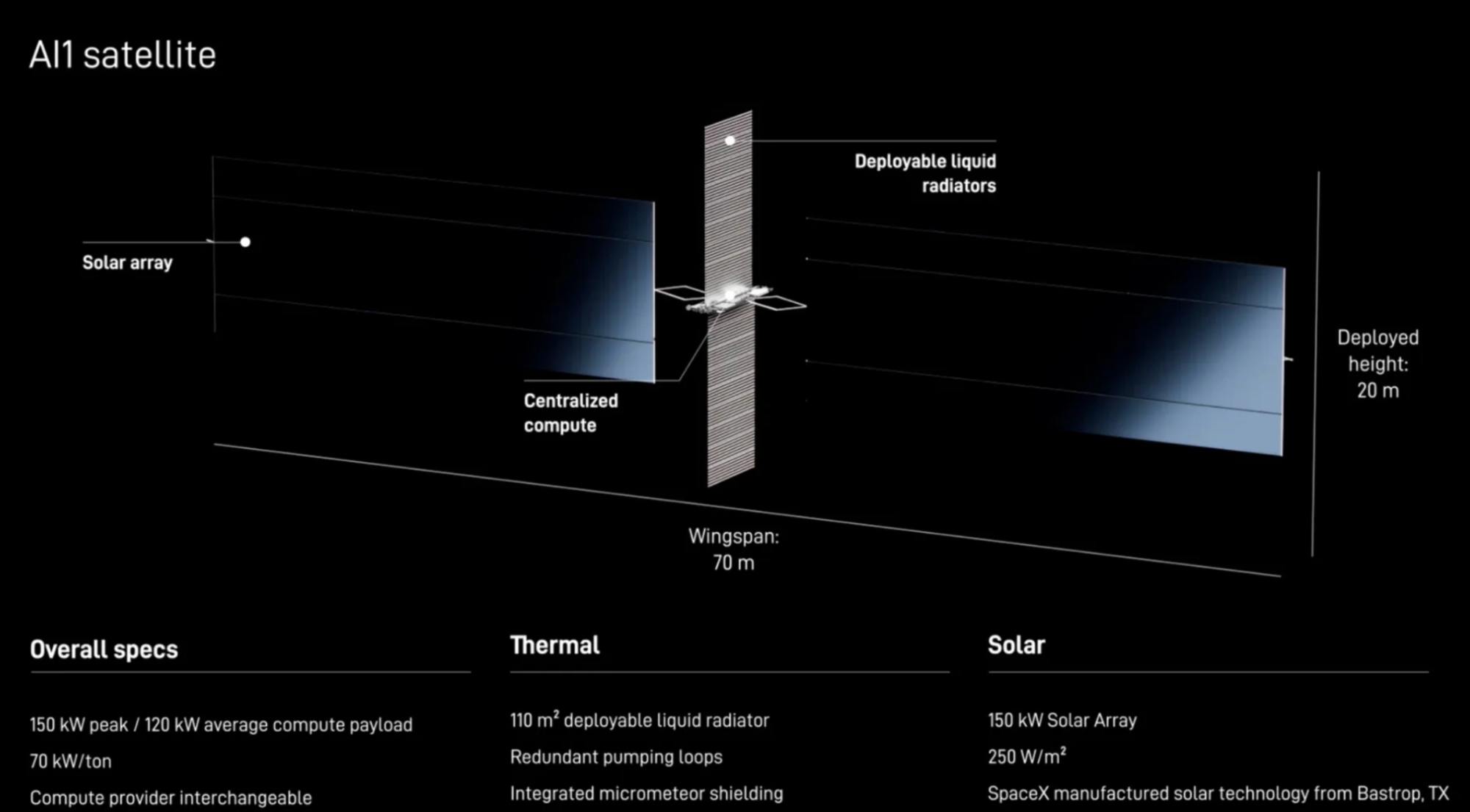
Philip Johnston, the CEO of Starcloud, an Nvidia and YC-backed company that has raised $200M to put orbital datacenters in space, estimates an in-orbit solar panel produces roughly eight times the energy per square meter of an equivalent panel on the ground. This is due to continuous illumination, no atmosphere, no clouds, and no day-night cycle in the dawn-dusk sun-synchronous orbit Starcloud targets. A panel built for space also sheds much of the glass and weatherproof framing it needs on Earth, and because the orbit holds the array in near-continuous sun, only a small battery buffer is required rather than a heavy, full storage system.
Reduced infrastructure capex further solidifies the cost advantages of orbital datacenter projects. Johnston puts a terrestrial AI build on the order of $15 million to $20 million per megawatt, compared to what he estimates is under $5 million per megawatt for the orbital equivalent.
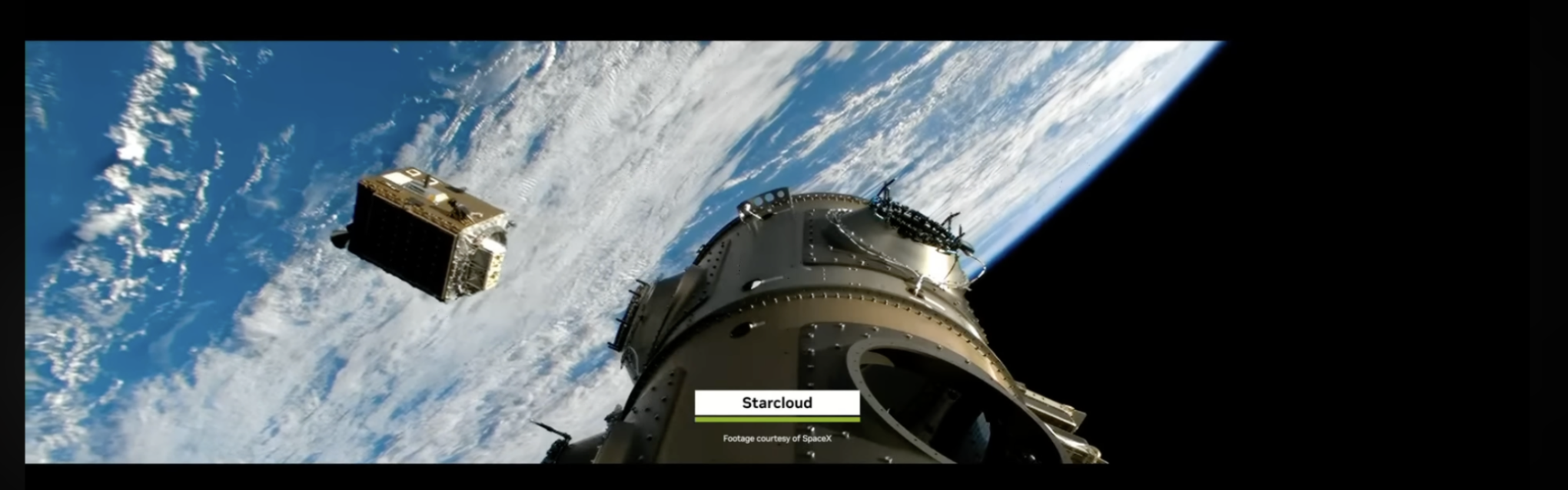
Why? Gone are the land costs, chillers, cooling towers, backup generators, UPS battery strings, and AC-to-DC conversion stages that a terrestrial datacenter cannot do without, but an orbital one can. The parts list for a Starcloud production satellite is short: solar panels, radiators, the bus, the chips (and their memory and motherboard), a small battery buffer, a single reaction wheel, and two optical terminals for communication. Starcloud pencils its infrastructure cost below $5 million per megawatt as a result, about 3x lower than a terrestrial equivalent. Energy saving is the headline, but the infrastructure saving is a comparable part of the story, and it is structural rather than locational.
Against these numerous advantages, there are of course challenges and costs that have no terrestrial equivalent and, notably, have yet to be proven out at scale.
The orbital challenges
1. Thermal
In a vacuum like outer space, there is no convection and no water loop. The only way to reject heat is to radiate it, and the Stefan-Boltzmann law says the rate scales with the fourth power of the radiator’s absolute temperature. For a payload dumping tens to hundreds of kilowatts of waste heat, that has historically implied a radiator surface measured in tens to hundreds of square meters, which means more mass to launch in to orbit (therefore higher costs). Using ISS radiator density as a benchmark, roughly 15 kilograms per square meter, the thermal system becomes a major fraction of the mass you are paying to launch. A large, low-cost deployable radiator has been reported as one of Starcloud’s two primary technical hurdles.
The skeptics often concentrate here. Independent teardowns of Starcloud’s whitepaper figures argue that the radiator and solar-array launches rival the compute launches, and that mass is the binding constraint on every large structure you try to put up. If radiator mass per kilowatt runs high, it drastically scales up the total tonnage, and total tonnage is what you multiply by launch price to get the launch cost that largely drives feasibility of these orbital clusters.
What the skeptical version usually omits is the operating point, which is exactly the lever that Starcloud is pulling. At a steady-state panel output near 200 watts per square meter, a radiator held around 50 degrees Celsius rejects roughly 800 watts per square meter, so the radiator area needed is approximately a quarter of the solar array area. That is already a less alarming picture than the worst-case framing. The fourth-power relationship then does something useful: raising the GPU operating temperature from 50 to 80 degrees Celsius sharply increases radiated power per unit area and roughly halves the radiator surface required, which roughly halves the radiator mass and the launch cost associated with it.
The catch is that running GPUs hotter normally trades against reliability, which is why a highly consequential item in the whole thermal argument is not a radiator at all. It is silicon. Nvidia has formally unveiled its Space-1 Vera Rubin Module, an AI chip system designed to maintain maximum performance without throttling. The NVIDIA Space-1 Vera Rubin Module is engineered to operate at structurally higher temperatures by combining radiation shielding with specialized conduction systems that channel and radiate intense thermal energy directly into the vacuum of space.
A chip that is comfortable running hot is, in mass terms, a chip that lets you fly a much smaller radiator, thereby bringing down the launch cost. The thermal problem is real, but it is not static, and the direction of travel is to engineer the radiator term down through the chip rather than to accept it as fixed. Critics will then point to two other vulnerabilities: the potential for space debris collisions and the risk of chip performance loss caused by radiation.
2. Radiation and Space Debris
Without hardening, cosmic rays and trapped particles flip bits, and error-correcting codes only cover so much, since radiation can corrupt memory even while it sits idle. Starcloud’s Philip Johnston has said that their approach thus far has been to stress test this issue on the ground. They run multiple campaigns at a cyclotron facility in Knoxville for total-dose testing and used heavy-ion beams at Brookhaven National Laboratory to reproduce the cosmic-ray environment that does the worst damage, in some cases compressing roughly five years of orbital exposure into a 24-hour run to inform shielding decisions. There are other startups, such as Atlanta-based Cosmic Shielding, who are addressing the radiation issue. Cosmic Shielding, for example, has developed a lightweight nanocomposite, branded Plasteel, that it uses to build enclosures protecting advanced commercial processors from the intense radiation that bombards spacecraft.
As it relates to Debris and “Kessler-syndrome” risk, the challenge is one that scales with the success of orbital data center companies. Kessler Syndrome (or the Kessler Effect) is a hypothetical scenario where the density of objects in Low Earth Orbit (LEO) becomes so high that collisions between them cause a cascading chain reaction. Each crash generates thousands of new, untraceable high-speed fragments, triggering further collisions and eventually rendering Earth’s orbit unusable.
What gives proponents peace of mind? They often point to SpaceX’s Starlink, which now operates on the order of 10,000 satellites in low Earth orbit (LEO) without having had a single collision. This is thanks to sophisticated automated collision avoidance operating continuously across the fleet, which can also in theory be applied to AI-satellites. With an operational depth of 1,840 kilometers or 1,100 miles, space at LEO altitudes is genuinely large, larger than most people realize, and the operational record suggests dense constellations are manageable with the right avoidance systems. Debris risk remains a real systems-engineering burden, coordination challenge, and regulatory exposure, but it is not a physics wall. To mitigate the growing crisis of space debris, regulatory bodies worldwide enforce strict end-of-life disposal guidelines for satellites. Operators must outline how they will safely remove their spacecraft from orbit before they can secure a launch or operating license. This presents a new startup opportunity: space debris cleanup. An example is TransAstra, who has developed a “capture bag” designed to capture and move objects such as satellites in space into far away “space graveyards” or back into the atmosphere to burn up, and has proven numerous capture-bag capabilities in a micro-gravity environment onboard the International Space Station.
The one number: $/kg
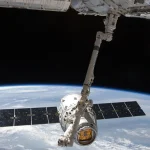
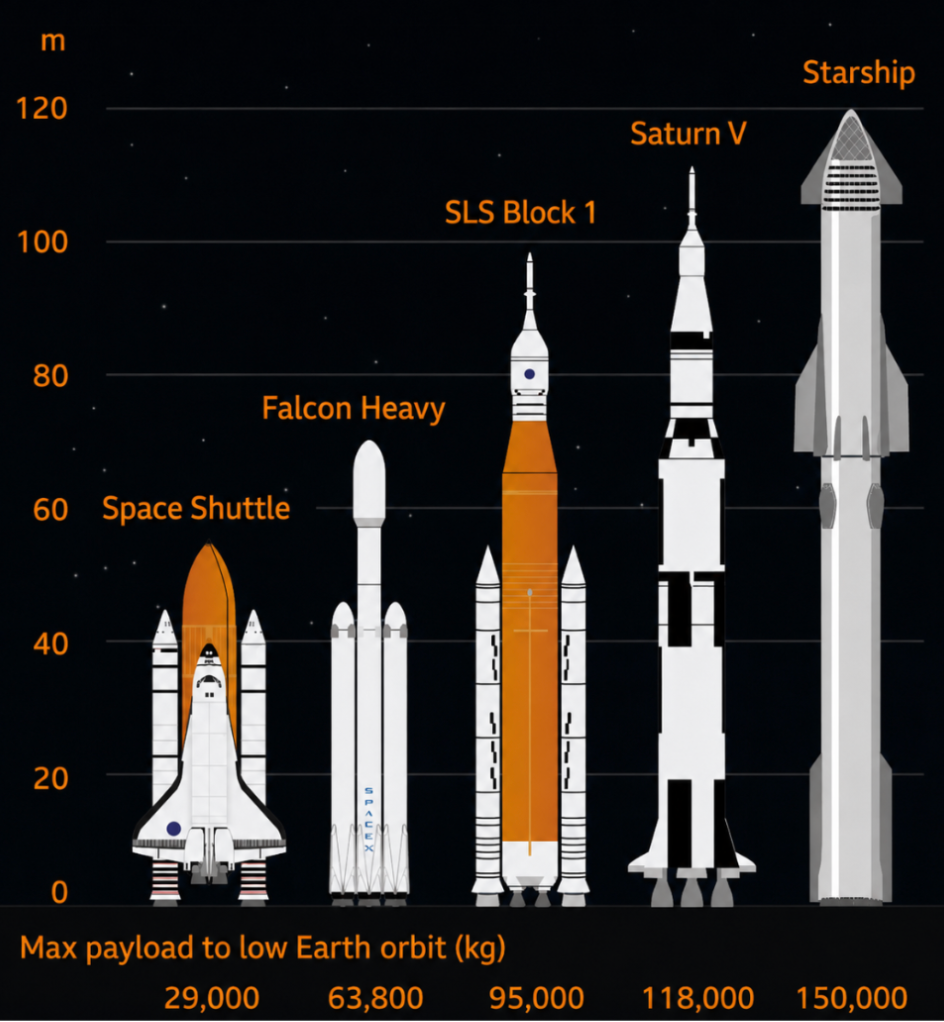
Strip the argument down and the orbital cost case is a leveraged bet on one number: dollars per kilogram to orbit. Power advantage, infrastructure savings, modular satellites, disposability, all of it is downstream of whether the cost of sending mass-to-orbit collapses down far enough. And much of this rests on SpaceX’s Starship vehicles. Starship is a fully reusable, two-stage super heavy-lift launch vehicle designed to carry both crew and cargo to Earth orbit, the Moon, Mars, and beyond. It is the tallest and most powerful rocket ever built, standing about 120 to 142 meters (398 to 466 feet) tall depending on its iteration, and is designed so that both the Super Heavy booster and the Starship spacecraft are rapidly reusable, therefore able to land and fly repeatedly.
As we’ve laid out, orbital datacenters have several advantages and must overcome a few challenges, however, the economic feasibility still depends on launch price, and that is where the bet for a company like Starcloud largely concentrates. Johnston’s parity reference, the figure at which Starcloud estimates it will be cost-competitive with terrestrial alternatives, is conditioned on commercial launch landing near $500 per kilogram (or $226.79 per pound).
Musk’s stated aspiration for Starship’s marginal launch cost is in the $10 to $20 per kilogram range. Today’s reality sits far above both that and Starcloud’s $500/kg parity threshold: skeptical analyses peg current SpaceX marginal cost around $2,461 per kilogram and ULA around $4,074. Google’s Suncatcher team concluded that liftoff would need to fall under $200 per kilogram by 2035 for their orbital vision to make sense. So parity needs launch to improve by at least five times from SpaceX’s current marginal cost on a vehicle that is not yet flying commercial payloads, from a single supplier with no competitor that is really close from a product development perspective (Blue Origin’s New Glenn is SpaceX Starship’s most direct heavy-lift competitor, but is significantly behind on commercialization).
The orbital compute business that does not need Starship yet
When asked whether Starcloud is fully reliant on Starship, CEO Philip Johnston gave an honest yet nuanced answer: yes and no. The terrestrial-parity ambition, the part that needs to undercut a ground hyperscaler on cost per kilowatt-hour, is entirely a Starship (or other heavy-lift reusable rocket) bet, because only Starship’s payload and price unlock profitable Starcloud-3 economics. But the company’s near-term revenue is not. Starcloud-1, Starcloud-2, and Starcloud-2.1 are smaller units providing edge and cloud compute to other spacecraft, including military and government customers, and Johnston explained in a recent Sequoia Capital interview that this business can carry the company until Starship is flying at rate.
That near-term business solves a real and specific problem, and it has nothing to do with beating terrestrial datacenters. Earth-observation satellites, especially synthetic-aperture radar, generate enormous data volumes, on the order of 5 gigabytes per second, while their downlink is throttled by slow radio-frequency links of roughly 1 gigabit per second and by the wait for a ground station to come overhead. The result is that satellites discard close to 90 percent of what they collect, because they lack the onboard compute to extract the valuable part before the transmission window closes or the data goes stale. Starcloud’s answer is to put the inference in orbit. A sensing satellite ships raw data to a nearby compute node over an optical link, the node finds the vessel in terabytes of ocean imagery, and only the high-value result comes down. The raw dataset never has to be beamed to the ground at all. This is a place where orbital compute wins not because it is cheaper than a terrestrial datacenter, but because the terrestrial datacenter is on the wrong side of a downlink bottleneck and cannot do the job at any price.
So the bet is structured, not all-or-nothing. The space-to-space edge business is live, defensible, and Starship-independent. The terrestrial-parity business is the big prize and the concentrated launch bet.
Where Starcloud sits
The specifics of Starcloud’s position matter for the economics. The company raised a $170 million Series A in early 2026 at a $1.1 billion valuation led by Benchmark and EQT, reportedly the fastest Y Combinator company to reach unicorn status. It has filed with the FCC for a system of up to 88,000 satellites. The roadmap runs Starcloud-1 (the H100 test article, flown), Starcloud-2 (launching this year with multiple GPUs including a Blackwell part, an AWS server blade, and a bitcoin miner, flying what the company says is the largest deployable radiator on a private satellite, with Crusoe as an early customer and partnerships with AWS, Google Cloud, and Nvidia), Starcloud-2.1, and Starcloud-3, the 200-kilowatt, three-ton, Starship-deployed production node whose chassis is reportedly already welded.
Two choices tell you how they think about cost. First, they build in-house, because, in Johnston’s phrasing, the cost equation is brutal and the open-market satellite bus does not survive it. Second, and more strategically, Starcloud frames itself as the Equinix of orbit: it sells power, cooling, and connectivity, and lets customers fly whatever silicon they want. That moves obsolescence risk onto the tenant and makes Starcloud’s own business the throughput of cheap replacement launches. The one place the Equinix analogy breaks is access: a terrestrial colocation tenant can physically refresh their own hardware, while an orbital one cannot, so the orbital colo provider is really selling a power-cooling-connectivity envelope plus a launch-and-deorbit refresh service whose quality is, once again, a function of launch price and cadence.
The prize, if the launch bet lands, is large. Using figures from ARK Investment Management and SemiAnalysis, a one-gigawatt GB200-class facility supports on the order of 480,000 GPUs and roughly $14 billion of annual infrastructure-as-a-service rental revenue in the base case, and a frontier provider turning that rented compute into inference could see something closer to $35 billion per year. ARK is a directionally bullish source and these are facility-level estimates rather than Starcloud guidance, so weight them as a sizing of the opportunity, not a forecast. But the point stands that the addressable revenue per gigawatt is enormous, which is what justifies a concentrated bet on the one variable that gates it.
Cowboy Space: A different approach
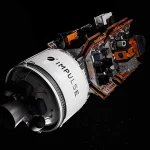
A company with a similar mission but taking a different approach is Cowboy Space Corporation (formerly known as Aetherflux), a startup founded by Robinhood co-founder Baiju Bhatt. In a recent Forbes interview, Bhatt explained that instead of filling a rocket’s upper stage with satellites, the company plans to turn the upper stage itself into the satellite. In this design, the rocket’s upper stage unfolds in orbit, with the rocket fairing becoming a giant radiator and large solar panels deploying to power a megawatt-class data center in space.
The company believes this fully integrated approach is superior to the strategies being pursued by other players. Rather than launching a separate data center payload, it integrates the data center directly into the launch vehicle’s upper stage, eliminating redundant mass and allowing every possible kilogram to be dedicated to high-performance AI compute. With limited publicly available information into the economics of this approach, one notable benefit of this full-stack approach is the reduction on the reliance of third-party launch providers and rocket manufacturers. The company’s website states that they own the launch and the infrastructure, and they expect to deliver orbital compute at a scale and speed Earth cannot match.
The company recently raised $275 million in a Series B funding round at a $2 billion valuation from notable investors including Andreessen Horowitz.
So do orbital datacenters pencil out?
Orbital datacenters can pencil out, but not yet, and only for inference in the foreseeable future (not for training). The largest training jobs need thousands of GPUs in tight synchronization, which in orbit means either implausibly large single structures or precise formation flight with reliable optical inter-satellite links across the cluster, and the heat density of a packed training node is exactly where the thermal argument is hardest. Almost everyone working on this expects training to come long after inference, and we believe that ordering is correct.
Orbital inference becomes competitive with terrestrial hyperscalers in the short-term if Starship reaches a targeted launch cost per kilogram of less than $500/kg. The economics only improve as launch cost is reduced, which should be driven by both (1) technological leaps / engineering breakthroughs, and (2) increased competition from other reusable heavy-launch vehicles coming to market, such as Blue Origin’s New Glenn.
Starcloud’s all-in energy cost in this end state is estimated to be lower than half a cent per kwH (including launch), and they already have an existing customer LOI charging them 3 cents per kwH, demonstrating a highly profitable and scalable business model. Orbital compute is clearly a real opportunity, but the thesis remains fragile because today it depends heavily on one price point, one launch vehicle, and one dominant supplier.
One thing we know for sure: the future is exciting.