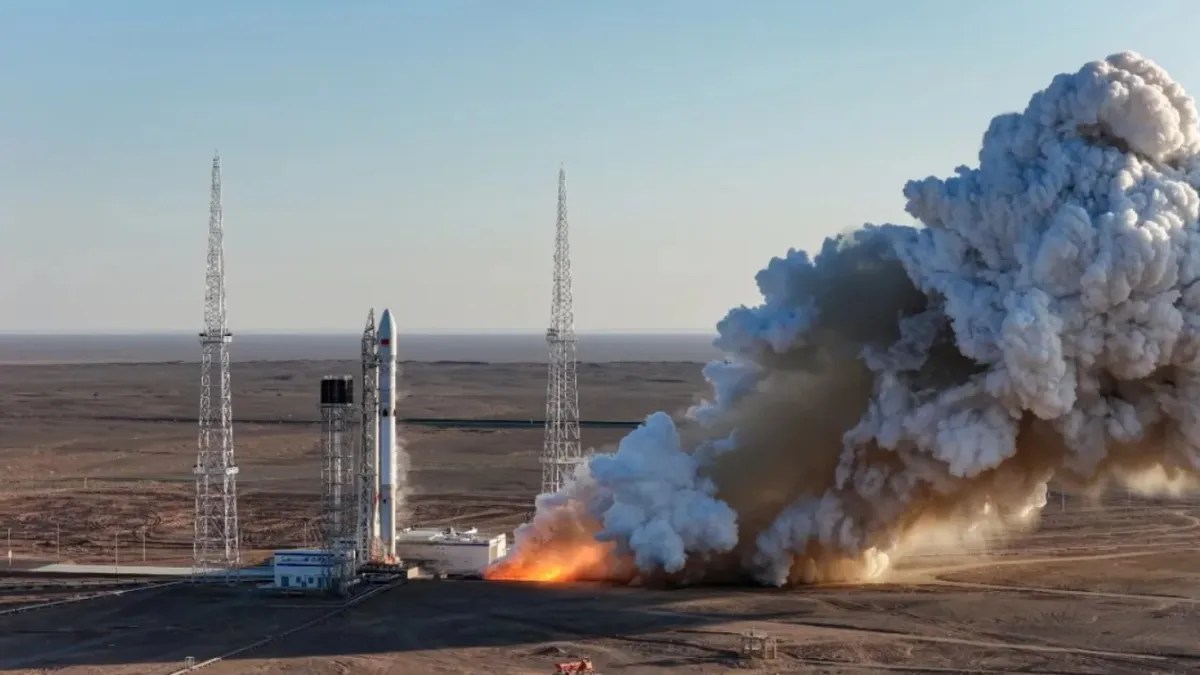
China’s reusable Long March-12B rocket has successfully completed a static firing test, marking a key milestone ahead of its planned flight missions, its developer said on Friday.
The test was conducted at the Dongfeng commercial space innovation pilot zone in northwest China and involved a full-duration engine firing while the rocket remained anchored to the ground, a critical step in validating propulsion and structural systems.
The Long March-12B is being developed by a commercial rocket manufacturing company under the umbrella of the China Aerospace Science and Technology Corporation (CASC). It is designed as a next-generation reusable launch vehicle aimed at supporting the large-scale deployment of commercial low-Earth orbit satellite constellations.
According to the developer, the rocket is capable of delivering up to 20 tonnes of payload to near-Earth orbit, placing it among China’s most powerful launch vehicles intended for commercial use.
“The test fully demonstrated the feasibility and reliability of the rocket’s design,” the company said in a statement, adding that the results provide a solid technical foundation for upcoming flight tests.
Static firing tests are typically among the final major ground-based verifications before a rocket proceeds to launch campaigns. Industry analysts say the successful test indicates progress in China’s efforts to expand reusable launch capabilities, an area seen as critical to reducing launch costs and increasing launch frequency.
China has been accelerating the development of reusable rockets as part of a broader push to support commercial space activity, including satellite internet constellations and Earth observation networks. The Long March-12B is expected to play a role in that strategy once it enters operational service.