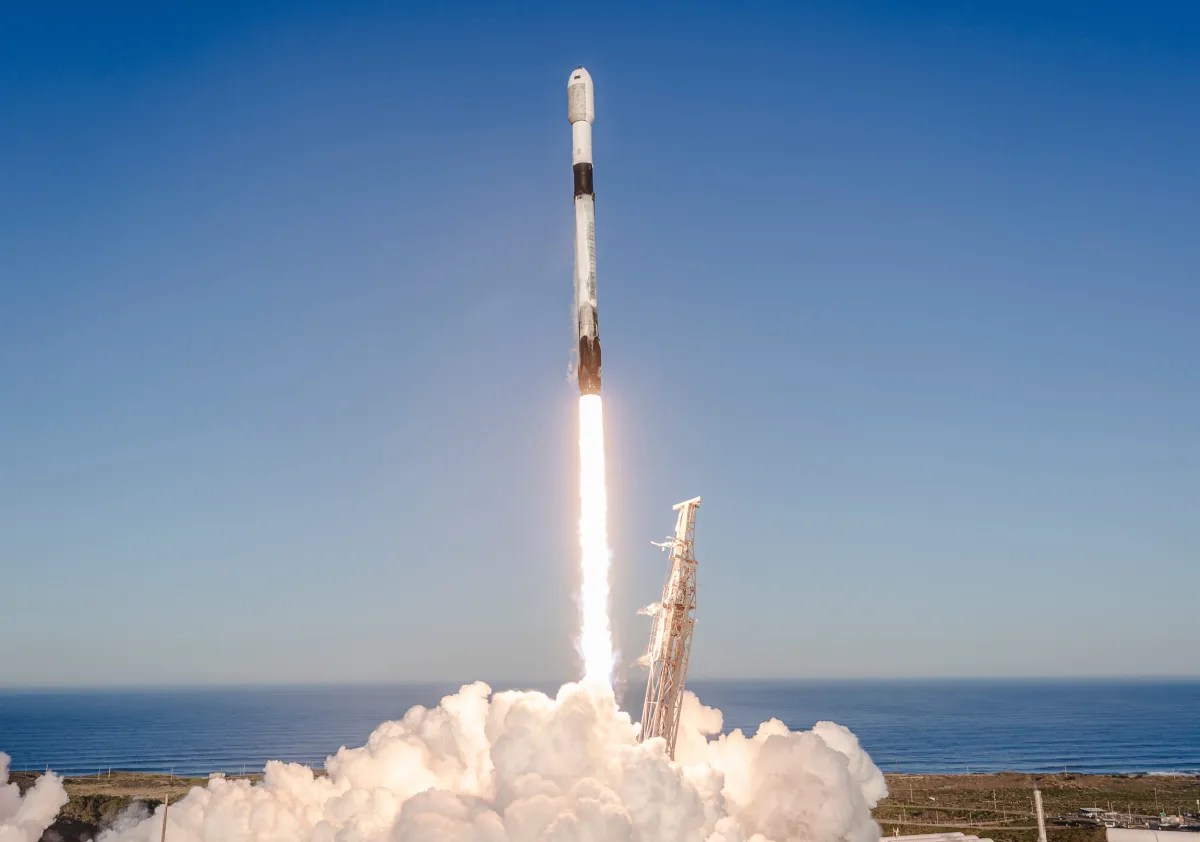
SpaceX has delayed upcoming Falcon 9 launches after the rocket’s upper stage failed to initiate a planned deorbit burn following a recent mission from California, the company said.
The issue occurred after a Falcon 9 launch from Vandenberg Space Force Base, where the rocket successfully deployed 25 Starlink satellites into orbit. According to SpaceX, the second stage experienced an engine-related anomaly during preparations for the deorbit burn, preventing it from re-entering Earth’s atmosphere as intended.
“During today’s Falcon 9 launch of Starlink satellites, the second stage experienced an off-nominal condition during preparation for the deorbit burn,” SpaceX said in a statement posted on X. “The first two MVac burns were nominal and safely deployed all 25 Starlink satellites to their intended orbit. Teams are reviewing data to determine root cause and corrective actions before returning to flight.”
During today’s Falcon 9 launch of @Starlink satellites, the second stage experienced an off-nominal condition during preparation for the deorbit burn. The vehicle then performed as designed to successfully passivate the stage. The first two MVac burns were nominal and safely…
— SpaceX (@SpaceX) February 3, 2026
Following the failed deorbit attempt, and in coordination with the United States Space Force, the Falcon 9 upper stage from the Starlink 17-32 mission was catalogued as orbital object 67673 to enable tracking. Space Force officials said the stage was expected to re-enter the atmosphere relatively quickly due to its low orbit, though SpaceX has not confirmed whether re-entry has already occurred.
As a precaution, SpaceX has paused other Falcon 9 launches while engineers analyze flight data and assess potential corrective actions across the fleet. The review has forced a delay to the next scheduled Falcon 9 mission, which had been planned for Feb. 5 from Cape Canaveral.
Falcon 9 is the workhorse of SpaceX’s launch operations, supporting both commercial missions and the rapid deployment of its Starlink broadband constellation. Launch pauses following in-flight anomalies are standard practice, allowing the company to identify root causes before resuming flight operations.