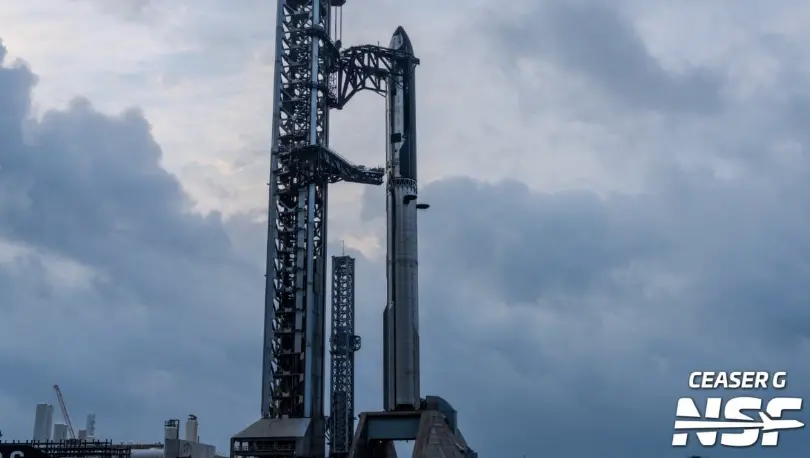
Following Booster 19’s successful full-duration, full-thrust 33-engine static fire on May 7, 2026, its partner Ship 39 rolled out to join the booster and form the Flight 12 stack ahead of a Wet Dress Rehearsal. While Saturday’s attempt was scrubbed ahead of prop loading, a new attempt on Monday appeared to go as planned.
Since Booster 19 rolled out of Mega Bay 1, several visual and structural differences have been noted compared to its previous appearances.
The aft section now features a full factory paint application matching official renders, providing improved thermal protection and a cleaner aesthetic.
Additional protective covers have been installed over the autogenous pressurization lines, extra stringers reinforce the forward section facing the tower, and the hot-stage truss box covers have received a fresh black paint job, likely for better durability and heat management.
Prior to the May 7 test, Booster 19 had already completed an extensive series of ground tests: four cryogenic proof tests, three pneumatic pressure tests, three tanking operations, two spin primes, two static fires (one 10-engine and one 33-engine), and a booster-only Wet Dress Rehearsal (WDR).
While it has not surpassed the test count of veteran Booster 7, this rigorous campaign underscores SpaceX’s commitment to thoroughly validating the new Block 3 hardware and Pad 2 infrastructure ahead of its debut flight.
The static fire itself lasted approximately 14–15 seconds, with all 33 Raptor 3 engines igniting and operating at full thrust. SpaceX described the test as a “full duration and full thrust 33-engine static fire with Super Heavy V3.”
Full duration and full thrust 33-engine static fire with Super Heavy V3 pic.twitter.com/vUJTqoHEZy
— SpaceX (@SpaceX) May 7, 2026
Company News
(adsbygoogle = window.adsbygoogle || []).push({});
Earlier attempts during the week were scrubbed due to water deluge pressure or sensor issues, but the team quickly recycled and achieved a successful firing — highlighting the capabilities of the new deluge and flame trench system at Pad 2.
Unlike previous Super Heavy static fires on Pad 1, which were typically limited to around 50% throttle to protect ground infrastructure, this test ran at liftoff power levels. The upgraded deluge system at OLP-2 proved its worth, successfully managing the immense energy release from the higher-performance Raptor 3 engines.
Block 3 boosters introduce several key advancements, including a taller structure for increased propellant capacity, an integrated hot-staging ring, three larger grid fins for improved control during recovery, and the switch to Raptor 3 engines that allow for reduced engine shielding.
 These changes are designed to enhance overall vehicle performance, reliability, and reusability as SpaceX works toward rapid turnaround operations.
With the static fire complete, focus has shifted to stacking Ship 39 for integrated testing. However, a setback occurred when part of the chopsticks on Pad 2’s tower sustained damage, possibly from the vibrations and pressures of the static fire.
Crews removed a damaged skate on the center line of the carriage overnight on May 7, but it was replaced late Friday, clearing the way for stacking.
Ship 39 and Booster 19 together at Pad 2 for the first time.
– @NASASpaceflight pic.twitter.com/ppPqJpDIad
— Max Evans (@_MaxQ_) May 9, 2026

Ship rolled out as Starbase entered the evening on Friday, before arriving at Pad 2. It waited in the Chopsticks for numerous hours before the go was given to lift the Ship atop Booster 19.
With Booster 19 and Ship 39 now mated, the first full-stack Wet Dress Rehearsal at Pad 2 was set to take place over the weekend, but never entered prop load due to an unknown issue that resulted in the attempt being scrubbed. Teams reattempted the test again on Monday and this time it appeared to go to plan.
This critical test simulates a complete countdown sequence, including clearing the range, evacuating the village, and fully loading both vehicles with propellant. It provides the launch control team with invaluable real-world experience on the new pad’s systems and procedures, helping identify any issues before the actual launch attempt.
Following the WDR, both vehicles are slated to return to the production area for final inspections, payload integration (if applicable), and any necessary refinements.
They will then roll out for the terminal countdown and Starship’s 12th integrated flight test, currently targeting mid-May. The mission is expected to follow a suborbital profile with planned ocean splashdowns for both stages.
Details on Ship 39’s configuration remain limited while it awaits transport, but early imagery shows metallic tiles installed in select areas of the heat shield — positioned near the edges rather than centrally, as was the case on Ship 37 during Flight 10.
Those earlier tiles experienced melting and oxidation in reentry plasma, spraying rust-like debris across the vehicle. The new positioning on Ship 39 may yield better results, though heat shield performance remains a key area of iteration.
While full mission success would be a major milestone for SpaceX, this remains a test flight featuring the debut of the Block 3 vehicle, its Raptor 3 engines, and operations from the new Pad 2. Should the mission go largely according to plan, the turnaround to the next flight could be short, with Booster 20 already stacked and Ship 40 having completed cryoproofing.
Featured Image: Booster 19 with Ship 39 – via Ceaser for NSF)