
Anti-Satellite Weapons (ASAT) are systems capable of targeting satellites to disrupt an adversary’s space-based capabilities. The rapid expansion of satellite technology has transformed outer space for both civilian and military operations. From global communications and precision navigation through GPS to providing critical weather forecasting, Earth observation, and defense surveillance, satellites are vital for modern society. The ASAT technology demonstrates military strength, it also raises profound concerns about space debris, escalation of conflicts and the militarization of a domain.
- Global Positioning System (GPS) navigation: Satellites provide precise location and timing data essential for both civilian use, such as transportation and logistics and military operations like missile guidance. Disabling GPS satellites can severely affect navigation accuracy worldwide.
- Communication networks: Satellites enable secure and reliable communication across remote regions and in combat zones where terrestrial networks are unavailable. Targeting these satellites could disrupt military coordination and civilian connectivity on a global scale.
- Earth observation and surveillance: Observation satellites monitor weather patterns, natural disasters, and enemy movements, making them vital for both disaster management and defense strategy. Destroying or disabling them would blind nations to critical intelligence.
- Early warning systems for missile defense: These satellites detect missile launches and provide real-time alerts that allow nations to respond quickly. Neutralizing them would leave countries vulnerable to surprise attacks and destabilize global security.
Types of Anti-Satellite Weapons

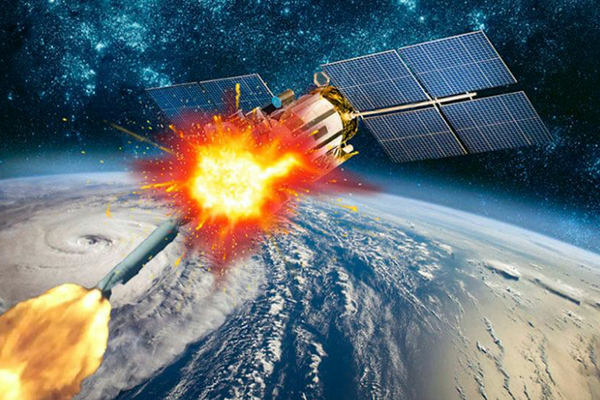
1. Kinetic Kill Weapons (KKW): Kinetic Kill Weapons rely on direct physical impact to destroy satellites in orbit. These systems typically involve ground-based or sea-based direct-ascent missiles that are launched to intercept a satellite at high speeds, causing complete destruction through collision. The advantage of KKWs is their high destructive capability, as they can completely eliminate an adversary’s space asset in one strike. Their major drawback is the generation of massive amounts of space debris, which threatens the attacker’s satellites and also endangers the broader orbital environment, potentially causing long-term hazards for space operations.
2. Co-Orbital ASATs: Co-Orbital Anti-Satellite systems work by placing a satellite into orbit close to the target and maneuvering it for a precise attack. Once in position, the attacking satellite can either ram into its target or deploy explosives to disable or destroy it. While this approach offers controlled targeting and the ability to carry out advanced maneuvers, it is less commonly used today because of its complexity, high costs, and the long preparation time required for deployment. Historically, such systems were developed during the Cold War, but modern militaries have shifted focus to faster and more cost-effective alternatives.
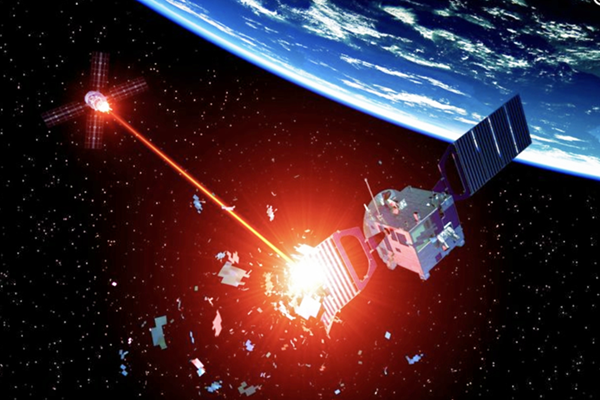
3. Non-Kinetic ASATs: Non-Kinetic ASAT weapons disable or neutralize satellites without physically destroying them, making them less debris-producing and more covert. These include Directed Energy Weapons (DEWs), which use high-powered lasers or microwaves to blind optical sensors, damage satellite electronics, or temporarily disable communication systems. Another category is Electronic Warfare (EW), where satellites are targeted through jamming of communication links, spoofing navigation signals, or disrupting command and control channels. Finally, Cyber-ASATs exploit vulnerabilities in satellite control networks, enabling hackers to take unauthorized control, disable functionalities, or even permanently damage the satellite’s operations. These non-kinetic approaches are increasingly favored as they can effectively neutralize adversary assets with less risk of escalating orbital debris and without leaving clear physical evidence of attack.
Why are ASAT Weapons Important?
- National Security: Satellites play a critical role in modern defense, supporting functions such as surveillance, reconnaissance, communication and navigation. Military operations around the world rely heavily on space-based assets for real-time intelligence and precision targeting. By developing Anti-Satellite (ASAT) weapons, nations gain the ability to neutralize or disable an adversary’s satellites, effectively blinding their surveillance systems and disrupting their communication networks. This capability strengthens national defense strategies and ensures preparedness in the event of a conflict.
- Deterrence: The possession of ASAT technology serves as a powerful deterrent against potential adversaries. When a nation demonstrates that it can disable or destroy satellites in orbit, it signals its ability to undermine the critical infrastructure of its rivals. This acts as a form of strategic warning, discouraging hostile actions by raising the risks and consequences of aggression. Much like nuclear weapons serve as a deterrent on Earth, ASAT capabilities provide leverage in the space domain, reinforcing stability by preventing adversaries from attempting bold military maneuvers.
- Geopolitical Power: Countries with operational ASAT systems position themselves as dominant players in the global space security landscape. Mastery of this technology showcases advanced military and technological capabilities, boosting a nation’s influence in international negotiations and alliances. Possessing ASAT weapons strengthens a country’s defense and also enhances its status as a spacefaring power, giving it a stronger voice in shaping future space policies and treaties. ASAT development is as much about demonstrating strength on the global stage as it is about military advantage.
Risks and Challenges of ASAT Weapons

- Space Debris: One of the most immediate and serious risks of ASAT weapons is the creation of long-lasting orbital debris. When a kinetic ASAT destroys a satellite, thousands of fragments are generated, many of which remain in orbit for decades. These fragments travel at extremely high speeds and can damage or destroy other satellites, spacecraft, or even the International Space Station (ISS). The 2007 Chinese ASAT test, for example, created more than 3,000 trackable debris pieces, highlighting how a single test can compromise the safety of all space assets.
- Escalation of Conflict: The use of ASAT weapons carries the danger of triggering rapid escalation between nations. Satellites are integral to military operations and to civilian communication, weather forecasting and navigation systems. Destroying or disabling one could be perceived as a direct act of war, prompting retaliation that could spiral into a broader military conflict. Given that many spacefaring nations are also nuclear powers, the stakes of such escalation are dangerously high.
- Space Sustainability Threats: Frequent ASAT testing increases the likelihood of Kessler Syndrome, a theoretical scenario in which space debris collides with other objects, creating a self-perpetuating chain reaction of collisions. Such an event could render entire orbital regions unusable for decades, crippling both commercial and scientific missions. This not only threatens future satellite operations but also undermines long-term goals like lunar exploration, Mars missions, and the establishment of space-based infrastructure.
- Dual-Use Technology: Another challenge with ASAT weapons is their dual-use nature. Technologies such as high-powered lasers or electronic warfare systems can be developed under the guise of civilian applications, such as satellite servicing or space communication improvements. This blurs the line between peaceful and military use, making regulation and verification difficult. The dual-use dilemma complicates international arms control efforts and raises suspicion between nations, potentially fueling an arms race in space.
International Treaties and Regulations
- Outer Space Treaty (1967): The Outer Space Treaty remains the cornerstone of international space law, signed by more than 100 countries. It prohibits the placement of weapons of mass destruction such as nuclear weapons, in orbit or on celestial bodies, ensuring that space is used for peaceful purposes. However, the treaty does not explicitly ban the development or use of conventional ASAT weapons, leaving a legal loophole that allows nations to continue pursuing such technologies under the guise of defense.
- Prevention of an Arms Race in Outer Space (PAROS): The PAROS initiative, introduced by the United Nations, aims to prevent the militarization of space and the deployment of space-based weapons. While many nations support the idea, efforts to create a binding treaty have stalled due to geopolitical rivalries and disagreements over definitions and verification mechanisms. Without consensus, PAROS remains more of a political statement than an enforceable framework, limiting its effectiveness in curbing ASAT proliferation.
- Voluntary Debris Mitigation Guidelines: To address the growing problem of orbital debris, international bodies such as the UN Committee on the Peaceful Uses of Outer Space (COPUOS) and the Inter-Agency Space Debris Coordination Committee (IADC) have issued voluntary debris mitigation guidelines. These guidelines encourage satellite operators and nations to adopt best practices, such as deorbiting defunct satellites and minimizing debris creation during launches. However, compliance is voluntary, and without strict enforcement, many countries continue to test ASAT weapons that generate long-lasting debris.
- Lack of Binding Global Rules: The absence of legally binding international regulations on ASAT weapons remains one of the greatest challenges to space security. Current treaties and guidelines focus on general principles rather than specific prohibitions, allowing nations to justify ASAT development as part of their defense strategies. This legal vacuum fuels concerns about a future space arms race, where multiple nations may pursue increasingly advanced ASAT capabilities, raising risks for both military and civilian space assets.
Demonstrations by Major Space Powers
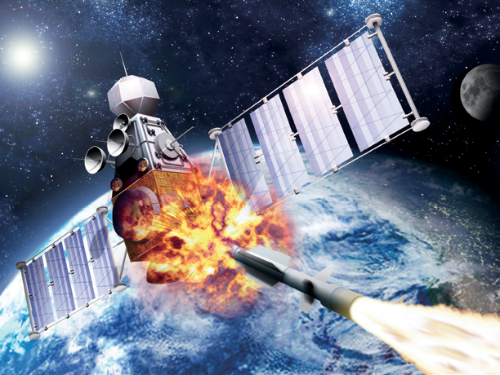
- United States: The United States has been a pioneer in demonstrating ASAT technology. In 1985, the U.S. successfully destroyed a satellite using an ASM-135 missile launched from an F-15 fighter jet, marking one of the earliest proof-of-concept missions. Later in 2008, the U.S. Navy conducted Operation Burnt Frost, where a Standard Missile-3 (SM-3) interceptor destroyed the malfunctioning USA-193 satellite in Low Earth Orbit (LEO). The operation was framed as a safety measure to prevent hazardous fuel reentry, but it also highlighted America’s continued ASAT capability, reinforcing its position as a space defense leader.
- Russia: Russia has pursued ASAT systems since the Cold War, with projects ranging from co-orbital interceptors to direct-ascent missiles. More recently, it has conducted multiple tests of the PL-19 Nudol missile system, designed to intercept satellites in LEO. While not all demonstrations have resulted in confirmed satellite destruction, the tests clearly signal Russia’s intent to maintain a strong presence in space defense. These activities raise global concerns about space militarization and the potential risks of debris creation from future tests.
- China: China conducted a highly controversial ASAT test in January 2007, which remains one of the most destructive events in the history of space. A ballistic missile was launched to intercept and destroy the Fengyun-1C weather satellite in LEO. The collision generated over 3,000 trackable debris pieces and tens of thousands of smaller fragments, many of which remain in orbit today, posing long-term threats to satellites and human spaceflight. This test drew widespread international criticism and intensified global discussions about the need for stricter space security agreements.
- India: In March 2019, India joined the ranks of space powers with demonstrated ASAT capabilities through Mission Shakti. The test involved the successful interception and destruction of a live satellite in LEO using a direct-ascent missile. India emphasized that the mission was conducted at a relatively low altitude to minimize space debris, with most fragments expected to reenter the atmosphere quickly. The demonstration was seen as a major milestone in India’s defense strategy, signaling its technological maturity and positioning it as the fourth country in the world to showcase such capabilities.
Future of Anti-Satellite Weapons

- Shift Toward Non-Kinetic ASATs: The future of ASAT development is expected to move away from destructive kinetic systems that generate long-lasting space debris. Instead, countries will focus on non-kinetic methods such as cyberattacks, signal jamming, spoofing, and directed-energy weapons like high-powered lasers and microwaves. These approaches allow satellites to be disabled or disrupted without creating hazardous orbital fragments, making them more appealing for long-term space sustainability.
- Space Defense Shields: As ASAT threats grow, space defense systems will likely evolve to include active protective measures such as laser-based countermeasures. These technologies could blind or disable approaching hostile satellites or missiles before they reach their target, effectively acting as a “shield” for valuable space assets. Such systems would transform space security from a purely defensive posture into one of active deterrence.
- AI-Powered Space Monitoring Systems: Artificial Intelligence (AI) is set to play a central role in monitoring and responding to ASAT threats in real time. With the increasing number of satellites and objects in orbit, AI algorithms can analyze massive amounts of tracking data, detect anomalies, and predict potential attacks. By automating threat detection and response, AI will provide nations with faster decision-making capabilities in the rapidly evolving space domain.
- Stronger International Diplomacy: The rise of ASAT technologies also underscores the urgent need for stronger international agreements and collaborative frameworks. Without binding rules, the risk of escalation and weaponization of space increases dramatically. Future diplomacy efforts will likely focus on arms control, transparency measures, and space sustainability initiatives to balance national security needs with the collective interest of keeping space safe for all.
Anti-Satellite Weapons (ASAT) represent one of the most powerful and controversial advancements in space security. The destructive consequences of kinetic ASATs, particularly the creation of long-lasting orbital debris pose significant risks to the safety and sustainability of outer space, threatening both military and civilian satellites that enable global communication, navigation, weather monitoring and scientific research. The future of these technologies must therefore be guided by strong international cooperation, transparent space policies and innovations that prioritize non-destructive defense mechanisms over aggressive capabilities.