Symphony Space is developing a Space-as-a-Service technology platform designed to simplify access to orbit for commercial, government, academic and defense users. Instead of requiring customers to build and operate dedicated satellites, the company provides a reusable orbital infrastructure where payloads can be hosted through a subscription-based model. By eliminating the need for costly hardware ownership and lengthy spacecraft development, Symphony aims to make deploying space missions as straightforward as provisioning cloud computing resources on Earth.

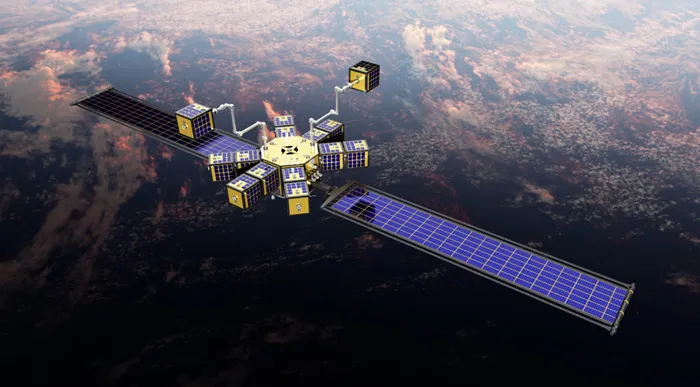
At the center of the company’s technology portfolio is Adagio, a reusable payload hosting platform built around the proprietary Conductor Core Bus. Designed with a payload capacity of up to 1,200 kg and an operational lifespan of more than 15 years, Adagio serves as a shared orbital platform that provides essential spacecraft functions including power, communications, thermal management, precision pointing, robotics and ground network connectivity allowing customers to focus solely on their mission payloads. The platform is designed to reduce mission costs by up to four times compared with conventional single-use payload hosting solutions while significantly shortening the time from contract to launch through a standardized spacecraft architecture.
Also Read: What is a Payload Mass of a Satellite Bus?
The Adagio platform follows a modular operational model that enables payloads to launch as rideshare secondary payloads, eliminating the need for dedicated launch vehicles. After launch, an Orbital Transfer Vehicle (OTV) transports the payload module to the Conductor platform, where a robotic arm autonomously captures and berths it. Within days, hosted payloads become fully operational while Symphony manages platform health, power allocation, communications and mission infrastructure, enabling customers to concentrate on operating their experiments, sensors or technology demonstrations. The company also supports payload integration, interface testing, validation and pre-launch acceptance through the in-house engineering facilities.

Symphony’s technology is designed to support a broad range of missions through the mission-agnostic architecture. The platform can host payloads for Earth observation, communications, scientific research, in-space manufacturing, pharmaceutical and biotechnology experiments, AI computing, defense and intelligence missions, space domain awareness, ISR and resilient communications. The company also leverages blockchain-backed data integrity to provide cryptographically isolated payload operations, ensuring secure data handling and non-interference between hosted missions operating on the same platform.
Building on Adagio, Symphony Space is developing an orbital infrastructure ecosystem centered on modularity, reconfigurability and long-term orbital operations. The platform is designed to accommodate payload upgrades, servicing and reconfiguration throughout the operational life. Through partnerships supporting ground station connectivity, sovereign data infrastructure, and future modular orbital services, Symphony aims to establish reusable space infrastructure that reduces barriers to entry while enabling faster, more flexible and more cost-effective access to orbit.
About Symphony Space
Symphony Space is a U.S-based aerospace company developing reusable orbital infrastructure and Space-as-a-Service technologies for commercial, government, academic and defense customers. The flagship Adagio platform provides modular payload hosting, spacecraft services and long-term orbital operations through a subscription-based model, enabling organizations to deploy and operate space missions without developing dedicated spacecraft.