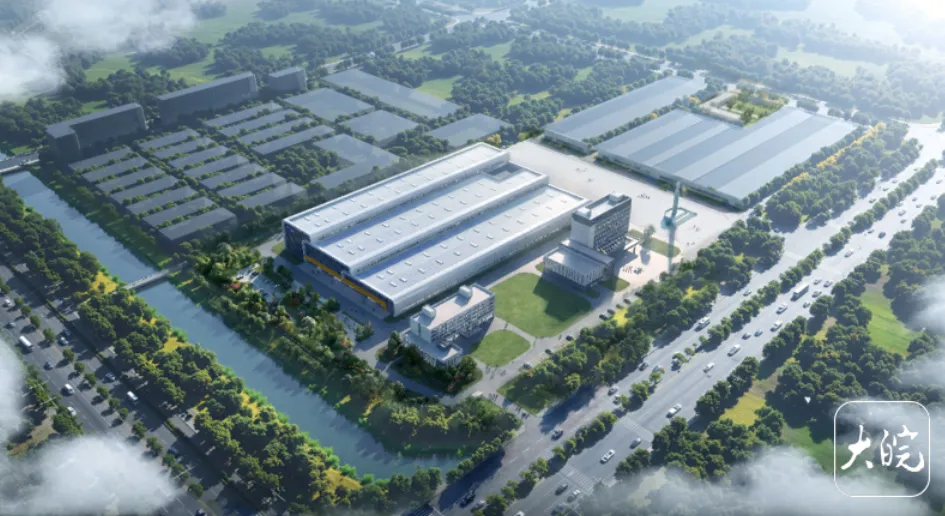
August 10, 2026 — Galactic Energy has officially begun construction of a major industrialization project in Chizhou, Anhui Province, designed to support the production of 24 reusable liquid launch vehicles annually.
The second-phase project, located in the Wanjiang Jiangnan Emerging Industries Concentration Zone, represents another major step in Galactic Energy’s expansion in Chizhou and marks further progress toward the large-scale production of reusable liquid rockets in China’s commercial space sector.
The project is being implemented by Anhui Galaxy Power Equipment Technology Co., Ltd., a subsidiary of Galactic Energy. With a total investment of 1.5 billion yuan ($210 million), the project will include a reusable rocket engine technology R&D center, Phase II of the liquid launch vehicle final assembly line, and Phase II of the Pallas engine assembly line.
It will also feature supporting facilities including a test stand for reusable rocket propulsion systems, a turbopump hydraulic test stand, and a space education and research center. The overall project will cover multiple functions spanning research and development, final assembly, testing, and science education.
Once fully operational, the facility is expected to achieve an annual production capacity of 24 reusable liquid launch vehicles, generating an estimated annual output value of 1.2 billion yuan and approximately 50 million yuan in annual tax revenue.
The new infrastructure is expected to address key hardware constraints in Galactic Energy’s ability to manufacture reusable rockets at scale and conduct extensive ground testing and validation. At the regional level, the project is also expected to strengthen the concentration of advanced manufacturing capabilities and accelerate the development of what China calls “new quality productive forces.”
From Ceres-1 to Pallas-1
Galactic Energy is one of China’s leading private commercial launch companies and was the country’s first private rocket company to achieve a sustained series of successful launches. Its product portfolio currently includes the Ceres series of solid-propellant launch vehicles and the Pallas series of medium-sized reusable liquid launch vehicles.
The company has achieved a number of milestones in China’s commercial launch industry, including becoming the first Chinese private rocket company to deliver satellites to a 500-kilometer Sun-synchronous orbit, an 800-kilometer inclined orbit, and a dawn-dusk orbit. It also conducted the first sea launch by a private Chinese rocket company and was among the first to establish rocket mass-production and high-frequency launch capabilities.
Galactic Energy established operations in the Wanjiang Jiangnan Emerging Industries Concentration Zone in late 2019, laying the foundation for its aerospace manufacturing activities in Chizhou.
In May 2023, the Pallas-1 liquid launch vehicle completed final assembly and rolled off the production line at the site. The rocket has since undergone multiple critical tests ahead of its maiden flight.
On August 3, Galactic Energy announced that the Pallas-1 Yao-1 rocket would conduct its launch mission at an appropriate opportunity in the near term. The newly launched Phase II industrialization project is intended to provide the production capacity needed to support the rocket’s future high-frequency launch operations.
Galactic Energy’s official English-language website identifies the rocket as Pallas-1, describing it as a medium reusable liquid launch vehicle with a vertically recoverable first stage and a designed reuse count of 25 flights.

Chizhou Builds a Commercial Space Industry Cluster
Galactic Energy’s expansion is taking place alongside the rapid development of the broader commercial space industry cluster in the Wanjiang Jiangnan Emerging Industries Concentration Zone.
The industrial zone has already attracted 23 upstream and downstream companies, with total project investment reaching 19.26 billion yuan. Its industrial chain spans rocket R&D and manufacturing, satellite payloads, aerospace materials, space-based data services, and aerospace education and tourism.
As the industrial cluster’s leading enterprise, Galactic Energy’s Phase II project represents both a strategic move to accelerate the company’s transition toward large-scale reusable rocket manufacturing and a major milestone in the expansion of Chizhou’s commercial space industry.
Once the new test stands, assembly lines, and R&D facilities are completed, the area is expected to establish an integrated industrial loop covering rocket development, final assembly and integration, and ground testing and validation.
The resulting infrastructure could help accelerate the iteration of reusable launch vehicle technologies in China while providing the manufacturing and testing capacity required to support the country’s growing demand for high-frequency commercial space launches.