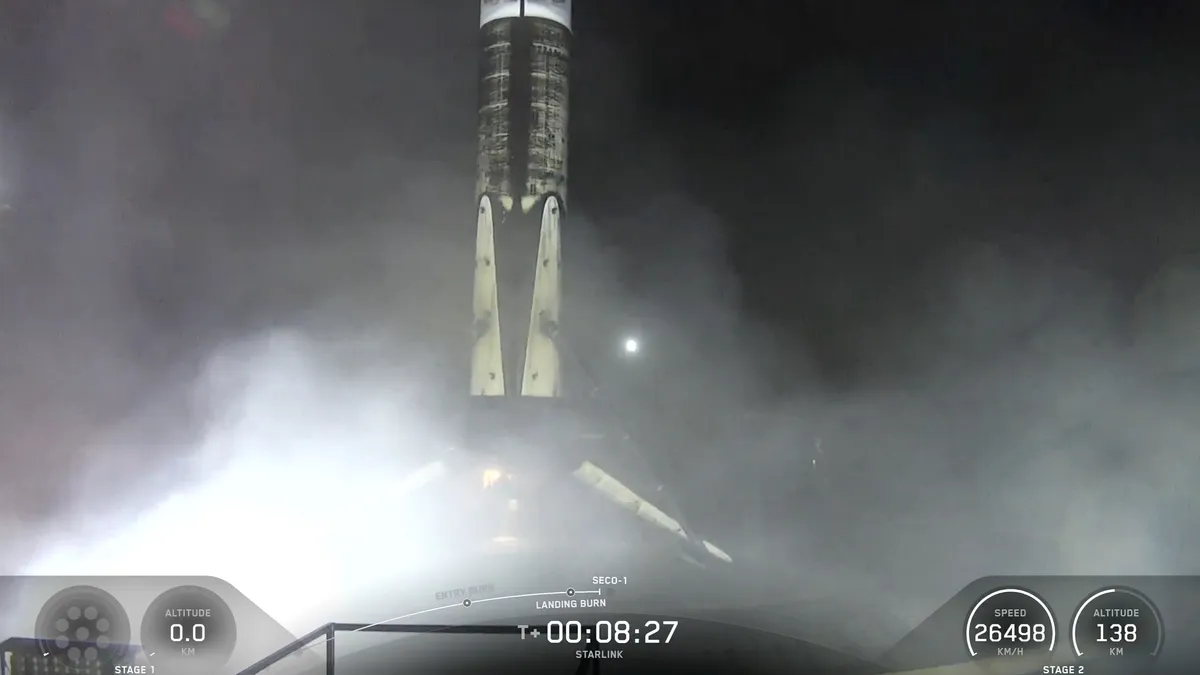
SpaceX has completed its 100th mission of 2026, reaching the milestone on Aug. 19 with another Starlink deployment from California. The mission, Starlink Group 17-50, sent 24 Starlink broadband satellites toward low Earth orbit aboard a flight-proven Falcon 9, underscoring how rapidly SpaceX has transformed orbital launch from an occasional event into a high-frequency operational service.
The Falcon 9 lifted off from Space Launch Complex 4 East at Vandenberg Space Force Base at 12:01 a.m. EDT (0401 GMT) on Aug. 19, or 9:01 p.m. local time on Aug. 18. The launch represented SpaceX’s 97th Falcon 9 flight of the year and its 100th mission overall in 2026.
The mission also demonstrated the increasingly routine nature of booster reuse. The Falcon 9’s first stage returned to Earth approximately 8.5 minutes after liftoff and landed on the drone ship Of Course I Still Love You in the Pacific Ocean. The booster, designated B1097, completed its 12th mission.
The upper stage was scheduled to deploy the 24 Starlink satellites into low Earth orbit about 61.5 minutes after liftoff. For SpaceX, however, the significance of the flight extends well beyond another successful Starlink launch: the company is now operating at a launch tempo that was almost unimaginable for the traditional commercial launch industry.
A 100-launch year is becoming SpaceX’s new baseline
SpaceX’s 100th mission of 2026 is significant partly because it is no longer unprecedented for the company.
SpaceX first surpassed 100 launches in a calendar year in 2024, completing 138 missions. Falcon 9 accounted for 132 of those flights, while Falcon Heavy flew twice and Starship conducted four test flights. The company increased its total to 170 missions in 2025, including 165 Falcon 9 launches and five Starship flights.
The 2026 milestone therefore represents the continuation of a steep upward trajectory rather than a one-off record.
More importantly, most of those missions are not independent commercial launches for unrelated customers. Starlink is the primary engine behind the cadence.
At the time of the Aug. 19 launch, 74 of SpaceX’s 2026 missions had been dedicated to building or maintaining the Starlink constellation. The network had grown to nearly 11,000 operational satellites.
That relationship between launch cadence and constellation deployment is central to SpaceX’s business model. Instead of waiting for a customer to purchase a launch, manufacture a payload and schedule a mission, SpaceX can generate a substantial portion of its own launch demand through Starlink.
The result is a vertically integrated system: SpaceX designs and manufactures satellites, operates the broadband network, manufactures the Falcon 9, provides launch services and reuses the rocket’s most expensive hardware.
That model helps explain why launch frequency has become such an important competitive metric.
B1097 illustrates what rocket reuse looks like at scale
The Starlink Group 17-50 mission also provides a useful snapshot of the maturity of Falcon 9 reuse.
B1097 was flying for the 12th time. Earlier in 2026, the same booster achieved another milestone when it performed the 600th successful landing of an orbital-class rocket stage in SpaceX’s history during a Starlink mission.
The technical principle behind Falcon 9’s operational advantage is straightforward but difficult to execute.
After separation from the second stage, the booster uses a combination of aerodynamic control surfaces, cold-gas or propulsive attitude control and Merlin engine burns to control its trajectory. Depending on the mission profile, it can return to a landing zone near the launch site or fly farther downrange to a drone ship.
During the Aug. 19 mission, B1097 used the latter approach.
The ability to recover the first stage does more than save the cost of manufacturing an entirely new rocket for every mission. It also changes the logistics of launch operations. A booster can be inspected, refurbished as necessary, integrated with another payload and returned to service rather than being discarded after a single flight.
That distinction has become increasingly important as satellite constellations create demand for dozens or even hundreds of launches each year.
The Falcon 9 is therefore not simply a reusable rocket. It is part of an operational system designed around repeated flights.
Starlink has become the payload that fills the launch pipeline
The 24 satellites launched on Starlink Group 17-50 are another increment in the construction of one of the largest satellite networks ever assembled.
A broadband constellation requires a fundamentally different launch strategy from a conventional communications satellite.
Traditional geostationary communications satellites are expensive, individually valuable spacecraft that may serve a geographic market for 15 years or more. Operators therefore launch relatively few of them and spend considerable time optimizing each mission.
Starlink uses the opposite philosophy.
The system relies on large numbers of relatively standardized spacecraft distributed across multiple orbital planes. Individual satellites can therefore be replaced or supplemented without depending on a single spacecraft to provide the entire service.
This approach creates a natural requirement for sustained launch capacity.
As satellites reach the end of their operational lives, new spacecraft must replace them. Additional launches can also expand network capacity, improve coverage and alter the distribution of spacecraft across orbital planes.
For SpaceX, a frequent Falcon 9 schedule is therefore not merely a launch-services capability. It is infrastructure for maintaining a global telecommunications network.
The Aug. 19 launch came during an exceptionally busy month
The 100th mission arrived only days after SpaceX demonstrated another aspect of its launch cadence.
On Aug. 15, the company launched two Falcon 9 rockets just 38 minutes apart from Florida and California. One mission carried eight Globalstar satellites from Cape Canaveral Space Force Station, while another launched the classified USSF-366 mission from Vandenberg Space Force Base. Both first stages were successfully recovered.
That 38-minute interval established a new record for the shortest time between two orbital launches, surpassing SpaceX’s previous record from Aug. 31, 2024.
The sequence is important because it demonstrates that SpaceX’s advantage is not simply the ability to build rockets quickly. It is the ability to coordinate launch pads, range operations, ground infrastructure, payload processing, flight-proven boosters and recovery assets at high tempo.
That operational architecture is considerably harder for competitors to replicate than any individual component.
SpaceX’s next target is far beyond 100 launches
The Falcon 9 will eventually become less central to SpaceX’s long-term launch strategy if the company’s Starship program achieves its intended goals.
SpaceX founder and CEO Elon Musk has previously described a future in which Starship could fly multiple times per day, potentially pushing the company’s annual launch total toward roughly 1,000 missions. Falcon 9 and Falcon Heavy are ultimately intended to be phased out in favor of Starship.
That target remains an ambitious technological and operational objective.
Starship is substantially larger than Falcon 9 and is being developed as a fully reusable two-stage system. If SpaceX succeeds in making both stages rapidly reusable, its theoretical launch economics could be dramatically different from today’s partially reusable Falcon 9 architecture.
But the transition also introduces new challenges. Starship must demonstrate reliable orbital operations, rapid turnaround, controlled atmospheric reentry, recovery of its booster and eventually recovery of its upper stage.
In that sense, Falcon 9’s 100-mission year can be viewed as both an achievement and a bridge to the next stage of SpaceX’s strategy.
The company is already demonstrating what high-frequency reusable launch looks like with Falcon 9. Starship is intended to multiply that capability.
The competitive gap is shifting from rocket design to launch operations
SpaceX’s achievement also changes the nature of competition in the launch market.
Blue Origin’s New Glenn, United Launch Alliance’s Vulcan, Rocket Lab’s Neutron and emerging Chinese reusable launch vehicles are pursuing technologies that could eventually reduce the gap in reusable launch capability.
But matching Falcon 9’s hardware performance is only part of the challenge.
A competitor must also develop sufficient launch infrastructure, secure a steady customer base, maintain production capacity, manage range availability and demonstrate that recovered boosters can return to flight rapidly and reliably.
This is why SpaceX’s launch statistics matter to the broader industry.
A rocket that can technically be reused but flies only a few times per year does not create the same economic advantage as a booster that can support a dense manifest.
SpaceX’s 2026 campaign suggests that launch frequency itself has become a competitive capability.
China is building its own path toward high-frequency reusable launch
The implications are particularly significant in China, where the government and commercial sector are accelerating work on reusable launch vehicles and large low Earth orbit constellations.
China has been deploying spacecraft for its own large-scale broadband constellation programs, including Guowang and the commercial Spacesail network. A modified Long March-6 launch on June 4, for example, placed another group of satellites into orbit for the Spacesail constellation. A similar launch on July 4 added another satellite group.
China is also rapidly closing the technological gap in reusable launch.
On July 10, China’s state-owned space sector successfully recovered the first stage of a Long March 10B using a ship-based net-capture system. The achievement represented China’s first successful orbital booster recovery and introduced a different approach from Falcon 9’s propulsive landing architecture.
Chinese commercial launch company LandSpace then achieved another milestone with Zhuque-3. On Aug. 18, the methane-fueled reusable rocket successfully landed its first stage on solid ground using landing legs, making LandSpace the first Chinese private company to accomplish an orbital booster recovery of this type.
The significance for the Starlink model is clear.
China is not merely attempting to reproduce reusable rockets as an engineering exercise. Reusable launch technology is increasingly connected to the country’s ambitions for large satellite constellations, commercial space services and a more competitive launch industry.
The strategic challenge for Chinese operators will be moving from successful demonstrations to repeatable, high-frequency operations.
That is precisely the stage at which SpaceX currently has its greatest advantage.
The real race is becoming constellation plus launch infrastructure
The Starlink Group 17-50 launch illustrates a broader transformation in the global space industry.
The traditional launch market was largely organized around individual missions: one rocket, one customer and one major payload.
The emerging model is increasingly organized around infrastructure.
A constellation operator needs hundreds or thousands of satellites. Those satellites require manufacturing capacity, launch capacity, ground stations, spectrum coordination, network management and replacement launches.
This creates a feedback loop.
More satellites increase network capacity. More network capacity can support more customers. More customers generate revenue that can finance additional satellites and launches. Higher launch volume improves operational experience and spreads fixed infrastructure costs over more missions.
SpaceX has combined those elements more tightly than any other launch provider to date.
The 100th mission of 2026 is therefore less important as a round number than as evidence of that integrated system operating at scale.
What comes after the century mark
SpaceX is unlikely to treat 100 missions as the endpoint.
The company’s immediate trajectory remains centered on continuing Falcon 9 operations while expanding Starlink and preparing for the eventual transition to Starship. The Falcon 9 launch rate already demonstrates that reusable orbital launch can support a cadence far beyond the historical norms of the industry.
The next question is whether SpaceX can transfer that operational discipline to Starship.
If it succeeds, the consequences could extend well beyond Starlink. A fully reusable heavy-lift system capable of frequent launches could support larger satellite constellations, national-security missions, lunar infrastructure and eventually deep-space transportation.
Meanwhile, competitors in the United States and China are pursuing their own reusable architectures and constellation strategies.
The Aug. 19 Starlink mission therefore marks more than SpaceX’s 100th mission of 2026. It represents a stage in the industry’s transition toward an operating model in which rockets are treated less like disposable launch vehicles and more like repeatedly used transportation assets.
SpaceX has now reached that model with Falcon 9 at a scale unmatched by its competitors. The more consequential question is whether the company can push the same concept from roughly 100 missions per year toward several hundred—and eventually toward the much more radical launch cadence envisioned for Starship.
For the global launch industry, the benchmark is no longer simply whether a rocket can reach orbit or land after launch. Increasingly, the benchmark is how often it can do so, how quickly it can return to flight, and whether the surrounding industrial system can sustain that pace.