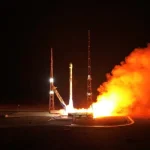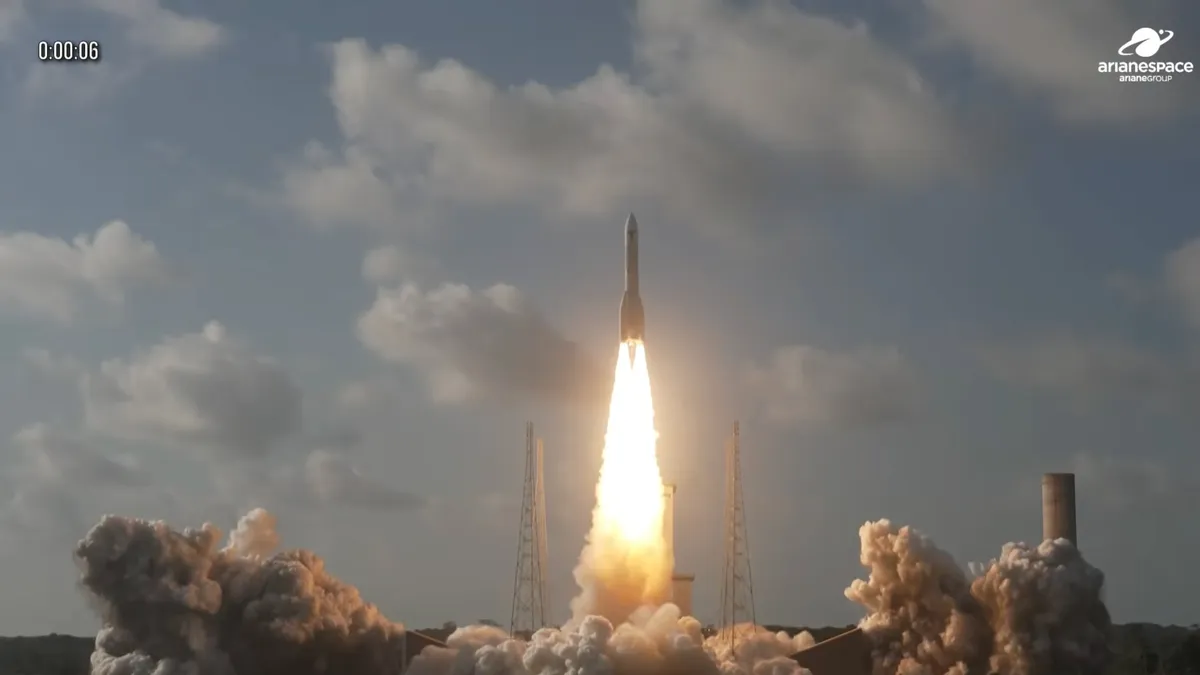
Europe’s Ariane 6 launcher successfully placed the Meteosat Third Generation Imager-2 (MTG-I2) weather satellite into its intended transfer orbit on Aug. 27, marking the rocket’s first mission to a geostationary destination and a major milestone for both the Ariane 6 program and Europe’s next-generation meteorological infrastructure.
The launch took place from the ELA-4 pad at the Guiana Space Centre in French Guiana using the Ariane 62 configuration, which employs two P120C solid rocket boosters. The mission was one of the most strategically important Ariane 6 flights to date, combining operational weather services with Europe’s efforts to restore independent access to space across multiple orbital regimes.
Third Satellite in the MTG Constellation
MTG-I2 is the second imaging spacecraft and the third satellite overall in the Meteosat Third Generation (MTG) program, developed through cooperation between the European Space Agency (ESA) and EUMETSAT. It joins the already operational MTG-Imager and MTG-Sounder spacecraft in orbit.
The satellite is designed to provide high-resolution meteorological imagery for Europe, Africa, the Atlantic Ocean and surrounding regions. Its Flexible Combined Imager (FCI) instrument significantly improves temporal and spatial coverage compared with previous Meteosat generations, supporting faster detection of rapidly developing weather systems and more accurate forecasting of severe storms.
MTG imagers can observe the entire Earth disk visible from geostationary orbit every 10 minutes while providing rapid scans of Europe at intervals as short as 2.5 minutes. The enhanced observation cadence is particularly valuable for monitoring convective storm development, aviation hazards, wildfires and other fast-changing weather phenomena.
A New Era for European Weather Monitoring
The MTG system represents Europe’s largest meteorological satellite modernization effort in decades. Unlike the previous Meteosat Second Generation spacecraft, the MTG architecture combines dedicated imaging and atmospheric sounding satellites to provide a more comprehensive picture of weather evolution.
When fully deployed, the MTG constellation is expected to generate dramatically more data than the Meteosat Second Generation fleet. The increased data volume supports more sophisticated numerical weather prediction models, near-real-time severe weather monitoring and improved climate observation capabilities.
The constellation also plays a growing role in sectors beyond traditional forecasting. Higher-frequency imagery and lightning detection data are increasingly used by aviation operators, emergency management agencies, renewable energy providers and maritime services that depend on accurate short-term weather intelligence.
First Geostationary Assignment for Ariane 6
While Ariane 6 entered service as Europe’s successor to Ariane 5, the MTG-I2 mission carried additional significance because it was the rocket’s first operational launch toward geostationary orbit. The mission represented the farthest destination reached by Ariane 6 so far and demonstrated the launcher’s ability to support Europe’s most demanding institutional payloads.
Geostationary missions remain a critical market segment for launch providers because they support communications, weather and national security satellites that often represent some of the highest-value spacecraft in operation. Successfully executing a geostationary transfer mission helps validate Ariane 6’s performance across the full range of payload classes it is expected to serve during its operational life.
For Europe, the achievement also demonstrates growing confidence in the launcher following its early flights and supports plans to increase launch cadence. Ariane 6 is expected to support a diverse manifest that includes weather satellites, Galileo navigation spacecraft, scientific missions and commercial payloads in the coming years.
Manufacturing and Operational Implications
The MTG program reflects a broader trend in Earth observation and meteorological satellite development: greater emphasis on data throughput and refresh rates rather than simply increasing sensor resolution. Modern weather forecasting increasingly relies on frequent observations that can be assimilated into numerical models within minutes of acquisition.
From a satellite manufacturing perspective, the transition from Meteosat Second Generation to MTG required more advanced onboard processing, higher-capacity communications systems and extensive qualification campaigns to validate long-duration geostationary operations. The deployment of multiple specialized spacecraft also illustrates a growing preference for distributed mission architectures that separate imaging and sounding functions while maintaining coordinated coverage.
The successful launch of MTG-I2 therefore strengthens not only Europe’s meteorological capabilities but also the industrial ecosystem responsible for producing large, high-performance geostationary satellites and the launch systems required to deploy them.
Next Steps for the MTG Program
Following orbital insertion and spacecraft checkout, MTG-I2 will undergo a commissioning campaign before entering operational service within the MTG constellation. Additional satellites planned under the program will further expand observation capabilities and ensure continuity of European weather monitoring well into the 2040s.
The launch also sets the stage for additional EUMETSAT missions on Ariane 6, including future MetOp Second Generation spacecraft, reinforcing the launcher’s role as a cornerstone of Europe’s civil space infrastructure.