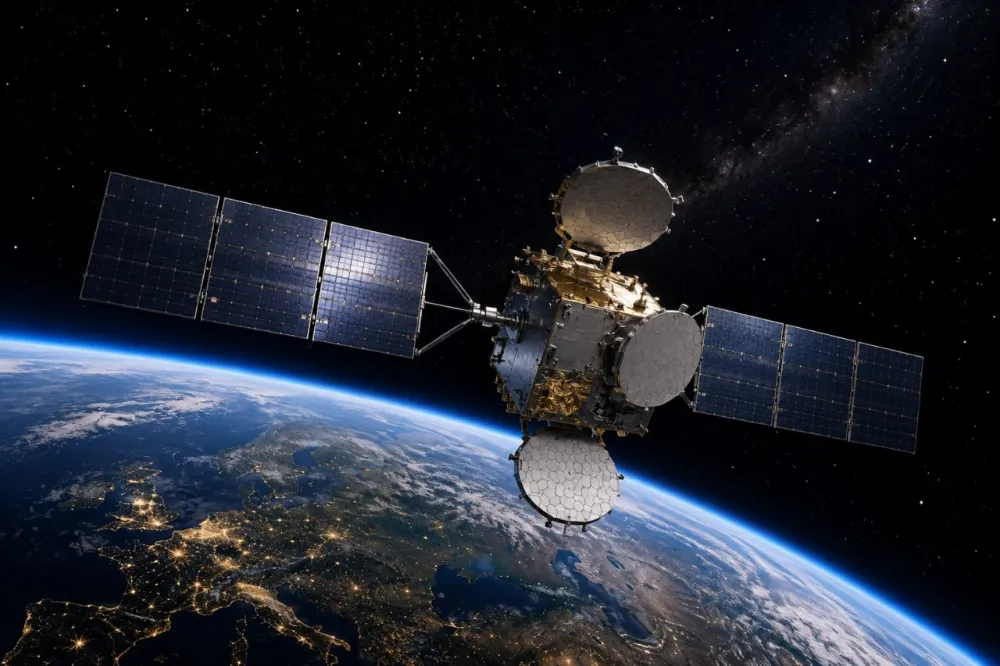
German satellite manufacturer OHB has secured a contract worth nearly €1 billion ($1.16 billion) from SES to develop and manufacture all 18 medium Earth orbit satellite platforms for the European Union’s IRIS² secure connectivity constellation.
Announced on August 31, 2026, the award is the first major industrial contract placed since IRIS² entered full-scale implementation on August 6. It converts a central part of Europe’s sovereign communications initiative from system planning into satellite production.
SES is responsible for delivering the medium Earth orbit, or MEO, component of IRIS² through SpaceRISE, the consortium it leads alongside Eutelsat and Hispasat. OHB has been part of the consortium’s industrial core team since the program’s early development.
The first IRIS² satellites are scheduled to launch in 2029, with initial services expected in 2030.
OHB to Supply the Platforms, SES to Lead the MEO Segment
Under the contract, OHB will develop and produce 18 satellite platforms, rather than complete spacecraft including their communications payloads. SES will lead the overall MEO segment and has previously said it expects to invest up to €1.35 billion in that portion of the network.
Each OHB-built satellite will have a launch mass of approximately 2.6 metric tons and deliver up to 15 kilowatts of power. Those figures place the spacecraft in the class of large, high-capacity telecommunications satellites, despite IRIS² being frequently described primarily as a constellation program.
The 18 platforms will form the orbital, power, thermal and command foundation for the MEO communications payloads. Producing them as a coordinated fleet should allow OHB to standardize equipment and integration procedures, but the contract still represents a substantial manufacturing and testing campaign.
Power systems, deployable structures, thermal management and payload interfaces will need to support high-throughput communications equipment throughout long operational lives in MEO. The production program will also require repeated structural, vibration, electromagnetic compatibility and thermal-vacuum verification while maintaining configuration control across 18 units.
For OHB, the award expands its role in large European infrastructure programs after its participation in Galileo and Copernicus. It also provides a significant production backlog extending toward the beginning of IRIS² deployment.
IRIS² Expands to 348 Satellites
The European Commission and SpaceRISE signed the original 12-year IRIS² concession contract on December 16, 2024. At that stage, the network was expected to include 290 satellites and require approximately €10.55 billion in investment.
Following a major program review and several months of negotiations, the parties signed an implementation agreement on August 6, 2026. The revised baseline increases the main constellation to 348 spacecraft: 330 in higher low Earth orbit and 18 in MEO.
The updated architecture adds 66 higher-LEO satellites intended to increase capacity for defence, security and emergency services. European officials expect the expansion to raise available governmental communications capacity by about 60% within the EU and 54% worldwide.
Total planned investment now exceeds €15.6 billion. Approximately €11.6 billion is expected to come from European public funding, while the SpaceRISE partners plan to invest as much as €4 billion.
The €11.6 billion public contribution is separate from OHB’s nearly €1 billion satellite-platform contract. Expressed in dollars, the OHB award is worth approximately $1.16 billion.
Industrial responsibilities are divided among the three principal SpaceRISE operators. SES leads the MEO segment, Eutelsat is responsible for the 330-satellite LEO layer, and Hispasat is the prime contractor for a government ground segment valued at more than €1.6 billion. That ground infrastructure will include antennas, control systems and terrestrial network connections needed to manage secure services.
Why IRIS² Uses Both LEO and MEO
IRIS² is not designed as a direct architectural copy of SpaceX’s Starlink. Starlink relies on a much larger fleet concentrated in LEO, while IRIS² combines LEO and MEO assets with access to existing European communications capacity.
Satellites in LEO offer low signal latency and can concentrate capacity over areas of high demand, but their relatively small coverage footprints require large numbers of spacecraft, frequent user handovers and extensive gateway infrastructure.
MEO satellites operate farther from Earth and therefore introduce more propagation delay than LEO spacecraft. In return, each satellite can cover a much larger geographic area. A fleet of 18 MEO spacecraft can provide broad, persistent coverage while requiring fewer satellites and handovers than a purely LEO architecture.
SES has said the IRIS² MEO satellites will use inclined orbits, expanding coverage beyond the equatorial geometry of its existing O3b and O3b mPOWER systems. The planned configuration is intended to support pole-to-pole connectivity, including regions difficult to serve with equatorial MEO spacecraft.
The MEO layer can therefore provide wide-area resilience and continuity, while the larger LEO fleet supplies lower-latency capacity. Integrating the two will depend on the performance of the ground network, traffic-management software and interconnection between orbital layers—not simply the number of satellites deployed.
Europe Moves From Policy to Production
IRIS² is intended to provide encrypted and resilient communications for EU institutions, national governments, defence users, emergency services and critical infrastructure operators. Commercial capacity will also serve companies and communities beyond the reach of reliable terrestrial networks.
The program has gained strategic urgency as European governments seek communications infrastructure that remains under European jurisdiction during conflicts, disasters or disruption to terrestrial networks. The war in Ukraine demonstrated both the operational value of commercial satellite broadband and the risks created when governments depend heavily on infrastructure controlled by a small number of non-European providers.
Unlike Starlink’s predominantly commercial deployment model, IRIS² is a public-private system built around sovereign and accredited government services. Its performance will consequently be judged not only by bandwidth and latency, but also by cybersecurity, resistance to interference, service continuity and the ability to prioritize authorized traffic during crises.
The OHB award is an early test of whether Europe can translate that strategic objective into an integrated production program on schedule. The 2029 launch target leaves roughly three years for detailed design, procurement, qualification, fleet manufacturing and launch preparation. Long-lead electronics, high-power payload support equipment and radiation-qualified components will be important schedule drivers.
Deployment will also require sufficient European launch capacity for both the 2.6-ton MEO spacecraft and the much larger number of LEO satellites. European launchers are expected to play a central role, making IRIS² not only a satellite manufacturing program but also a major source of institutional demand for Europe’s launch industry.