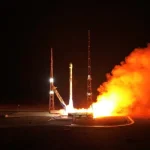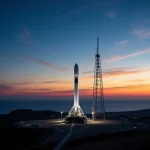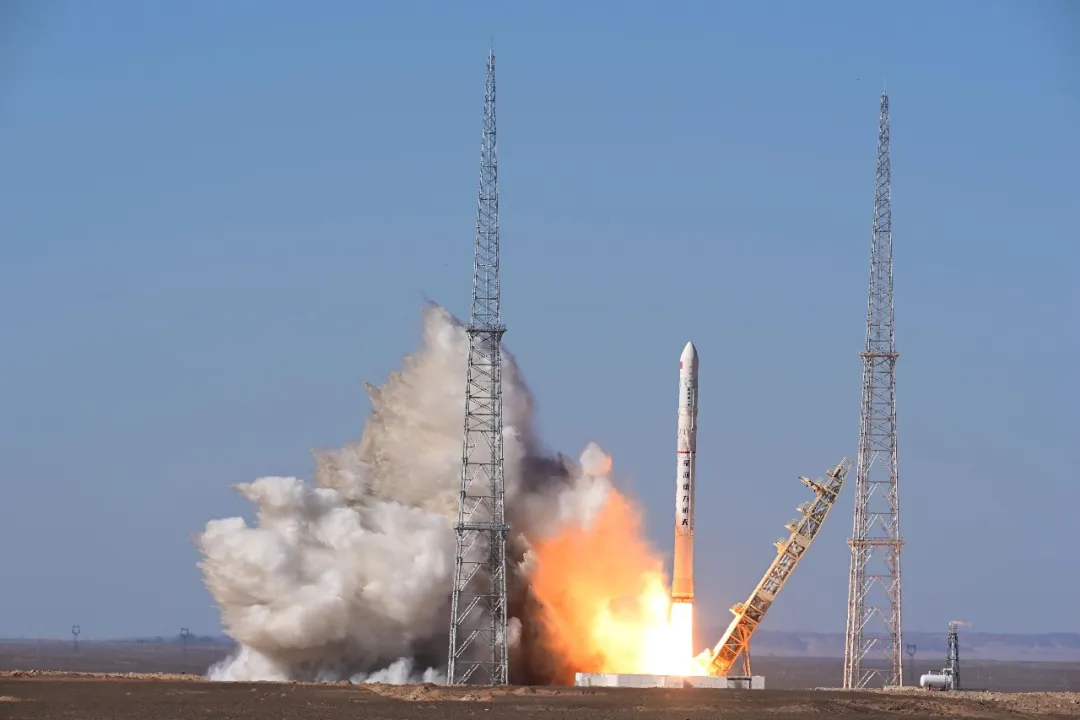
At 10:00 a.m. on September 1, 2026, Pallas-1 Y1, a medium-to-large reusable liquid-propellant launch vehicle developed by Galactic Energy, lifted off from the Dongfeng Commercial Space Innovation Test Zone. The rocket successfully entered its designated orbit as planned, performed normally throughout the flight, and achieved all test objectives, marking the successful completion of the mission.
The flight marks another successful orbital debut of a new launch vehicle developed by a Chinese private rocket company.
With Pallas-1 reaching orbit, China now has four private commercial launch companies that have successfully placed liquid-propellant rockets into orbit: LandSpace with ZhuQue-2, ZhuQue-2E and ZhuQue-3; CAS Space with Kinetica-2; Space Pioneer with Tianlong-2; and Galactic Energy with Pallas-1.
The Dongfeng Commercial Space Innovation Test Zone is a launch facility developed by the Jiuquan Satellite Launch Center to support the growth of China’s commercial space industry. Located in Ejin Banner, Alxa League, Inner Mongolia Autonomous Region, it is jointly developed and managed by commercial space companies and the launch center and is primarily used for commercial rocket launches.
This mission was the maiden flight of Pallas-1.


1. Pallas-1: Key Specifications
Pallas-1 is a two-stage launch vehicle with an optional upper stage. It measures 52 meters in length, has a core-stage diameter of 3.35 meters, a liftoff mass of approximately 283 metric tons, and liftoff thrust of 350 metric tons.
(1) First Stage
The first stage is powered by seven CQ-50 reusable liquid oxygen/kerosene pintle engines independently developed by Galactic Energy. One engine is positioned at the center, with the other six arranged around it.
Together, the seven engines generate 350 metric tons of thrust at sea level and have a sea-level specific impulse of 265 seconds.
The propulsion system also features engine-out capability. If any one of the seven engines fails, the remaining six can maintain normal flight and allow the vehicle to continue its mission to orbit.
The CQ-50 uses a gas-generator cycle, supports deep throttling across a range of 32% to 105% of rated thrust, and is capable of multiple restarts.
Development of the CQ-50 began in December 2018. A 100-second gas-generator ground hot-fire test was completed on July 6, 2019, followed by the first full-system hot-fire test in March 2022. In April 2026, calibration and delivery of 22 flight-production engines were completed.
(2) Second Stage
The second stage uses a single vacuum-optimized CQ-50V liquid oxygen/kerosene engine. It produces 60 metric tons of thrust in vacuum and has a vacuum specific impulse of 330 seconds.
2. Key Development Milestones
In May 2023, assembly of the Pallas-1 integrated test vehicle was completed.
In June 2023, the vehicle completed an interstage separation test.
In July 2023, the auxiliary power system completed its first full-system hot-fire test.
In September 2023, the first-stage feed lines of the pressurization and propellant feed system completed vibration testing.
In February 2024, the control system completed hardware-in-the-loop simulation testing.
In April 2024, the second-stage liquid oxygen tank of the pressurization and propellant feed system completed a cold-flow test.
In May 2024, the CQ-50 liquid oxygen/kerosene engine completed an engine-servo matching test.
In July 2024, the payload fairing completed a series of static-load, modal and separation tests.
In November 2024, wind-tunnel testing of the aerodynamic characteristics of first-stage retropropulsion was completed.
In September 2025, the second-stage propulsion system completed a hot-fire test.
In November 2025, the first-stage propulsion system completed a hot-fire test at the No. 1 semi-fixed rocket-stage test stand at the Oriental Spaceport in Haiyang, Shandong Province.
On September 1, 2026, Pallas-1 successfully completed its maiden orbital flight.
3. Dedicated Launch Pad Infrastructure
On May 26, 2026, Galactic Energy announced that Phase I of the Pallas-series launch pad at the Dongfeng Commercial Space Innovation Test Zone of the Jiuquan Satellite Launch Center had been completed and entered service.
With the facility operational, Galactic Energy became the fourth Chinese private commercial launch company to operate a self-built launch pad.
The September 1 mission marked the first use of Phase I of the Pallas-series launch facility. The site supported the complete pre-launch process for Pallas-1, including testing, propellant loading and launch operations.
More importantly, the launch pad gives Galactic Energy an integrated infrastructure chain spanning rocket development, production, testing and launch operations.
The facility was also an important factor in enabling Pallas-1 Y1 to conduct its maiden flight in 2026. With a dedicated launch pad, Galactic Energy no longer needs to share the same launch infrastructure with other rocket companies and wait in line for access to launch-pad resources.
Going forward, the company can continue optimizing its launch facilities and streamlining pre-launch procedures based on operational experience from successive missions, potentially shortening turnaround times and increasing launch cadence.