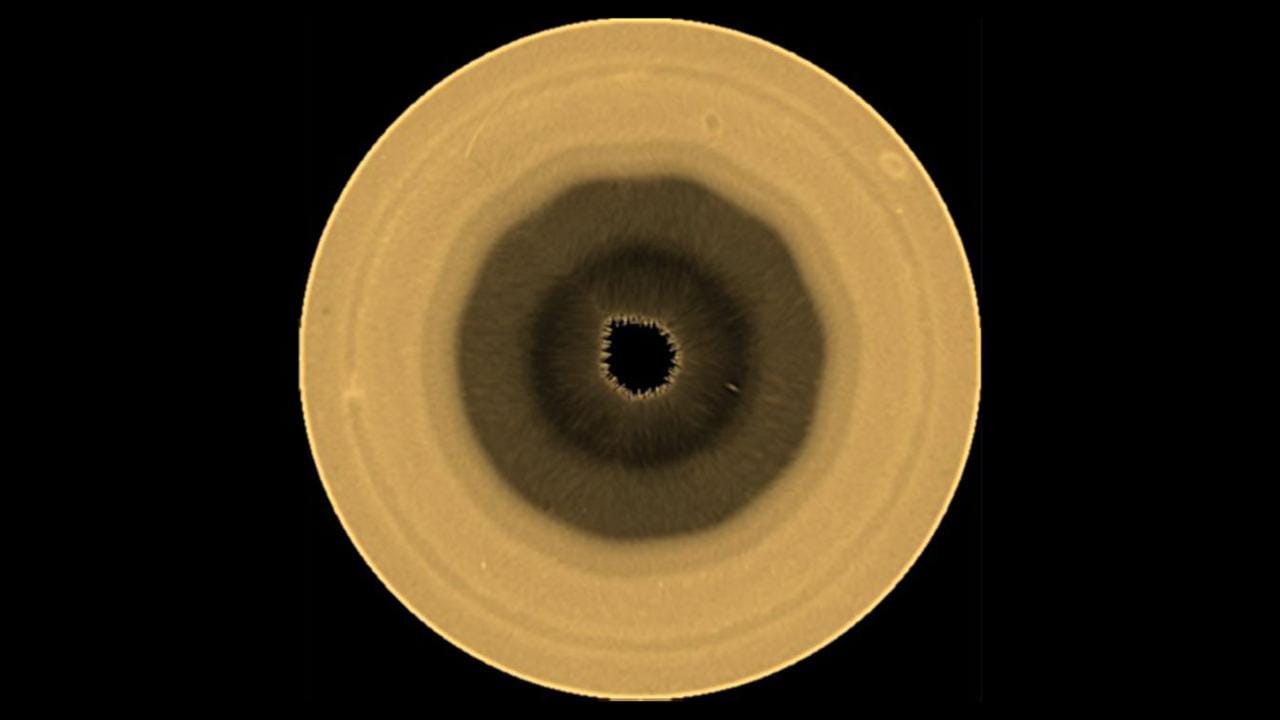
NASA’s Hubble Space Telescope has revealed a giant, evolving ten-sided atmospheric wave around Saturn’s south pole—the first large, regular-sided jet pattern observed in the planet’s southern hemisphere. Known as a decagon, the feature appears in observations dating back to 2023 and has become increasingly distinct, offering scientists a rare opportunity to track the development of a planetary-scale atmospheric wave. The findings, published September 2, 2026, in Science Advances, raise questions about what triggered the pattern and whether it could become as long-lived as Saturn’s northern hexagon.
What might have caused Saturn’s decagon to form?
Saturn’s south polar decagon may have formed when a disturbance in a powerful jet stream developed into a repeating atmospheric wave. Researchers have identified two possible origins: a disturbance distributed periodically along the jet, or forcing by an anticyclonic vortex immediately to its north. Neither mechanism has been confirmed.
The study proposes that the decagon could be a Rossby wave confined within Saturn’s atmospheric circulation. Rossby waves are large-scale meanders in rotating fluids. In the proposed interpretation, the jet’s changing wind profile across latitude helps restrict the wave’s north–south movement, while atmospheric conditions limit its vertical propagation. Such confinement could allow an organized pattern to persist around the planet.
The ten-sided outline represents the repeating geometry of that wave. Explaining why this particular jet supports ten sides, and why the pattern became detectable recently, remains part of the unresolved formation problem. The paper presents this wave interpretation and the proposed triggers as possibilities supported by observations and simplified modeling, rather than an established formation history.
How could a nearby vortex have triggered the decagon?
An anticyclonic vortex near 55 degrees south latitude is a possible source of the initial disturbance. Located north of the decagon, the vortex was observed in 2023 and became substantially darker in 2025.
Study co-author Michael Wong of the University of California, Berkeley, suggests that the vortex could have perturbed the neighboring jet, after which the atmospheric balance of forces allowed a persistent polygonal wave to develop.
This hypothesis assigns the vortex a possible initiating role. Its proximity and changing appearance do not establish that it caused the decagon, and researchers still need detailed three-dimensional simulations to test the connection. The composition of the aerosols responsible for the decagon’s blue appearance also remains unknown.
What have computer simulations established about the formation mechanism?
Researchers used a simplified atmospheric model based on shallow-water equations to investigate how decagonal waves could develop and survive within a jet stream. Such models represent large-scale fluid motion without resolving the atmosphere’s complete three-dimensional structure.
The simulations demonstrate possible routes to a decagonal pattern, but they do not identify the actual sequence of events on Saturn. Producing a polygon is only part of the problem: a successful explanation must also account for the observed movement, oscillation, vertical structure and persistence.
The research team therefore treats the simulations as preliminary. Whether the pattern is sustained mainly near the upper clouds or connected to deeper circulation remains unresolved.
Could Saturn’s changing seasons explain the decagon’s appearance?
Seasonal change is relevant, but it has not been established as the trigger. Saturn’s changing viewing geometry made the southern hemisphere easier to observe between 2023 and 2025, while seasonal temperature changes provide an evolving atmospheric environment.
Infrared observations help researchers distinguish these effects. Measurements with the Very Large Telescope’s VISIR instrument characterize temperatures, atmospheric stability and changes in wind speed with altitude—conditions needed to assess how the wave can persist.
The evidence therefore supports investigating a seasonal influence, but does not yet demonstrate that seasonal heating or cooling caused the decagon.
How did astronomers identify Saturn’s decagon?
In 2024, Agustín Sánchez-Lavega of the University of the Basque Country and amateur astronomers Trevor Barry and Jean-Paul Oger noticed an undulating southern band in ground-based images. Further observations in 2025 strengthened the evidence for a decagon.
Researchers examined Hubble’s observation record and traced the feature back to 2023. The images were collected through the Outer Planet Atmospheres Legacy program, or OPAL, whose repeated observations allow scientists to reconstruct atmospheric changes across years.
How fast does the decagon move, and why does that matter?
The jet containing the decagon reaches approximately 400 kilometers per hour, while the overall pattern shifts at about 10 kilometers per hour relative to Saturn’s rotation. Its vertices also oscillate with a period of roughly 32 days.
The difference between atmospheric flow and pattern speed is important: clouds can move rapidly through a region while a wave progresses much more slowly. The oscillation provides another measurable characteristic that formation models must explain. Researchers have not observed equivalent vertex oscillations in Saturn’s northern hexagon.
How deeply does Saturn’s decagon extend?
Hubble observations at different wavelengths show that the decagon extends across atmospheric layers. Its apparent position changes between wavelengths because those observations probe different altitudes.
This establishes vertical structure within the observable atmosphere, but does not determine the wave’s full depth beneath the upper clouds. Scientists still need to establish whether deeper winds sustain the pattern.
Did Cassini see an earlier version of the decagon?
Cassini did not identify the persistent southern decagon during its 2004–2017 mission at Saturn. It observed a disturbance with a polygonal appearance in 2004, but that feature lasted only a few days.
The brief Cassini disturbance has not been established as an earlier version of the current decagon. The distinction matters because temporary jet meanders and a pattern persisting across several years place different demands on atmospheric models.
What observations could resolve the decagon’s origin?
Researchers seek further Hubble and James Webb Space Telescope observations, alongside more detailed atmospheric modeling, to determine what drives the wave and whether it becomes a stable, long-lived feature.
Continued monitoring will test how its shape, motion and vertical structure evolve as Saturn’s southern hemisphere becomes easier to observe. These measurements should help distinguish possible formation mechanisms and establish whether the decagon develops the durability of the northern hexagon.