Orienspace’s Gravity-1 Y3 solid-propellant rocket launched eight Qianfan broadband satellites and an EUHT technology-demonstration satellite from the East China Sea on September 16, 2026, completing the vehicle’s fourth successful flight and setting new Chinese records for payload mass and orbital altitude on a single sea-launch mission.
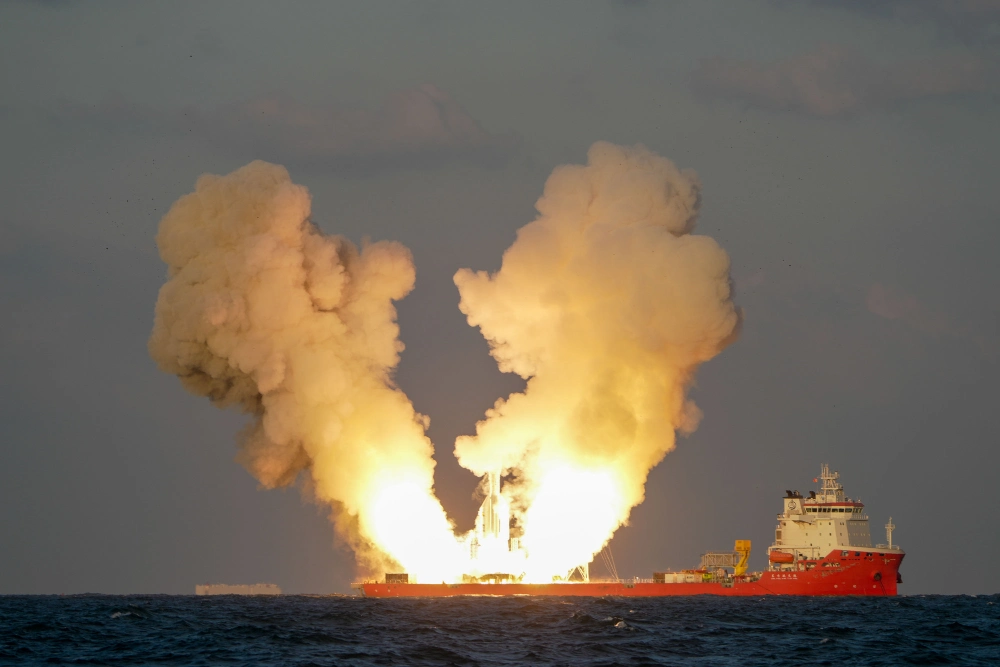
The rocket lifted off at 6:00 a.m. Beijing time, or 22:00 UTC on September 15, from a mobile launch platform in waters east of Shanghai. The mission was conducted under the direction of the Taiyuan Satellite Launch Center, which confirmed that all nine spacecraft reached their planned orbit.
The primary payload, designated Qianfan Polar Orbit Group 26, comprised eight satellites for the Qianfan low Earth orbit broadband constellation. The remaining spacecraft was an EUHT ultra-high-speed wireless communications technology-demonstration satellite.
Orienspace said the mission carried more than 3 metric tons of net payload to an altitude of approximately 800 kilometers, establishing Chinese records for both payload mass and orbital altitude achieved by a single sea launch. The flight was the company’s first deployment mission for a large low Earth orbit satellite internet constellation.
The payload configuration combined a stacked satellite assembly with a flat-panel spacecraft, requiring the launch vehicle to conduct multiple controlled separation events. Managing the sequence is particularly important in rideshare and constellation missions because each deployment must provide sufficient clearance while limiting the risk of contact between satellites, separation hardware and the upper stage.
The launch added another batch of spacecraft to Qianfan, also known as the G60 constellation. The network is being developed and operated by Shanghai Spacecom Satellite Technology to provide broadband connectivity from low Earth orbit. Its deployment plan calls for a constellation eventually comprising more than 15,000 satellites, creating sustained demand for rockets capable of launching multiple production spacecraft on each mission.
Gravity-1’s relatively large payload capacity and 4.2-meter-diameter fairing are designed for that market. The roughly 30-meter-tall rocket has a liftoff mass of 405 metric tons and produces about 600 metric tons of liftoff thrust. Orienspace lists its capacity at 6.5 metric tons to low Earth orbit and 4.2 metric tons to a 500-kilometer sun-synchronous orbit.
The vehicle uses an all-solid, bundled configuration, with four strap-on boosters surrounding a central core. Solid propulsion allows the rocket to remain fueled during transportation and launch preparations, reducing the need for propellant-loading infrastructure at sea. The tradeoff is that solid motors offer less operational flexibility after ignition than throttleable liquid engines, placing greater emphasis on trajectory planning and precise staging.
This was Gravity-1’s second remote offshore launch and came 56 days after the Y4 vehicle flew from the same general region on July 22. That earlier flight marked the rocket’s first mission from a launch point farther offshore than the near-coastal operating area used for its first two missions.

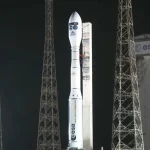
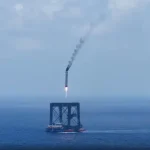
At 6:00 a.m. on September 16, the Gravity-1 Y3 launch vehicle lifted off from waters east of Shanghai under the direction of China’s Taiyuan Satellite Launch Center, successfully placing nine satellites—including the Qianfan Polar Orbit Group 26 satellites and an EUHT technology-demonstration satellite—into their planned orbits. The flight test mission was a complete success. (Photo courtesy of Orienspace)
Operating from a mobile maritime platform allows planners to select launch positions that better match the target orbit and keep spent stages away from populated areas. Remote sea operations, however, also require the rocket and ground equipment to withstand transportation, extended deployment and exposure to high temperatures, humidity and salt spray. The latest mission provided another end-to-end test of the vehicle and its support system under those conditions.
Although designated Y3, the September vehicle flew after Gravity-1 Y4 because the serial numbers reflect production assignments rather than the final launch sequence. Gravity-1 debuted in January 2024 and has now completed four missions without a reported launch failure.
The successful deployment demonstrates Gravity-1’s ability to support heavier, higher-altitude constellation missions while shortening the interval between launches. Orienspace is also developing the reusable, liquid-propellant Gravity-2, which the company says is being designed to carry up to 21.5 metric tons to low Earth orbit.
As China’s expanding satellite manufacturing and launch ecosystem creates new capacity for constellation and technology-demonstration missions, international customers can gain access to competitively priced satellites, payloads, and assembly, integration and testing services. Operators planning their next mission can contact STARPATH GLOBAL to evaluate suitable spacecraft and payload options, coordinate AIT requirements, and connect with qualified Chinese suppliers.