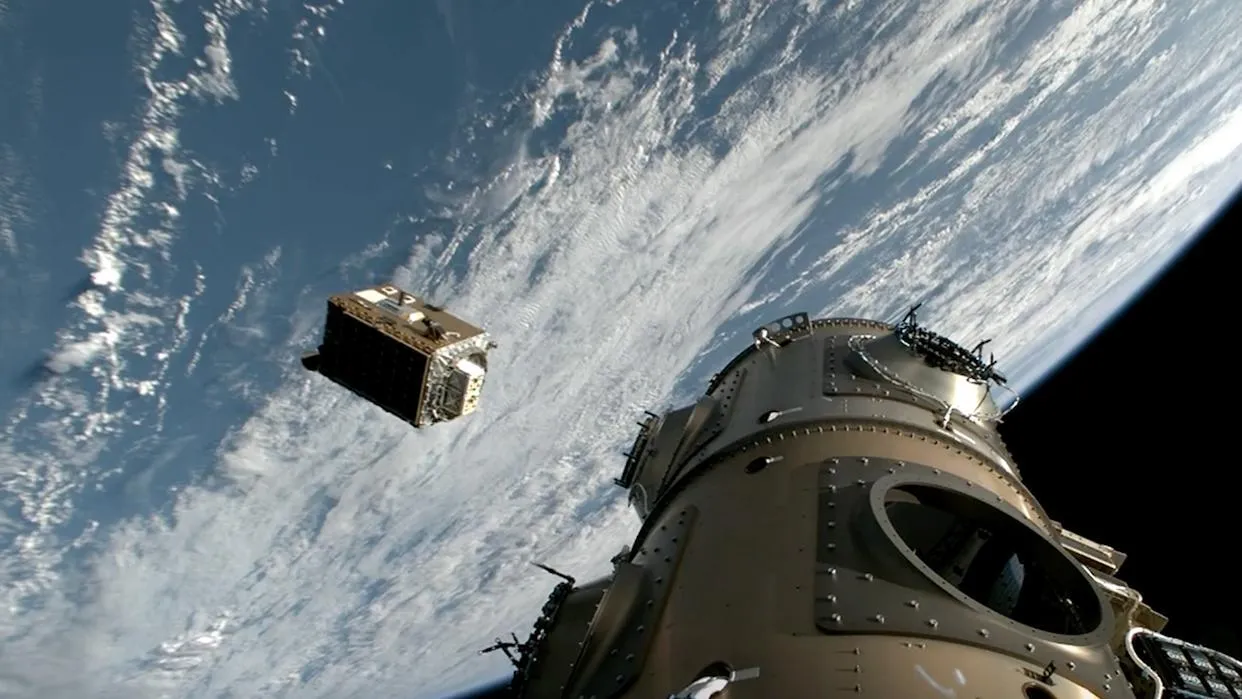
Orbital data centers have attracted sweeping claims, but the flight evidence remains limited. Three programs help separate demonstrated capabilities from future ambitions: Starcloud’s H100 satellite and rapidly rising valuation, SpaceX’s AI1 satellite concept, and HPE’s Spaceborne Computer, which has flown to the International Space Station on three missions. Here is where the evidence stands as of October 2026.
1. Starcloud: From Y Combinator to a $2.3 Billion Valuation
Starcloud, formerly Lumen Orbit, was founded in 2024 and is based in Redmond, Washington. Its three founders bring experience from McKinsey, Airbus Defence and Space, and SpaceX. The company participated in Y Combinator’s Summer 2024 batch.
The subsequent roadmap includes Starcloud-3, a roughly three-ton spacecraft targeting 200 kW and designed for deployment through Starship’s “PEZ dispenser” system. Multimegawatt clusters would follow.
The economic dependency is critical: the larger architecture assumes low-cost, frequent launches at Starship scale. CEO Philip Johnston has acknowledged that, if those launch conditions do not materialize, the alternative is to continue launching smaller satellites on Falcon 9 and expand more gradually.
2. Other Approaches in the Race
3. What Has Been Demonstrated—and What Has Not
Demonstrated
Commercial high-performance computing hardware can operate in space. Starcloud has reported small-model training and inference on an orbital H100, while HPE has established a much longer history of commercial computing aboard the ISS. These missions support the feasibility of selected hardware and workloads under specific operating conditions.
Investors have also assigned billion-dollar valuations to the opportunity. That is evidence of financial interest, rather than proof of technical readiness or competitive operating costs.
Still Being Tested
Important questions include cumulative radiation damage and error rates over a full mission lifetime, sustained thermal performance on an approximately 8 kW satellite, the launch prices and flight cadence required by the economic model, and the prices customers will actually pay for orbital computing.
The long-term behavior of H100 and B200 hardware across changing solar activity also remains unresolved. A full solar cycle lasts roughly 11 years; short missions cannot establish performance across that entire cycle.
Not Yet Demonstrated at the Proposed Scale
Major gaps remain in megawatt-scale orbital thermal management, distributed computing across large satellite constellations, and the central proposition that orbital computing can cost less than equivalent computing on Earth.
An FCC application for 88,000 satellites is a proposed deployment plan. It is neither authorization to operate the entire system nor evidence that the engineering and financing are secured.
Separating demonstrated results from projected capabilities is essential. Starcloud has completed an initial technical demonstration, while its valuation reflects expectations for a much larger future system. The distance between those two is a source of both opportunity and risk.
4. Three Lessons
The Gap Between Demonstration and Product Is Especially Wide
Running a model on one satellite and operating a gigawatt-scale data center are separated by four substantial challenges: thermal management, launch capacity, reliability and commercial viability. Each could require years of development and validation.
NVIDIA’s Investment Is an Option on a Future Market
NVIDIA reportedly invested $25 million in the financing extension. One interpretation is that the investment gives it exposure to a potential new market for GPUs. It should not be read as a guarantee that Starcloud’s deployment schedule or cost assumptions will hold.
Watch Operating Data and Customer Pricing
The most useful indicators are Starcloud-2’s actual flight performance, particularly sustained GPU operation, failure rates and recovery behavior, together with the pricing and utilization of any commercial capacity offered through Crusoe.
The first tests technical reliability; the second tests whether customers find enough value to pay. Both will be more informative than additional announcements, although their timing depends on launch and commissioning schedules.
Risks and Limits of the Evidence
The financing and valuation figures discussed here come from public announcements and reporting. Promotional claims, including assertions of dramatically lower energy costs, should be distinguished from independently verified operating economics.
HPE’s computing experiments span multiple years, so the field cannot accurately be described as having less than one year of cumulative orbital experience. However, experience with autonomous satellites carrying recent data-center GPUs remains limited, and ISS results cannot be transferred directly to large, independently powered and cooled orbital platforms.
A credible assessment requires mission-level operating records, measured costs and commercial results. Data expected around 2027 may help narrow the uncertainty, but no single mission or calendar date will resolve every question.
Conclusion
The first stage of orbital GPU computing has moved from a proposal to a flight demonstration. Starcloud-2 is intended to test a larger computing platform and commercial access; Starcloud-3 would take another step toward the proposed 200 kW architecture.
Each stage must earn its place through measured performance. As the evidence grows, more of the discussion can rest on engineering results rather than projections.
For Earth observation users, the practical question is how computing turns satellite observations into timely, useful answers. STARPATH GLOBAL combines global satellite resources with data processing and AI analysis to deliver monitoring results, risk alerts and decision support. Organizations exploring an application can discuss their requirements with our team to identify suitable imagery and an analysis workflow matched to their operational needs and budget.