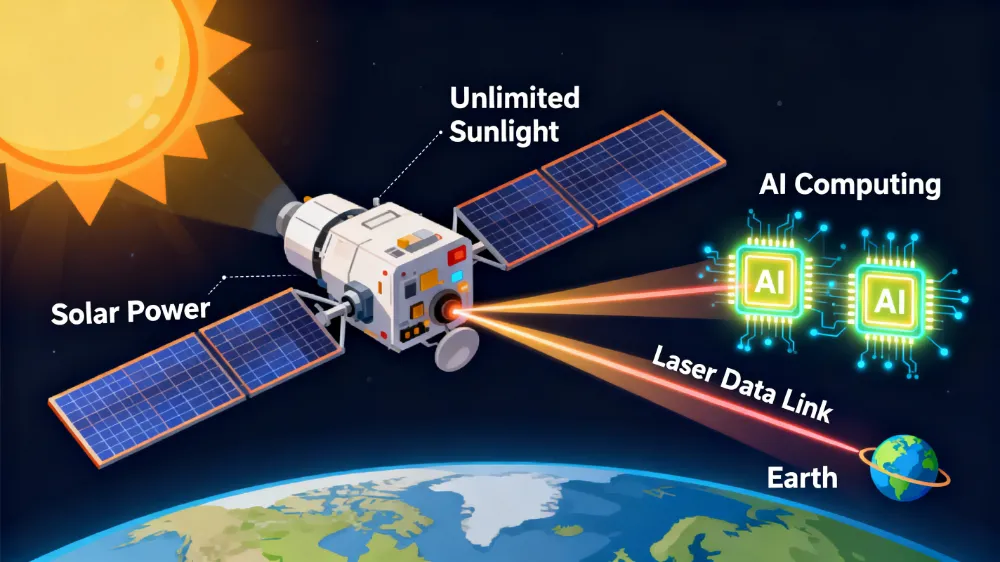
Ground-based AI chips are a game built around Nvidia’s CUDA ecosystem, and any challenger must contend with developer ecosystems, compute benchmarks and framework compatibility. But in space, an opportunity has emerged to reshuffle the AI compute chip landscape — the competitive dynamics of space-based computing differ from those on the ground, and Nvidia holds no obvious advantage there. Competition in space computing is essentially a reshuffling of the AI computing paradigm under space conditions, and its core lies in chip energy efficiency, which has become a central competitive factor in building space infrastructure.
The physical constraints of radiation hardening, power consumption and heat dissipation in space chips have rewritten the rules for peak computing performance, redrawing the starting line for chip competition in the space environment. Ground-based computing power is stacked up; space computing power depends on controlling energy consumption. This article surveys companies that have secured irreplaceable positions along the space computing chip, system and application chain, for reference.
The Rules of the AI Chip Game Have Changed
Competition among ground-based AI chips centers on training, which requires tens of thousands of GPUs in clusters, high-bandwidth interconnects and unified scheduling through the CUDA ecosystem — Nvidia’s undisputed home turf.
But the core task of space computing is not training — it’s inference. Space-based inference demands that a chip produce stable, effective inference output per unit of power, along with high reliability, low latency and radiation resistance. Many of the advantages Nvidia has built up on the ground are no longer decisive factors in space.
The operational logic of space computing follows a sensing-decision-execution loop, where massive volumes of data must be processed through real-time, on-orbit inference so that only useful information is transmitted back to Earth — a completely different paradigm from ground-based training.
Inference’s demands for low power consumption, customization and high energy efficiency happen to be where Chinese manufacturers excel, which is exactly where the opportunity for domestic chips lies.
On the ground, Chinese chips can compete with Nvidia on raw TOPS performance but cannot match the CUDA ecosystem; in space, Chinese chips can compete with Nvidia on TOPS-per-watt, where the CUDA ecosystem starts to lose its edge.
The Energy-Efficiency Ledger of Space Computing
Chinese space computing chips have already made progress on energy efficiency. For the first time, the leading metrics of competition in space have become efficiency and reliability rather than the scale of an application ecosystem.
Without Nvidia’s ecosystem dominance, the competitive benchmark has been reset — space computing is a track where Chinese chipmakers can compete on genuinely equal footing.
Chinese FPGA manufacturers already have real, accumulated experience in this field, while Nvidia’s GPUs require reconstruction to work in space.
The competitive logic of space computing is shifting toward a hybrid of FPGA and ASIC architectures, which will be an opportunity for Chinese chipmakers to strengthen their position.
Space Computing Is an Advantageous Track for Chinese Chips
Nvidia dominates the competitive landscape of ground-based AI chips, but in space, that landscape is being rewritten.
First, radiation-hardening requirements weaken Nvidia’s advantage. Space environments require chips to undergo specialized radiation-hardening design. Nvidia’s addition of radiation hardening and triple-modular-redundancy computing architecture to Vera Rubin is a non-native retrofit. Chinese space chips, by contrast, have been optimized for radiation resistance from the design stage onward — StarDetect has already built a three-layer protection architecture combining “structural shielding, fault-tolerant hardening and active avoidance.” Shanghai Fudan Microelectronics Group’s mass-produced space-grade radiation-hardened FPGA is a natively space-designed product, and this kind of native space design experience is difficult for Nvidia to replicate in the short term.
Second, the software-ecosystem moat is greatly diminished in space. On the ground, the CUDA ecosystem is Nvidia’s deepest moat, but the software stack running on space chips is closer to a dedicated system than a general-purpose platform. This means Chinese chipmakers can run specific inference tasks in the space environment using their own software stacks without needing to compete head-on with the CUDA ecosystem.
Third, the computing-power ledger in space differs from that on the ground. Space computing pursues effective inference output per watt. On the TOPS/W metric, Chinese chips have already produced competitive figures — StarDetect’s 10 TOPS/W and optical computing’s threefold efficiency advantage are numbers that can be placed on the same table as Nvidia’s space chips, without being overshadowed by the halo of the CUDA ecosystem.
Conclusion
Energy efficiency itself has become a core competitive factor in building space infrastructure, encompassing both domestic substitution and supply-chain leverage — factors that are also profoundly shaping the competitive landscape of space-based AI chips.
Space computing is a special track for Chinese chips because it is free of Nvidia’s monopoly. On the ground, Nvidia has built a formidable moat through the CUDA ecosystem, but in space, radiation-hardening requirements constrain that advantage, giving Chinese chipmakers a chance to compete on relatively equal footing.
Competition today is no longer purely about peak computing power but about effective compute per unit of power. The demanding energy-efficiency requirements of the space environment give Chinese chips an opportunity to compete with international manufacturers head-to-head on the TOPS/W metric.
At the same time, the physical constraints of heat dissipation and energy in space applications are also creating new opportunities for FPGAs and reconfigurable architectures, whose characteristics prove more valuable in satellite-based scenarios than raw peak computing power alone.
The commercial closed loop for space computing is embedded in demands for remote sensing and edge computing — in the needs of on-orbit computation itself. These scenarios are already pushing space computing from concept toward practical use, helping every watt of computing power find real commercial value.
Chinese chipmakers have spent two decades chasing the ground-based track, falling behind on ecosystem. But in space, the ecosystem moat is broken by the physical environment, and the rules of computing power return to the technology itself — giving Chinese chipmakers a chance to define their own rules of the game on relatively equal footing.
In space, ADASpace, Cambricon and Shanghai Fudan Microelectronics Group are each carving out different links in the chain, piecing together the early shape of a Chinese space computing ecosystem.
Space computing is the fairest fight for Chinese chips. Once computing power enters space, the rules are reshuffled, and the demands of AI chips need to be recalculated from scratch.
As the competition for space-based computing power shifts toward energy efficiency and on-orbit reliability, the next challenge is turning these technical advantages into deployable, mission-ready systems. STARPATH GLOBAL specializes in custom satellite design, payload integration, and satellite data intelligence services, helping organizations build high-efficiency computing and on-orbit inference capability directly into their satellite platforms from the design stage onward. If you’re exploring opportunities in space computing, custom satellites, or data intelligence partnerships, get in touch with our team for a tailored technical consultation.