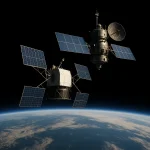
“With lasers connecting satellites and ground stations providing access, isn’t the network already connected?” The reality is more complicated. Low Earth orbit satellites travel at more than 7 kilometers per second, while connections change, switch or become unavailable. A data packet moving through dozens of satellites and ground stations must find a route that works at that particular moment.
That makes routing one of the least visible—and most consequential—layers of a satellite constellation.
Three Challenges on a Moving Network
1. Doppler shift. A satellite’s rapid motion causes the received signal frequency to change over time. Transmitters and receivers must compensate for this effect, which 3GPP identifies as a major challenge for non-terrestrial networks (NTNs).
2. Frequent handovers. A low Earth orbit satellite may remain within a user’s view for only a few minutes. Connections must therefore pass from one satellite to another, potentially much more frequently than in terrestrial cellular networks.
3. Changing latency. As the distance between network nodes changes, so does the round-trip time (RTT). These variations, together with interruptions and packet loss, can disrupt TCP’s estimates of network conditions and reduce throughput.
Think of a terrestrial network as a road system with relatively fixed junctions. A satellite constellation resembles a network of moving interchanges: the bridges themselves travel, and some connections disappear as others become available.
Three Approaches: Transparent Relaying, Regenerative Payloads and Inter-Satellite Routing
1. Transparent relaying, or “bent-pipe” operation. The satellite changes the signal’s frequency, amplifies it and relays it to the ground. Base stations and the core network remain on Earth. This is the simplest architecture, but traffic depends on ground gateways, and some paths require additional ground relays that increase latency.
2. Regenerative payloads. Some base-station functions—or even core-network functions—move onto the satellite. China’s Pengcheng Nanke-1 satellite and the Tiansuan Constellation, led by Beijing University of Posts and Telecommunications (BUPT), are exploring onboard network processing. Depending on the architecture, this can reduce reliance on ground processing and avoid some ground detours.
3. Inter-satellite routing. Satellites communicate directly through inter-satellite links, including laser links. A satellite that cannot currently reach a ground station can forward its data through other satellites until it reaches one with a suitable downlink.
These approaches can be combined. Regenerative payloads provide onboard processing, while inter-satellite links create additional paths through the constellation.
Standards are evolving in the same direction. Within 3GPP’s 5G-Advanced work, Release 19 supports regenerative payload architectures and includes provisions for inter-satellite links. Work toward 6G is exploring closer integration between terrestrial networks and multiple orbital layers.
A related demonstration in China illustrates the challenges of coordinating satellite links. Reported in June 2024, a ground-based field trial brought together China Telecom’s satellite communications subsidiary, BUPT, GalaxySpace, the China Academy of Information and Communications Technology (CAICT), UNISOC and other partners. The team demonstrated a dual-satellite cooperative transmission architecture, achieving peak throughput above 1 Gbps and smooth 8K video playback under simulated satellite-link conditions.
The trial demonstrated cooperative transmission and terminal-side signal combining. It was relevant to future integrated satellite networks, although it did not by itself establish that multi-hop routing had been demonstrated in orbit.
Technical Term: Store-and-Forward Networking
When a connection becomes unavailable, data does not always need to be discarded or immediately retransmitted. A satellite can store it and wait until the next link becomes available.
This is a central principle of Delay/Disruption Tolerant Networking (DTN), an approach used in space communications, including deep-space missions.
In everyday terms, it is like a courier holding a parcel at a depot until the next truck arrives. The entire delivery route does not have to be open at the same time.
Where Should Routing Decisions Be Made: In Orbit or on the Ground?
Satellite orbits are predictable. Using orbital data, operators can calculate in advance when two satellites will be able to communicate and when a satellite will have access to a ground station.
That allows a ground system to prepare a network-wide contact schedule, calculate routes and periodically upload instructions to the satellites. Much of the planning intelligence remains on Earth.
The case for onboard decision-making starts with the unexpected: a failed link, an urgent new task or an available computing resource that was not part of the original plan. Waiting for ground instructions can consume a valuable communication window. Local decisions can allow a satellite to respond sooner.
The central trade-off is between exploiting predictable orbital motion and responding autonomously to changing conditions.
Increasing onboard computing capacity expands the options. Satellites in China’s Three-Body Computing Constellation have been reported to offer up to 744 TOPS, or 744 trillion operations per second, per satellite. That provides context for the growth of space-based computing, although AI processing capacity alone does not determine routing performance.
More capable onboard computers can support greater autonomy. Whether a particular routing decision belongs in orbit or on the ground still depends on the network architecture, available information, power budget and reliability requirements.
Key Facts
1. A Chinese ground-based field trial reported in June 2024 demonstrated dual-satellite cooperative transmission, with peak throughput above 1 Gbps and smooth 8K video playback. Participants included China Telecom’s satellite communications subsidiary, BUPT, GalaxySpace, CAICT and UNISOC.
2. 3GPP’s NTN studies address Doppler shift, changing propagation delays and frequent handovers as important technical challenges.
3. Release 19, part of the 5G-Advanced evolution, supports regenerative satellite payload architectures and includes provisions for inter-satellite links.
The Engineering Trade-Off
Option A: Plan routes centrally on the ground. A ground controller can use a network-wide view to optimize routes and upload schedules. However, plans can become outdated when unexpected conditions arise, and responses may depend on the next available ground connection.
Option B: Make routing decisions onboard. Satellites can react quickly to local changes, but this requires processing resources and routing software across the fleet. It also increases the challenge of ensuring that local decisions produce good results for the network as a whole.
The two approaches can also work together: ground systems prepare the overall plan, while onboard software handles exceptions.
Would the balance change if the constellation grew from 10 satellites to 1,000?
The Takeaway
The hard part is keeping data on a usable path as the network moves. Routing is one of the quiet foundations of reliable space-based computing.
For Earth observation users, these engineering choices ultimately affect how quickly an observation becomes a usable result. STARPATH GLOBAL integrates satellite imagery and geospatial analytics to deliver monitoring results, risk alerts and decision support. Teams can discuss their requirements with STARPATH GLOBAL to identify data sources and delivery workflows suited to their coverage, update frequency and budget.