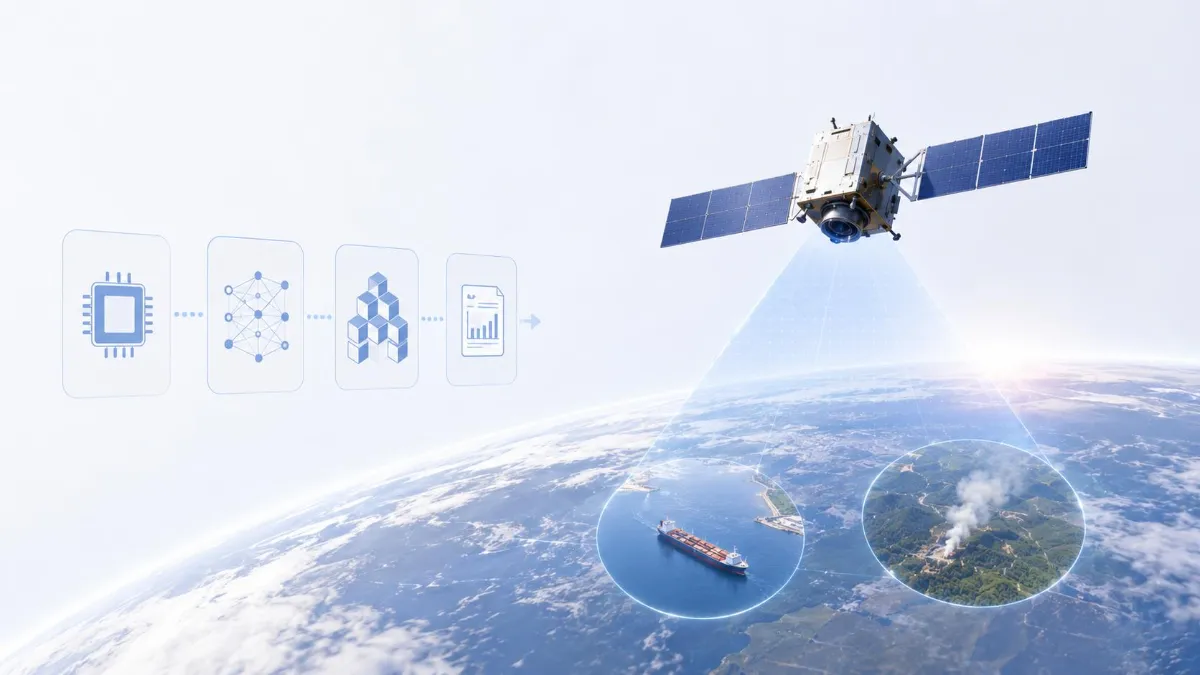
A wildfire breaks out, and a satellite hundreds of kilometers above Earth captures a clear view of the blaze. Under the conventional workflow, the imagery must wait for a ground-station contact window, be downloaded and processed at a data center, and finally reach the incident commander. That process can take days. By then, the fire may have changed direction.
What if the processing happened in space instead? A satellite could identify a threat shortly after capturing an image and transmit a concise finding, potentially reducing response times to minutes when a communications link is available. Data generated in space would be processed there too—an approach known in China as “space data, space computing.”
The change involves more than transmission speed. It changes how satellites work. Far from being one company’s unusual idea, onboard intelligence has become a shared priority in the global competition to combine space technology with artificial intelligence.
Why a Wildfire Cannot Wait
Start with a few easily overlooked numbers.
As Earth observation resolution improves, satellites are generating enormous volumes of data. Industry estimates put China’s daily collection of raw remote-sensing data at more than 20 terabytes. Some next-generation satellites with exceptionally wide imaging swaths reportedly generate nearly 50 gigabytes per second—roughly the data volume of a two-hour 4K film, depending on compression.
Yet satellites are not continuously connected to the ground. For systems relying mainly on ground stations in China, a satellite may have only a few minutes to transmit during each pass over an available station. The interval between downlink opportunities varies with the orbit, ground-station coverage and communications arrangements.
The result? Shangguang Wang, dean of the School of Computer Science at Beijing University of Posts and Telecommunications and chief scientist of the Tiansuan Constellation, has told the media that a satellite operating at full capacity may ultimately transmit less than 10% of its data to Earth. Jianhua Lu, a professor at Tsinghua University and a member of the Chinese Academy of Sciences, has described the problem more bluntly: “90% of remote-sensing satellites are idling in orbit.”
For emergency responders, that description strikes a nerve. Forest fires, flood-defense breaches, offshore oil spills and earthquake-induced landslide dams all demand timely information. An hour’s delay can change how many people need to be evacuated or how much forest is lost. Satellites can capture the scene, yet their observations may arrive too late to be useful—a major bottleneck for the space information industry.

A global race is already underway to address that bottleneck. In the United States, SpaceX plans to deploy a vast number of satellites in low Earth orbit. Japan is focusing on in-orbit processing of Earth observation data. In May 2025, ADA Space and Zhejiang Lab launched a computing constellation from Jiuquan, described by its developers as the world’s first to interconnect computing satellites across an entire orbital plane. ADA Space’s broader Star-Compute program envisages a network of 2,800 computing satellites.
In August 2025, China’s State Council issued its Opinions on Deepening the Implementation of the “Artificial Intelligence Plus” Initiative, explicitly calling for faster development of frontier technologies, including space computing.
Computing in orbit has moved beyond a laboratory research topic. It is becoming an industry shaped by national strategies and competition among companies.

Making a Two-Kilogram Computer Ready for Space
Interest in the sector is growing rapidly. Making computing chips work reliably in space is another matter.
Inside a laboratory in Liangxi District, Wuxi, an engineer is testing a small black box. It has mounting holes at its corners and cables extending from its sides. An adult can hold it in one hand. This is the AS-1 onboard AI computing unit, currently undergoing ground testing at Zhisuan Xingkong, a Wuxi-based technology company.
Its purpose is to let satellites and drones perform some intelligent processing and information extraction where data is generated. Instead of sending everything to ground facilities, a satellite would first filter, identify and analyze observations in orbit, reserving limited communications capacity for information that matters.
The idea sounds straightforward. Implementing it presents a series of engineering challenges.
The first is radiation. High-energy particles in space can strike a chip and change a stored zero into a one. A single bit flip can corrupt a calculation or even reverse a result. The team must combine component selection, system-level radiation mitigation, fault-tolerant design and recovery mechanisms to support reliable long-term operation.
The second is heat rejection. Space has no surrounding air to carry heat away through conventional convection. Liquid cooling can transport heat within a spacecraft, but radiators must ultimately release it into space. The team redesigned the structure to conduct heat from the chips to a larger radiating surface, increasing the area available to reject heat.
The third is autonomous recovery. If equipment fails in orbit, a technician cannot simply visit to repair it. The team has incorporated hardware and software redundancy, memory error correction, watchdog monitoring, fault detection and autonomous recovery mechanisms so the unit can recover from certain failures without human intervention.

From the project’s launch in March to completion of the prototype in September, seven calendar months covered component selection, procurement, software development, integration and testing, with formal reviews at every stage.
According to the company, the resulting device weighs less than two kilograms and consumes about 90 watts—comparable to a household projector—while delivering a stated computing capacity of 248 TOPS, or 248 trillion operations per second. Through natural-language interaction, users can run tasks including object detection, change detection and semantic segmentation. The product was designed from the outset around spacecraft constraints on mass, power consumption and interfaces to reduce the difficulty of subsequent satellite integration.
“If we process it in space, a large volume of raw data becomes a small amount of valuable information,” said Lin Ziyang, the company’s chief executive. “What we need to transmit is no longer ‘data,’ but ‘answers.’”
Behind that distinction is a shift in computing architecture: data does not always have to return to Earth before it can be analyzed. Processing can move closer to its source.

From One Satellite to a Network
Making one satellite intelligent is only the first step.
Space-based computing depends on tightly connected systems: computing chips, electrical power, intersatellite laser communications, spacecraft platforms and computing payloads. A weakness in any one can constrain the entire system.
“Processing space-generated data in orbit is now moving from technology and engineering validation toward commercialization,” Lin said. “The first commercially viable services are likely to emerge in applications with demanding response times and heavy downlink requirements. Going further—processing Earth-generated data in space and coordinating large-scale computing across space and ground—will require more mature power systems, communications, launch economics and space computing infrastructure.”
Lin outlined the economics. Ground-based computing facilities may follow a five-to-eight-year equipment cycle, with hardware retaining some residual value when replaced. For orbital equipment designed for a similar service life, that period may mark the end of the mission, with no practical recovery or resale option. Launch and operations also add substantial costs.
He put current satellite launch costs in China at tens of thousands of yuan per kilogram, arguing that costs remain roughly an order of magnitude above the levels needed for large-scale deployment.

Industry participants widely expect advances in reusable commercial rockets to bring a turning point in space computing costs during China’s 15th Five-Year Plan period, from 2026 to 2030. Some optimistic forecasts put the potential market above $100 billion around 2030.
“The most valuable near-term applications are tasks that need to be processed in space first and place a very high value on time, such as emergency response, defense and real-time monitoring,” Lin said.
The industry is still young, but companies are already racing to establish their positions. Zhisuan Xingkong has organized its business into three layers. At the foundation are AI computing units and specialized models that enable satellites and drones to interpret data onboard. The middle layer consists of high-quality aerospace datasets and high-value tokens. At the application layer are industry-specific AI agents for emergency response, agriculture, marine operations and meteorology.
The company is also pursuing cooperation with constellation operators on data, models, AI computing payloads and related applications.

“Wuxi has a relatively complete industrial supply chain,” Lin said. The city has brought together 109 companies across aerospace subsectors, building an ecosystem spanning rockets, maritime launch capabilities, satellites, networks, communications, navigation, remote sensing and computing. Liangxi District has introduced a three-year aerospace industry action plan targeting an industry scale exceeding RMB 40 billion by 2028, with the integration of AI and aerospace among its priorities.
As launch, space power and computing costs fall, orbital computing could gradually become a resource available on demand. Space information capabilities now largely reserved for specialist organizations could eventually be accessed by a wider range of industries and even individuals, much like cloud computing.
For example, an AI agent supporting an offshore operation could automatically coordinate satellite data, models and computing resources to analyze environmental conditions and recommend an operating plan within a short period. The user might never need to know which satellite supplied the observations.
“At that point, the significance of space computing will extend beyond serving satellites themselves,” Lin said. “It will become a new kind of digital infrastructure connecting real-world data with artificial intelligence.” He sees the sector moving from concepts, constellation development and individual satellite demonstrations toward commercial deployment.
As data is generated in orbit, more of the intelligence needed to interpret it may develop there too. This round of competition in space technology and AI will depend on more than satellite numbers or launch prices. It will also depend on who can give those eyes hundreds of kilometers above Earth the ability to interpret what they see.
For satellite users, the value lies in turning observations into answers that arrive in time to support a decision. STARPATH GLOBAL combines global satellite resources with data analysis software to deliver monitoring results, risk alerts and decision support. Organizations can discuss their requirements with the team to select imagery, analysis methods and delivery schedules suited to their operations.
(Images courtesy of the company interviewed.)