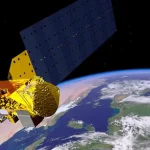
A lunar communications satellite is a spacecraft that orbits the Moon and relays information between the lunar surface and Earth. Rovers, landers and astronauts use compact, low-power radios to transmit data to the satellite overhead. These satellite can temporarily store the information and forward it to Earth once a communication link becomes available, with the help of large and more powerful antenna system. In simple terms, it functions like a mobile communications tower orbiting the Moon.

A relay satellite in lunar orbit gives far-side and polar assets a path to Earth that the Moon’s own bulk would otherwise block
Why is Lunar Communication Important?
Lunar far side has no direct line of sight to Earth: The Moon is tidally locked, which means it completes one rotation on its axis in the same amount of time that it takes to orbit Earth. As a result, the same side of the Moon generally faces our planet. A slight oscillating motion known as libration allows approximately 59% of the lunar surface to be observed from Earth over time, but parts of the far side remain permanently hidden. Spacecraft operating in these areas cannot establish a direct radio link with Earth because the Moon itself blocks the signal.
Communication from the lunar south pole can be intermittent: The south polar region has become a major destination for upcoming lunar missions because permanently shadowed craters may contain deposits of water ice. However, Earth appears very low on the horizon from these locations, and its elevation changes by several degrees throughout the month. Nearby crater rims, ridges and other terrain features can obstruct the line of sight and interrupt communications for several days.
Distance between Earth and the Moon creates significant communication challenges: The Moon is located an average of 384,400 Km from Earth, resulting in a one-way signal delay of approximately 1.28 seconds and a round-trip delay of nearly 2.6 seconds. Distance also substantially reduces the strength of the received signal because radio-wave power decreases according to the inverse-square law. At S-band frequencies, the free-space path loss between Earth and the Moon is approximately 211 dB, compared with about 153 dB for a satellite operating at an altitude of 500 Km in low Earth orbit. This difference of approximately 58 dB means that a signal transmitted from lunar distance can arrive around 600,000 times weaker than one transmitted from low Earth orbit.

Free-space path loss at 2.25 GHz for three destinations. Each 10 dB step is a tenfold loss of received power.
How does Satellites Orbit around Moon?
Low circular orbits are widely used around Earth, but they present significant challenges at the Moon. The lunar gravitational field is uneven because of large mass concentrations, known as mascons, located beneath ancient lava-filled impact basins. These concentrations exert varying gravitational forces on passing spacecraft, making most lunar orbits below approximately 100 Km unstable unless regular correction manoeuvres are performed.
Two principal families of lunar orbits can provide greater stability and more effective regional coverage: Elliptical Lunar Frozen Orbits and halo orbits.
Elliptical Lunar Frozen Orbits (ELFOs): They are highly elliptical and inclined orbits designed so that the long-term effects of the Moon’s irregular gravitational field largely balance each other. Their elliptical shape also enables a satellite to spend more time near its highest orbital point, where it travels more slowly. By positioning this high point over the lunar south pole, a communications satellite can maintain extended coverage of the region during each revolution.
Halo Orbits: They are three-dimensional trajectories around gravitational balance regions in the Earth–Moon system. From this position, the satellite can maintain visibility of both Earth and the lunar far side, allowing it to relay communications between them.
The number of satellites required depends on whether the constellation is intended for communications, navigation or both. A single strategically positioned relay satellite can provide a south polar mission with communication opportunities every two to six hours and coverage for approximately half of each two-week period. Continuous satellite-based navigation is more demanding because a receiver generally needs signals from at least four satellites simultaneously to determine its position accurately.
What are the Key Components inside a Lunar Communication Satellite?
Radio Systems: A lunar communications satellite typically has a proximity radio directed toward the Moon and a trunk radio that maintains the connection with Earth. The proximity system communicates with spacecraft and surface assets, such as landers, rovers and astronauts, using UHF or S-band frequencies. The Earth-facing system generally operates in X-band or Ka-band and uses a high-gain antenna to transmit data across the much greater distance. Lunar Pathfinder, for example, supports UHF communications from 390 to 450 MHz and S-band services at approximately 2 GHz. Its X-band Earth link provides downlink speeds of up to 5 Mbit/s and an uplink speed of 30 kbit/s.
Onboard Storage: A lunar relay satellite can receive and store data from users even when an Earth ground station is unavailable, then forward that information during the next communication window. This store-and-forward capability is a fundamental part of the lunar communications architecture. NASA’s planned lunar network uses Delay/Disruption Tolerant Networking, with Bundle Protocol Version 7 standardised under RFC 9171. Unlike conventional internet protocols, which generally depend on a continuous end-to-end connection, this approach is designed to maintain data delivery across delayed, intermittent and disrupted links.
Navigation Services: In addition to relaying communications, a lunar satellite can broadcast precise timing and ranging signals that help users determine their position. These combined capabilities mean that such spacecraft increasingly function as communication and navigation satellites rather than dedicated communication relays. NASA, ESA and JAXA have agreed on a common interoperable broadcast known as the Augmented Forward Signal. The agencies are also planning a joint demonstration around 2029 in which their satellites will transmit compatible S-band navigation signals that can be received and combined by a single user terminal.
Different Frequency Plan for Lunar Satellite Operation
| Frequency Spectrum | Operation |
| UHF Band: 390-450 MHz | Short range proximity links between a relay and a lander or rover. |
| S-Band: 2-2.3 GHz | Relay-to-relay crosslinks and the broadcast navigation signal. |
| X-Band: 7.2-8.5 GHz | Command. telemetry, ranging and Doppler tracking back to Earth. |
| Ka-Band: 23-27.5 GHz | High-rate user traffic and the trunk link carrying it to Earth. |
| Optical (Infrared Laser) | Very high rate downlinks. |