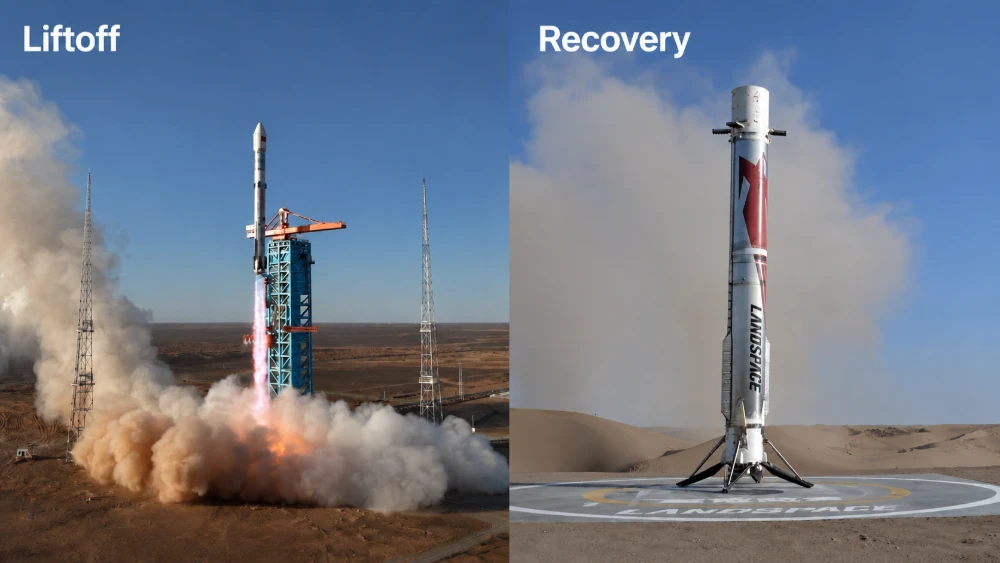
At 7:35 a.m. Beijing Time on August 19, 2026, the Zhuque-3 Y2 launch vehicle, developed by LandSpace Technology Corporation Ltd. serving as the prime contractor, lifted off from the Dongfeng Commercial Space Innovation Pilot Zone. Approximately 137 seconds after liftoff, the first and second stages separated. The second stage continued its flight and successfully placed the Honghu-03 satellite into its designated orbit. Meanwhile, the first stage followed its planned return sequence and made a successful soft landing at the Zhuque-3 landing site in Minqin County, Gansu Province, at around 7:41 a.m.
According to reports published by LandSpace and on the China National Space Administration’s website, the mission marked China’s first successful onshore recovery of an orbital-class launch vehicle first stage and the country’s first successful recovery of a reusable launch vehicle first stage using landing legs. Following the controlled offshore net-capture recovery of the Long March 10B first stage on July 10, this was China’s second successful controlled recovery of an orbital-class launch vehicle first stage.
Following the earlier offshore net-capture recovery, China has now achieved another major breakthrough in reusable launch vehicle technology. According to the China National Space Administration, the next step is to continue advancing the engineering application of reusable launch vehicles and strengthening China’s access to space through greater aggregate launch capacity, potentially lower lifecycle costs, and higher launch frequency.
For the commercial space sector, the significance of the mission extends beyond another successful rocket recovery. More importantly, as reusable launch technology progresses from experimental validation toward engineering application, both the cost and frequency of access to space could change. Those changes may ultimately influence satellite deployment and the commercial space industry as a whole.
Zhuque-3 Completes Onshore Recovery, Marking Another Key Step for China’s Reusable Rockets
From a technological perspective, at least three aspects of the mission deserve attention.
First, the mission validated a recovery architecture distinct from the offshore net-capture approach demonstrated by the Long March 10B. It achieved China’s first onshore recovery of an orbital-class rocket first stage and the country’s first such recovery using landing legs. Unlike the Long March 10B, whose first stage was recovered using an offshore net-capture system, Zhuque-3 validated a vertical powered landing architecture on land.
Second, the mission systematically validated the first stage’s complete return sequence, from stage separation to touchdown. After separation, the first stage completed a series of critical maneuvers, including high-altitude reorientation, a reentry burn for powered deceleration, aerodynamic glide control, a landing burn, and landing-leg deployment and cushioning. The mission therefore validated more than the final touchdown maneuver: it demonstrated the complete process of returning a rocket stage from high-speed flight to land.
Third, the technical architecture was further refined using data and engineering experience gathered during the Y1 mission. The development team optimized several critical elements of reusable flight, including reducing the number of engines used for the landing burn, upgrading the onboard autonomous flight-safety system and adding predicted-impact-point safety functionality, and improving thermal and structural protection for the complex aerodynamic and heating environment encountered during reentry. These changes were intended to simplify the landing propulsion architecture while strengthening autonomous safety control and adaptability to demanding return environments.

Publicly released configuration of the Zhuque-3 reusable launch vehicle. Specifications may vary by design iteration and mission configuration. Source: LandSpace.
At the same time, Y2 was not simply a recovery test. The second stage successfully placed Honghu-03 into its designated orbit, combining reusable-technology validation with an operational satellite launch on the same flight. This brought the recovery milestone into more direct contact with real-world launch requirements.
From Falcon 9 to Long March 10B and Zhuque-3: Multiple Paths to Reusability
Reusable rockets are not a new concept. SpaceX’s Falcon 9 has demonstrated that vertical powered recovery using landing legs can evolve into a mature model supporting repeated reuse and high-frequency launches. Blue Origin has also landed an orbital-class booster through its New Glenn program.
Based on publicly documented orbital missions, LandSpace appears to be the third commercial launch company—after SpaceX and Blue Origin—to place a payload into orbit and achieve a controlled powered landing of an orbital-class first-stage booster. This comparison excludes suborbital vehicles, parachute-assisted splashdowns, and non-powered capture systems.
SpaceX has flown some inpidual Falcon 9 first-stage boosters more than 20 times and has established a recovery system that uses both offshore drone ships and onshore landing zones.
China has also explored a recovery architecture different from that used by Falcon 9. On July 10, the first stage of the Long March 10B completed a controlled recovery using an offshore net-capture system—the world’s first capture of a launch vehicle first stage by a net system on an offshore platform.
The successful onshore recovery of the orbital-class Zhuque-3 Y2 first stage means that China has now completed key demonstrations of two different reusable-rocket recovery architectures: offshore net capture and onshore landing-leg recovery.

Zhuque-3 Y2 completed an onshore vertical landing using landing legs, while Long March 10B was recovered by a net-capture system on an offshore platform.Source: LandSpace and Xinhua.
Onshore and offshore recovery are not simply competing options with an obvious winner. They correspond to different mission profiles and engineering requirements. Compared with a recovery system that depends on an offshore platform, an onshore landing can eliminate some marine operations and offer operational advantages under suitable launch-site and mission conditions.
An offshore recovery point, meanwhile, can be positioned downrange along the rocket’s flight path. For some missions, this can reduce the propellant required for the first stage to return toward the launch site, although it also introduces additional requirements involving offshore platforms, transportation, and weather support.
For commercial spaceflight, the most important question is not which recovery method is inherently superior, but which can ultimately deliver highly reliable recovery, rapid turnaround, and consistent reuse.
From this perspective, the broader significance of Zhuque-3’s success is that China’s commercial space sector is building its own body of reusable-launch expertise and beginning to explore multiple solutions suited to different payload capacities and mission requirements.
From Recovery to Reuse: The Next Step Is Proving the Economics of Reflight
The mission also began combining first-stage recovery validation with an operational orbital launch. While recovering its first stage, Zhuque-3 Y2 successfully placed Honghu-03 into its designated orbit. LandSpace stated that the mission had laid the groundwork for inspecting and maintaining the recovered stage, conducting reuse flights, and pursuing commercial applications.
For a reusable rocket, successful recovery is only the beginning of the commercial cycle. Reusability becomes genuine commercial launch capacity only when the same first stage can be inspected and maintained under controlled procedures, flown again within an acceptable cost and turnaround period, and eventually reused consistently across multiple missions.
First-Stage Reuse Creates New Opportunities to Reduce Launch Costs
One of the most direct commercial benefits of reusable rockets is their potential to lower the unit cost of access to space.
Engines and vehicle structures account for a substantial share of rocket costs. According to a People’s Daily report citing LandSpace technical personnel, the first-stage structure represents more than 70% of the total cost of the launch vehicle. If the stage can be recovered, refurbished, and reflown at an acceptable cost, some of the hardware cost previously borne by a single mission could be distributed across multiple launches.
LandSpace has also stated that Zhuque-3’s first stage is designed for at least 20 uses, with the goal of significantly reducing the unit price of launch services.
This is why first-stage recovery has long been regarded as a critical part of reusable-rocket commercialization. It does not make propellant suddenly cheaper. Instead, it turns high-value hardware that could previously be used only once into an asset capable of generating transportation value repeatedly.
However, a real cost advantage will not materialize immediately after a single successful recovery. The final economics will depend on the number of reuse cycles, maintenance costs, turnaround time, recovery reliability, and reflight efficiency. From an industry perspective, however, Zhuque-3 Y2 has provided an important technical foundation for moving this operating model forward.
If reusable technology ultimately develops into reliable reflight capability, the transportation cost borne by satellite missions could decline accordingly. Ultimately, that cost change depends on whether a rocket can evolve from a disposable transportation system into a commercial launch asset capable of repeated use.
Recovery itself also carries costs. Landing legs, grid fins, and other recovery hardware add structural mass, while propellant must be reserved for the return and landing phases. Post-recovery inspection, maintenance, and transportation also require investment. Whether reuse can genuinely reduce the unit cost of reaching orbit therefore depends not only on the number of recoveries, but also on payload capacity in recovery mode, refurbishment requirements, and the volume of available launch missions.
When the cost of reaching space declines, the effects extend beyond the launch industry itself.
As the “Satellite Delivery Fee” Falls, Commercial Space Enters a Competition of Scale
If one of the central questions for commercial space in recent years has been whether reusable rockets can be successfully recovered, continued technological progress is likely to shift industry attention toward another question:
Once rockets can be reused, how quickly—and at what scale—can satellites be placed into orbit?
This represents a change in the commercial model.
When rockets can provide lower-cost, higher-frequency access to space, a larger supply of launch capacity may ease the payload, scheduling, and unit-cost constraints facing satellite deployment. Launch frequency and unit deployment cost are especially important for low Earth orbit constellations that require large numbers of satellites to operate together.
The China National Space Administration’s commercial space action plan calls for space research and manufacturing to transition toward lower-cost, scaled production. It identifies low-cost, highly reliable, responsive, and reusable commercial launch vehicles as a priority, while also supporting the development of satellite constellations for low Earth orbit communications, navigation augmentation, and high-resolution Earth observation.
LandSpace has likewise connected Zhuque-3’s future capabilities with large-scale constellation deployment, rapid batch launches, and improved launch efficiency.
If reflight reliability, market demand, and launch-support capacity all improve together, the effects could be transmitted along the following chain:
Lower unit cost to orbit → greater launch supply → faster constellation deployment → broader space infrastructure coverage
As this trend progresses, competition in commercial space may shift from “who can demonstrate reusability first” to “who can build and operate space infrastructure more quickly and at greater scale.”
The objective is not simply to maximize satellite numbers. It is a competition over infrastructure scale, coverage, and long-term operating capability. Organizations that can deploy and continuously operate more satellites at lower unit cost and higher launch frequency may be better positioned in the next phase of space infrastructure development.
From a Single Rocket to Industrial Coordination: China’s Commercial Space Sector Is Building the Foundations for Scale
If scale becomes increasingly important to commercial space competition, competitiveness will depend on more than the performance of any single rocket. It will also depend on whether the entire industrial chain can operate efficiently.
This is one of the reasons China’s commercial space sector deserves attention.
The chain extends from liquid oxygen-methane engine development and reusable-rocket design to volume manufacturing, launch, recovery, reuse, and ultimately large-scale satellite deployment. As it grows longer, it also requires increasingly close coordination.
In 2025, LandSpace announced that the 100th engine in its Tianque liquid oxygen-methane engine family had rolled off the production line. The company described the milestone as a transition from inpidual-engine breakthroughs to batch manufacturing and a new stage of scaled application.
The significance of this milestone lies not only in the number itself. It indicates that LandSpace has established a degree of batch-manufacturing capability for liquid oxygen-methane engines, providing one of the necessary foundations for higher-frequency rocket delivery.
This could become an important part of the foundation on which China’s commercial space sector develops greater scale in its next phase.
For commercial space, scale does not mean simply producing more rockets. It means enabling research and development, manufacturing, launch, recovery, reuse, and satellite deployment to operate as a continuous industrial chain.
If reusable technology progresses toward reliable reflight and gradually forms a closed loop with scaled engine and rocket manufacturing, launch-site support, mass satellite production, and constellation deployment, China’s accumulated manufacturing capacity, integrated supply chain, and engineering coordination could be translated into an advantage in building space infrastructure at scale.
The China National Space Administration’s action plan calls for “strengthening launch vehicle and satellite manufacturing and expanding application services.” It also promotes greater integration across industrial and supply chains and prioritizes reusable commercial launch vehicles and satellite constellations for low Earth orbit communications, navigation augmentation, and high-resolution Earth observation.
This means China’s future commercial space competitiveness may come not only from a single technological breakthrough, but also from its ability to turn technology rapidly into production capacity, production capacity into launch capability, and launch capability into large-scale space infrastructure.
Expanding Access to Space Is Creating New Industry Opportunities
As launch capacity expands, the effects will also extend into the satellite industry.
If greater launch availability supports the deployment of Earth observation constellations, more satellites in orbit could provide wider coverage, shorter revisit intervals, and a more continuous supply of data. This could help Earth observation services move toward more frequent, scalable, and operationally consistent delivery.
From this perspective, the significance of Zhuque-3 Y2 extends beyond a single successful recovery. As reusable launch capability advances toward engineering maturity and scaled operation, its downstream effects could include greater availability of satellite data and more frequent space-based monitoring. For organizations on Earth, however, that value is realized only when satellite data are matched to specific operational requirements and converted into usable information.
STARPATH GLOBAL provides satellite imagery, multi-source Earth observation data, and customized geospatial solutions. We help customers identify suitable data based on area coverage, spatial resolution, revisit frequency, acquisition timing, and application requirements, and turn those data into information that supports practical decision-making.
For customers with defined satellite development, payload, or launch requirements, STARPATH GLOBAL can also evaluate potential partner and resource-matching opportunities based on the project’s stage and technical needs.
To discuss an Earth observation requirement or a specific space project, please contact STARPATH GLOBAL.