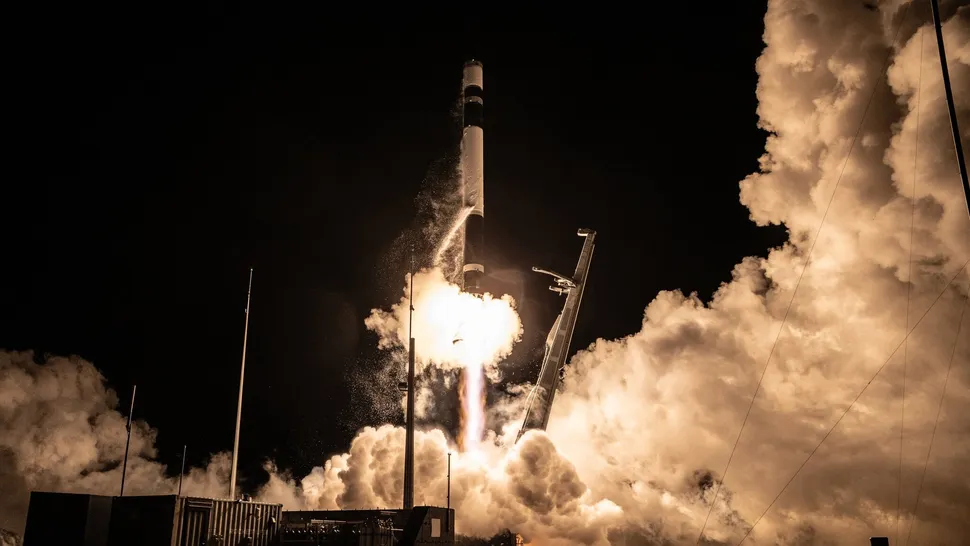
Rocket Lab is preparing to launch another Japanese synthetic aperture radar satellite on Aug. 20, adding a new spacecraft to one of the fastest-growing commercial Earth-observation constellations in Asia. The mission, named “The Lightning God Defends,” is scheduled to lift off aboard a Rocket Lab Electron from Launch Complex 1 on New Zealand’s Māhia Peninsula, carrying iQPS’ latest radar-imaging satellite, QPS-SAR-18, nicknamed SUSANOO-II after the Japanese god associated with lightning.
The launch window is scheduled to open at 9 a.m. EDT (1300 GMT) on Aug. 20, corresponding to 1 a.m. on Aug. 21 local time in New Zealand and 10 p.m. Aug. 20 in Japan. Rocket Lab plans to begin its livestream approximately 30 minutes before liftoff.
If the mission proceeds as planned, Electron’s upper-stage kick stage will deploy SUSANOO-II approximately 50 minutes after liftoff into a 575-kilometer circular low Earth orbit. The mission is Rocket Lab’s 14th launch of 2026 and 93rd Electron mission overall, while marking the company’s ninth launch for iQPS.
The flight comes only two weeks after Rocket Lab launched another iQPS spacecraft. On Aug. 6, Electron successfully deployed QPS-SAR-13, nicknamed MIKURA-I, on the “The Grain Goddess Provides” mission. The unusually rapid succession illustrates how the relationship between Rocket Lab and iQPS has evolved from individual launch transactions into an important part of the Japanese company’s constellation deployment strategy.
SUSANOO-II Is Another Step Toward a 36-Satellite Radar Network
iQPS, formally the Institute for Q-shu Pioneers of Space, is building a commercial constellation of small SAR satellites designed to provide high-resolution Earth imagery with much shorter revisit times than a conventional single-satellite system.
The company’s broader plan calls for a 36-satellite constellation. Earlier development targets envisioned reaching 24 satellites by May 2028 before expanding further, with the ultimate objective of delivering near-real-time observation services. iQPS says a fully deployed constellation could enable observations of specific regions at an average interval of roughly 10 minutes.
That objective changes the commercial value proposition of the satellites.
A single high-resolution Earth-observation satellite can produce valuable imagery, but its ability to revisit a particular location is constrained by orbital mechanics. A constellation distributes spacecraft around Earth, increasing the number of opportunities to observe a target. For customers monitoring ports, infrastructure, disaster zones, construction projects, agricultural areas or maritime traffic, the frequency of observation can be nearly as important as the resolution of an individual image.
SUSANOO-II therefore matters not simply as another satellite in orbit, but as another node in a network whose usefulness should increase as more spacecraft are deployed.
The satellite is also part of iQPS’ strategy of using relatively small spacecraft to reduce the cost and time required to build a large radar constellation.
Why SAR Gives iQPS an Advantage Over Optical Imaging
Synthetic aperture radar works differently from conventional optical Earth observation.
Optical satellites depend on reflected sunlight or other visible and infrared wavelengths. They can produce highly detailed and visually intuitive images, but clouds, darkness and smoke can interfere with observations.
SAR satellites actively transmit microwave energy toward Earth and measure the reflected signals. Because the radar supplies its own illumination, it can operate day or night and can collect useful imagery through cloud cover and adverse weather conditions that can obstruct optical sensors.
For iQPS, this is particularly important for the goal of frequent monitoring.
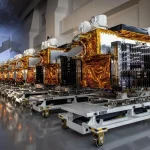
The QPS-SAR system uses an X-band radar operating at about 9.38 GHz, with an antenna approximately 3.6 meters across. The system has a bandwidth of roughly 600 MHz and peak radiating power of about 2 kilowatts.
Its published performance includes a spotlight-mode resolution of about 0.47 meter and a strip-map mode capable of approximately 1.8-meter resolution, with the latter sacrificing some spatial detail in exchange for a wider observation area.
The spacecraft are designed around a lightweight, deployable radar antenna. iQPS says its architecture makes the satellite roughly one-twentieth the weight and one-hundredth the cost of traditional SAR satellites, a comparison intended to demonstrate why a constellation of many smaller spacecraft can be economically attractive.
The tradeoff is important. A large government SAR satellite can carry a much more powerful and sophisticated sensor, but it is expensive and takes years to develop. A smaller commercial satellite can be manufactured and launched more rapidly, allowing an operator to replace individual spacecraft and continuously expand the network.
That model is increasingly becoming the norm in commercial remote sensing.
Rocket Lab and iQPS Are Building a Repeating Launch Pipeline
“The Lightning God Defends” is not the first time Rocket Lab has launched a satellite named after a Japanese deity.
On March 15, 2025, Electron launched QPS-SAR-9, known as SUSANOO-I, on the “The Lightning God Reigns” mission. That spacecraft also entered a 575-kilometer circular orbit.
The naming connection reflects the continuity between the missions, but the operational significance is more substantial: Rocket Lab has become iQPS’ primary launch provider as the Japanese company works through a large constellation deployment campaign.
The relationship predates the 2025 missions. Rocket Lab launched QPS-SAR-5 in December 2023, and in 2024 the companies signed a multi-launch arrangement covering dedicated Electron flights for iQPS.
Rocket Lab’s advantage for this type of customer is not simply the Electron’s payload capacity. iQPS needs a predictable sequence of launches rather than a single large deployment. Electron’s ability to conduct dedicated small-satellite missions allows the customer to put one spacecraft into its intended orbit without waiting for a rideshare mission whose trajectory and schedule are determined primarily by another customer’s requirements.
That flexibility becomes more valuable as a constellation approaches operational scale.
The Aug. 6 launch of MIKURA-I and the planned Aug. 20 launch of SUSANOO-II illustrate the cadence. Two dedicated iQPS missions are being attempted within roughly two weeks, demonstrating how launch frequency can become part of the constellation’s architecture.
Rocket Lab is also expanding beyond being merely a launch company. Its broader space-systems business, spacecraft components and satellite technologies give it additional exposure to the same commercial space infrastructure market that is driving demand for Earth-observation constellations.
The Commercial SAR Race Is Getting More Crowded
iQPS is entering a market that has become increasingly competitive.
ICEYE has emerged as one of the largest commercial SAR operators, with a rapidly expanding constellation and a strong focus on government and defense customers. Its fourth-generation satellites have pushed commercial SAR resolution to the centimeter-scale regime, with the company reporting capabilities as fine as 16 centimeters for its newest systems.
Capella Space is another major commercial SAR provider, emphasizing high-resolution imagery and flexible tasking. Umbra has similarly pursued very high-resolution X-band radar imaging, while Japan’s Synspective is building its own SAR constellation for commercial and infrastructure-monitoring applications.
This competition means iQPS cannot rely on resolution alone.
Its more distinctive proposition is the combination of small spacecraft, dedicated launch access, high-resolution SAR and a planned large constellation. If iQPS can execute its deployment schedule, the company could compete on observation frequency while keeping individual spacecraft relatively inexpensive.
The strategic question is therefore shifting from “How sharp is the image?” to “How quickly can a customer obtain the next useful image?”
For disaster response, maritime monitoring and infrastructure intelligence, that distinction can be decisive.
A 25-centimeter image that arrives hours later may be less valuable than a somewhat lower-resolution image delivered quickly enough to influence a decision.
Japan Is Developing a Commercial Earth-Observation Ecosystem
The iQPS program also illustrates a broader trend in Japan’s space sector.
Japan has historically possessed sophisticated government-backed Earth-observation and scientific spacecraft, but private companies are increasingly developing commercial systems that can serve both civilian and security-related markets.
iQPS is one part of this ecosystem. Synspective is pursuing SAR-based monitoring, while other Japanese companies are developing optical imaging, satellite components, ground infrastructure and data services.
The result is a shift from individual Japanese satellites toward commercially operated constellations.
The country is also strengthening space cooperation with the United States. On Aug. 10, 2026, Japan launched the QZS-7 navigation satellite on an H3 rocket carrying a U.S. Space Force space-domain-awareness payload, highlighting the growing security dimension of Japanese space infrastructure.
Commercial SAR constellations can contribute to this broader environment even when their primary business is civilian. Persistent radar imagery has applications in maritime awareness, infrastructure monitoring, disaster response and change detection—all capabilities that can also have national-security relevance.
That dual-use character is one reason SAR has become such a strategically important segment of the commercial space market.
The Real Test Comes After Launch
The most important milestone for SUSANOO-II will not necessarily be liftoff.
After deployment, the spacecraft must establish communications, complete commissioning, deploy and operate its radar system, and begin producing usable imagery. The satellite must then be integrated into iQPS’ growing constellation and ground-data infrastructure.
That process determines whether another spacecraft actually translates into improved customer service.
The larger strategic objective is clear: build enough satellites to make frequent observation commercially practical.
iQPS has been working with ground-segment providers to support constellation expansion, including plans for automated satellite operations and data handling. As the number of spacecraft rises, automation becomes essential because manually managing dozens of individual satellites would impose operational costs that could undermine the economics of a small-satellite business.
The same principle applies to data.
A large SAR constellation can produce enormous quantities of imagery. The commercial value therefore depends not only on collecting images but also on quickly processing them, identifying changes and delivering actionable information to customers.
This is where Earth-observation companies increasingly resemble data companies rather than traditional satellite operators.
Electron’s Role Is Becoming Part of the Constellation Strategy
Rocket Lab’s role in the iQPS program is consequently more strategic than simply providing transportation to orbit.
For a constellation operator, launch reliability and cadence directly affect the rate at which new satellites can enter service. A launch provider capable of supplying repeated dedicated missions can become part of the customer’s deployment architecture.
Electron is particularly suited to that role because iQPS satellites are relatively small and the missions require insertion into specific low Earth orbits.
The approach contrasts with the rideshare model popularized by SpaceX’s Transporter missions. Rideshare dramatically lowers launch costs per kilogram, but customers share a mission and may have less control over deployment timing and orbital parameters.
Dedicated small-launch missions cost more per kilogram, but they can offer schedule and orbital flexibility.
For a constellation racing toward operational density, that flexibility can be worth paying for.
Rocket Lab’s challenge is maintaining this advantage as competitors develop their own small-launch and medium-lift systems. The commercial launch market is becoming increasingly crowded, while large reusable rockets continue to push down the marginal cost of putting payloads into orbit.
Electron’s long-term value therefore depends less on competing with the largest rockets on raw price and more on offering reliable, responsive and specialized launch services.
A Successful Launch Would Keep the iQPS Deployment Tempo Moving
If “The Lightning God Defends” launches successfully, SUSANOO-II will become another operational building block in iQPS’ effort to create a dense commercial SAR network.
The timing is significant. Rocket Lab’s previous iQPS launch occurred on Aug. 6, and the new mission is scheduled only two weeks later. Rocket Lab is already preparing additional missions for other Earth-observation customers, including Synspective, while iQPS continues working toward a much larger constellation.
The immediate objective is straightforward: put another radar satellite into a 575-kilometer orbit.
The longer-term objective is much more ambitious.
iQPS is attempting to turn a fleet of small radar satellites into a near-real-time global Earth-observation service. If the company can approach its planned constellation scale, the network could provide a substantially different kind of commercial satellite intelligence—one based not only on high resolution, but on persistent access and rapid revisit.
That is the broader significance of SUSANOO-II. It is one satellite, but its value lies in the network it joins.
For Rocket Lab, the mission demonstrates the growing importance of repeat commercial constellation launches. For Japan, it represents the expansion of a private Earth-observation industry with potential civilian and security applications. And for the global SAR market, it adds another competitor to a rapidly developing field in which the ability to observe the planet frequently, regardless of weather or darkness, is becoming a central measure of commercial value.
The next milestone is therefore not simply whether Electron reaches orbit. It is whether iQPS can continue converting a sequence of successful launches into the dense, responsive radar constellation needed to make its near-real-time Earth-observation vision a practical commercial service.