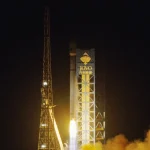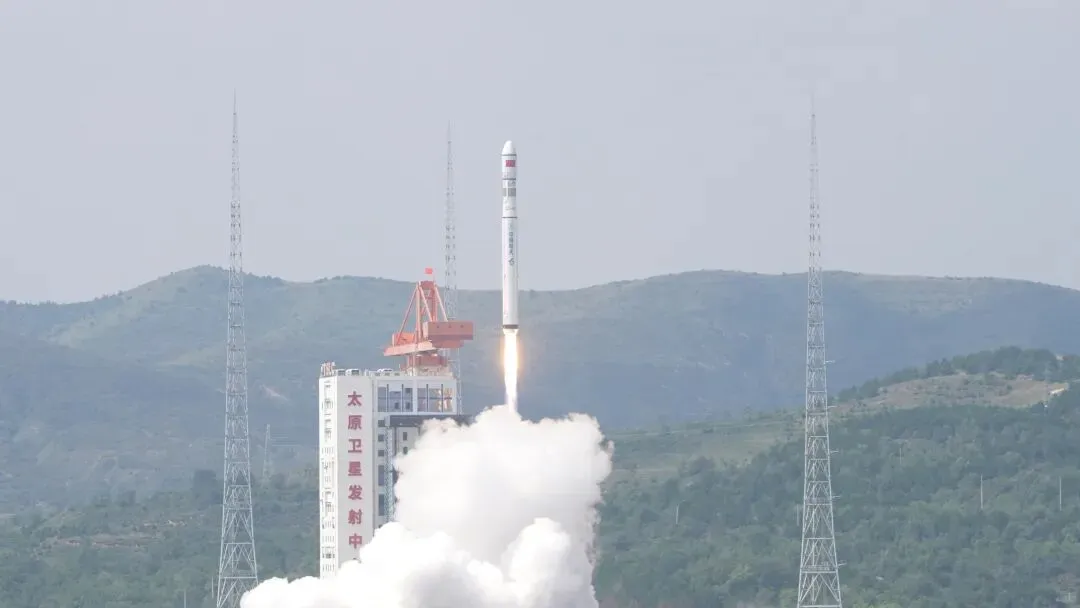
At 11:21 a.m. Beijing Time on August 25, a Long March 6C carrier rocket lifted off from the Taiyuan Satellite Launch Center, successfully placing seven satellites into their designated orbits.
The payloads included AIRSAT-14, AIRSAT-15, GISTDA CubeSat 1, Muduo-1A, Muduo-1B, Jing’an Dream Satellite and Bayi-04. The launch marked the 665th flight of China’s Long March rocket family.
Developed by the Shanghai Academy of Spaceflight Technology under China Aerospace Science and Technology Corporation, the Long March 6C is a new-generation, two-stage liquid-propellant launch vehicle capable of carrying different types of satellites into a variety of orbits. It can deliver 2.4 metric tons to a 500-kilometer sun-synchronous orbit.
Three of the satellites—AIRSAT-14, AIRSAT-15 and GISTDA CubeSat 1—were developed by Chinese commercial satellite manufacturer GalaxySpace. With their successful deployment, GalaxySpace has now launched 49 satellites of its own design.

Artist’s rendering of the Lingzhi-09 Thai CubeSat in orbit.
First Complete Satellite Delivery by a Chinese Commercial Space Company to Southeast Asia
GISTDA CubeSat 1, also known as Lingzhi-09, was developed for Thailand’s Geo-Informatics and Space Technology Development Agency, or GISTDA.
The satellite will collect Earth observation data covering land resources, agriculture and ecosystems in Thailand. It will also support hands-on teaching at Thai universities in areas including satellite design and development, spacecraft tracking and control, and remote-sensing applications.

The Lingzhi-09 Thai CubeSat developed by GalaxySpace.
GalaxySpace supplied GISTDA with an integrated package covering the satellite, ground systems and capability building. Through the project, the company delivered technology and expertise across the entire chain—from spacecraft and ground infrastructure to personnel training.
The mission represents the first time a Chinese commercial space company has completed the development, launch and in-orbit delivery of an entire satellite for a Southeast Asian country. It is also GalaxySpace’s first export of a complete satellite and ground system for deployment in a Belt and Road partner country.
The project demonstrates that Chinese commercial satellite companies are developing the ability to provide overseas customers with integrated solutions spanning delivery, operations and training.
Kong Dejian, an associate professor at the School of International Law at China University of Political Science and Law and deputy dean of the School of Law at Xinjiang University of Political Science and Law, said the global commercial space industry is undergoing rapid restructuring. Competition is expanding beyond individual technologies to encompass industrial systems and international service capabilities.
He said GalaxySpace’s delivery to Thailand shows that Chinese commercial satellite companies now possess end-to-end capabilities for overseas satellite projects. As global demand for space technology services continues to grow, China’s commercial space industry could find substantial opportunities in Southeast Asia and other international markets.

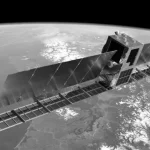
AIRSAT-14 and AIRSAT-15, the two SAR satellites developed by GalaxySpace for this mission.
SAR Satellites Combine Remote Sensing With In-Orbit Computing
AIRSAT-14 and AIRSAT-15, also developed by GalaxySpace, are synthetic aperture radar satellites delivered to AIRSAT. Each satellite weighs 360 kilograms and features a box-shaped configuration.
The two spacecraft carry high-resolution SAR payloads and specialized space-based cloud-computing payloads. After entering orbit, they will connect with other satellites in the same series to form an integrated network and conduct demonstrations of new technical architectures and applications.
The satellites are designed to support a transition from standalone functional spacecraft to an intelligent satellite cloud, creating an integrated space-based information platform that combines remote-sensing payloads with cloud processing.
Both satellites can receive, process and analyze data in orbit, establishing a complete chain from space-based sensing to intelligent information output. Their onboard computing capacity will provide stable, continuous support for a range of applications while reducing dependence on ground-based processing.

A GalaxySpace-developed SAR satellite with its single-sided solar array deployed.
During natural disasters such as floods and earthquakes, where rapid response is critical, the satellites will be able to process and interpret images within minutes. This could provide timely information for situation assessment and emergency decision-making while substantially reducing data-transmission bandwidth requirements compared with conventional operating models.
GalaxySpace said it has developed and successfully launched more than 10 SAR satellites, giving it mature capabilities across the commercial SAR satellite value chain.